Author name: vigyanlime@gmail.com

Calcium Hydroxide (Food Grade) – Uses, Benefits, Specifications & Applications
hydrated-lime

Calcium Hydroxide (Food Grade) – Uses, Benefits, Specifications & Applications

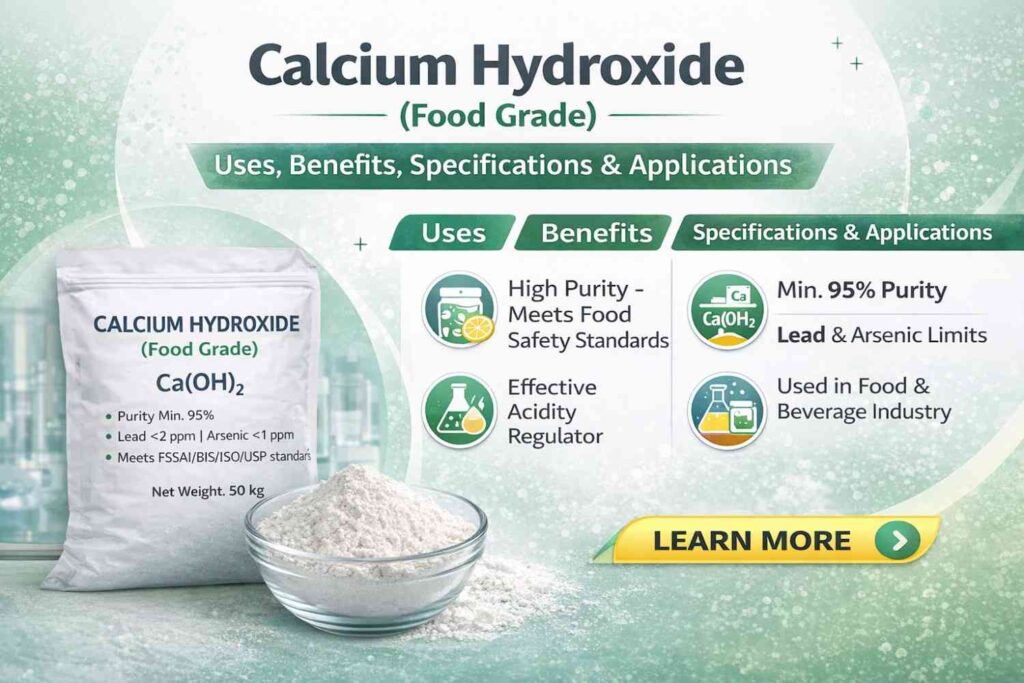
Calcium Hydroxide (Food Grade) Calcium Hydroxide (Food Grade), also known as Slaked Lime or Hydrated Lime, is an inorganic compound with the chemical formula Ca(OH)₂. It is produced by adding water to calcium oxide (quicklime) in a controlled process called slaking. This compound appears as a fine white, odorless powder and is widely used in the food processing industry as an acidity regulator, pickling agent, and calcium fortifier. Food grade calcium hydroxide is manufactured under strict standards such as FSSAI, BIS, ISO, and USP, ensuring it is safe for human consumption. Due to its high purity, controlled heavy metal content, and stable chemical properties, it plays an important role in several traditional and modern food applications. Hydrated Lime for Construction Industry Chemical Information Property Details Chemical Name Calcium Hydroxide Molecular Formula Ca(OH)₂ Molecular Weight 74.09 g/mol CAS Number 1305-62-0 Appearance White, fine powder Taste Alkaline Density 2.24 g/cm³ Melting Point 580°C (decomposes) Solubility Slightly soluble in water pH (1% solution) ~12.4 Product Specifications Food grade calcium hydroxide manufactured by Vigyan Lime follows strict quality parameters to ensure purity and safety. Parameter Specification Purity Minimum 95% Particle Size Passes 200 mesh Moisture Max 1% Arsenic Max 1 ppm Lead Max 2 ppm Appearance White odorless powder Shelf Life Up to 24 months Why Food Grade Calcium Hydroxide is Important in the Food Industry Food manufacturers use calcium hydroxide because of its ability to control acidity, improve texture, and increase calcium content. Key Benefits ✔ Improves food texture and firmness✔ Helps regulate pH levels in foods✔ Used as a natural calcium fortifier✔ Supports food preservation and stability✔ Safe for consumption when produced under food grade standards Because of these properties, calcium hydroxide has become an essential ingredient in many food manufacturing processes worldwide. Major Food Industry Applications 1. Pickling Agent Calcium hydroxide is commonly used in pickling vegetables such as cucumbers and peppers. It helps maintain the crisp texture of pickled foods. 2. Acidity Regulator It is used to control the pH level in processed foods, helping maintain flavor and stability. 3. Calcium Fortification Food manufacturers add calcium hydroxide to increase calcium content in products, improving nutritional value. 4. Traditional Food Processing In many cultures, calcium hydroxide is used in traditional food preparation methods to enhance taste, texture, and digestibility. 5. Food Additive It acts as a processing aid and stabilizer in several food products. Other Industrial Uses of Calcium Hydroxide Although this grade is suitable for food applications, calcium hydroxide is also widely used in other industries. Environmental Uses Water treatment Wastewater treatment Effluent treatment Flue gas treatment Chemical Industry Manufacturing citrates and nitrates Plastic stabilizers Paints and coatings Agriculture Soil pH adjustment Crop protection applications Packaging & Storage Our Food Grade Calcium Hydroxide is available in secure packaging to maintain product quality. Packaging Options 25 kg HDPE bags with inner liner 50 kg HDPE bags Custom packaging available Storage Guidelines Store in a cool and dry place Keep away from direct sunlight Ensure packaging remains tightly sealed Under proper storage conditions, the product has a shelf life of up to 24 months. Key Features of Food Grade Calcium Hydroxide High purity (minimum 95%) Free-flowing fine powder Long shelf life Odorless and stable Low heavy metal content Compliant with food safety standards Slaked Lime in Water Treatment Frequently Asked Questions (FAQs) What is food grade calcium hydroxide used for? It is mainly used as an acidity regulator, pickling agent, and calcium fortifier in food processing. Is calcium hydroxide safe for human consumption? Yes, when produced according to FSSAI, BIS, ISO, and USP food grade standards, it is safe for food applications. What does calcium hydroxide look like? It appears as a white, fine, odorless powder that is slightly soluble in water. How should calcium hydroxide be stored? It should be stored in sealed packaging in a cool, dry environment away from moisture and sunlight. What is the shelf life of food grade calcium hydroxide? Typically 24 months when stored properly. Food Grade Calcium Hydroxide Manufacturer in India Vigyan Lime is a trusted manufacturer and supplier of high purity food grade calcium hydroxide for food processing, pharmaceuticals, and industrial applications. Manufacturing Units Jodhpur & Nagaur (Rajasthan)Udaipur (Rajasthan)Haldwani (Uttarakhand)Sataun (Himachal Pradesh) Contact Vigyan LimeG-37, Race CourseDehradun, Uttarakhand 248001 info@vigyanlime.com +91-95685-01110, +91-95688-01110, +91-98370-55678
hydrated-lime

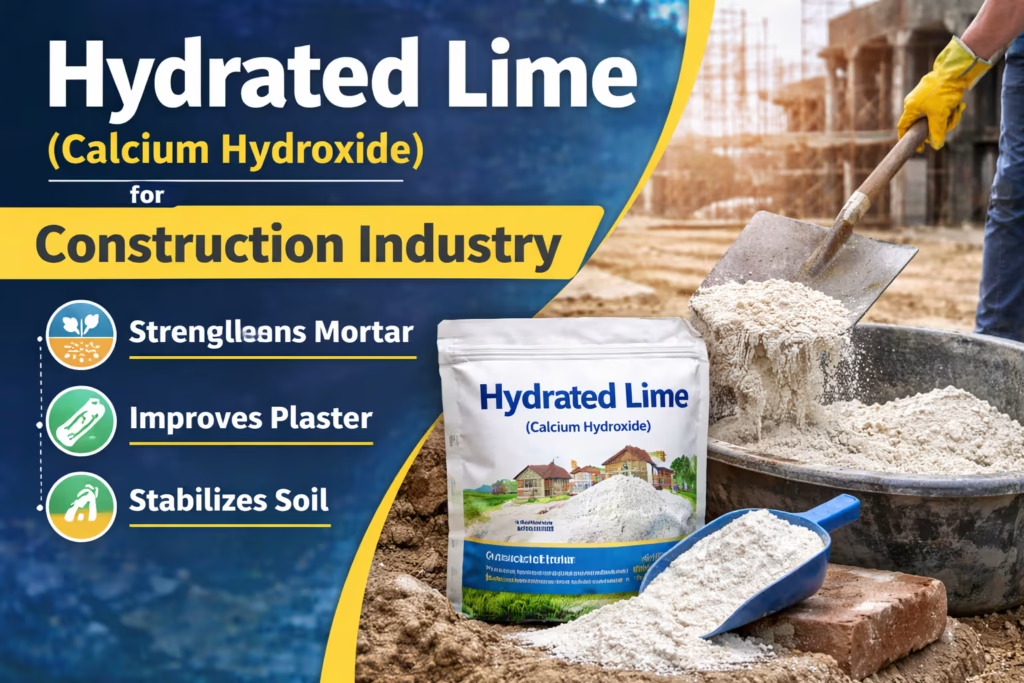
Hydrated Lime for Construction Industry: Uses, Benefits and Applications

The construction industry relies on many materials to create durable and long-lasting structures. One of the traditional and highly effective building materials is Hydrated Lime, also known as Slaked Lime or Calcium Hydroxide (Ca(OH)₂). Hydrated lime has been used in construction for centuries due to its excellent binding properties, durability, and workability. Even today, it remains an important material in modern construction projects including masonry, plastering, soil stabilization, and road construction. Because of its natural properties and environmental benefits, hydrated lime continues to be widely used in both residential and commercial construction projects. What is Hydrated Lime? Hydrated lime is a fine white powder produced by adding water to quicklime (calcium oxide). Chemical Reaction CaO + H₂O → Ca(OH)₂ This process is known as slaking, and the resulting compound is called hydrated lime or slaked lime. The material has strong alkaline properties and works effectively as a binding and stabilizing agent in construction materials. Importance of Hydrated Lime in Construction Hydrated lime improves the quality and performance of construction materials. When added to mortar or plaster, it enhances flexibility, strength, and durability. Builders and engineers use hydrated lime because it: Improves workability of mortar Increases bonding strength Reduces cracking in walls Enhances durability of structures These advantages make lime an essential component in many building applications. Major Uses of Hydrated Lime in Construction 1. Lime Mortar Hydrated lime is widely used in lime mortar, which is a mixture of lime, sand, and water. Benefits of lime mortar: Strong bonding between bricks and stones Better flexibility compared to cement mortar Reduced cracking in walls Improved durability Lime mortar is especially useful in heritage buildings and traditional construction. 2. Plastering and Wall Finishing Hydrated lime is used in plaster and wall finishing materials. Advantages: Smooth wall surface Better breathability of walls Improved moisture resistance Attractive white finish It also helps walls remain cooler and more resistant to weather damage. 3. Soil Stabilization In road construction and building foundations, hydrated lime is used to stabilize soil. Benefits include: Increased soil strength Reduced soil swelling and shrinkage Improved load-bearing capacity This makes soil more suitable for construction and infrastructure projects. 4. Whitewashing Hydrated lime is commonly used for whitewashing walls and buildings. Advantages: Natural disinfectant properties Bright white finish Protection against bacteria and fungi Whitewashing is still widely used in rural and traditional construction. 5. Road Construction Hydrated lime helps improve soil quality in highway and road construction. Benefits: Stronger road base Reduced moisture damage Longer road life It is frequently used in infrastructure development projects. Benefits of Hydrated Lime in Construction ✔ Improves mortar workability✔ Reduces cracks in buildings✔ Enhances durability of structures✔ Improves moisture resistance✔ Environmentally friendly building material Because of these advantages, hydrated lime is considered a sustainable construction material. Hydrated Lime vs Cement in Construction Feature Hydrated Lime Cement Flexibility High Low Breathability Excellent Limited Crack Resistance Better Moderate Sustainability Eco-friendly Higher carbon footprint Many builders combine lime and cement to create stronger and more flexible mortar. Frequently Asked Questions (FAQs) 1. What is hydrated lime used for in construction? Hydrated lime is used in mortar, plaster, whitewashing, soil stabilization, and road construction. 2. Is hydrated lime better than cement? Hydrated lime provides better flexibility and crack resistance, but cement offers higher compressive strength. Both are often used together. 3. What is the chemical formula of hydrated lime? The chemical formula is Ca(OH)₂ (Calcium Hydroxide). 4. Why is lime mortar used in construction? Lime mortar provides better workability, flexibility, and durability, especially for brick and stone structures. 5. Is hydrated lime environmentally friendly? Yes. Hydrated lime is considered a sustainable building material and is widely used in eco-friendly construction. Hydrated lime plays an important role in the construction industry due to its strength, flexibility, and environmental benefits. From lime mortar and plastering to soil stabilization and road construction, this versatile material continues to support modern infrastructure and traditional building techniques. With increasing interest in sustainable construction materials, the demand for high-quality hydrated lime is expected to grow in the coming years.

hydrated-lime

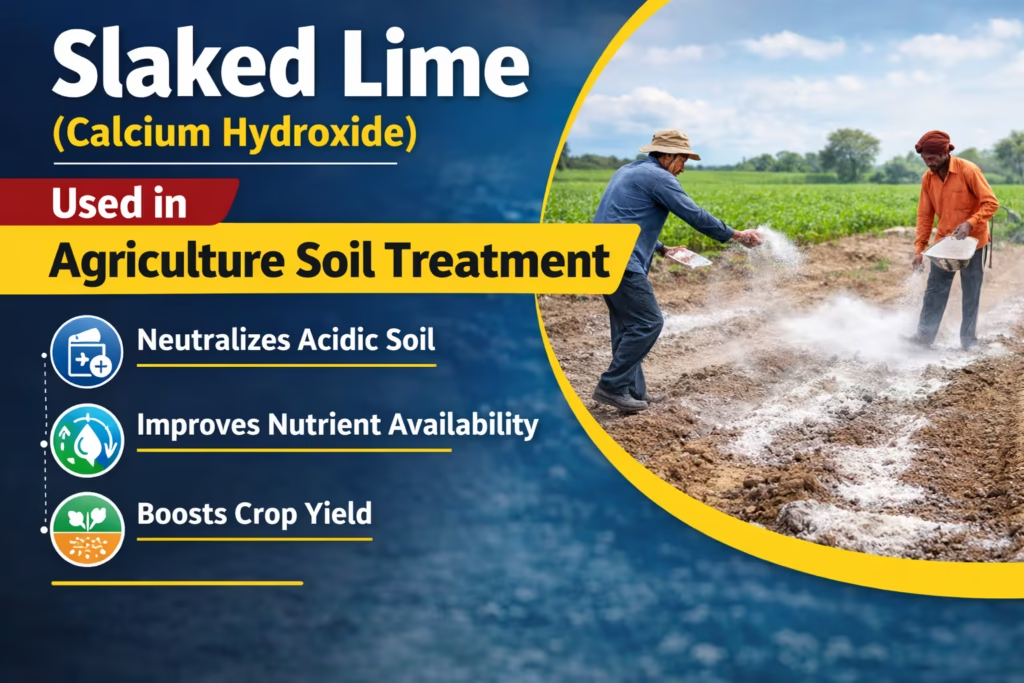
Slaked Lime in Agriculture Soil Treatment: Benefits, Uses and Application

Healthy soil is the foundation of productive agriculture. In many regions, soil becomes too acidic, which affects crop growth and reduces nutrient availability. To solve this problem, farmers often use Slaked Lime, also known as Calcium Hydroxide (Ca(OH)₂) or Hydrated Lime. Slaked lime is widely used in agriculture for soil treatment and pH correction. It helps neutralize acidic soil, improve soil structure, and increase the availability of essential nutrients for crops. Because of these benefits, lime treatment has become an important agricultural practice around the world. What is Slaked Lime in Agriculture? Slaked lime is a white alkaline powder produced by adding water to quicklime. In agriculture, it is mainly used as a soil conditioner to balance soil acidity. When applied to acidic soil, slaked lime reacts with acids in the soil and helps bring the pH level closer to neutral, which is ideal for most crops. Why Soil Treatment is Important Soil pH plays a major role in crop productivity. When soil becomes too acidic: Nutrients become unavailable to plants Crop growth slows down Soil microorganisms become less active Fertilizer efficiency decreases Applying lime helps restore the natural balance of soil chemistry. Benefits of Slaked Lime for Soil Treatment 1. Neutralizes Acidic Soil Slaked lime raises the soil pH and neutralizes acidity, creating a healthier environment for crops. 2. Improves Nutrient Availability Balanced soil pH allows plants to absorb nutrients like: Nitrogen Phosphorus Potassium more effectively. 3. Enhances Soil Structure Lime improves soil texture and increases aeration, which helps roots grow better. 4. Supports Soil Microorganisms Beneficial microorganisms thrive in balanced soil conditions, improving organic matter decomposition. 5. Increases Crop Yield By improving soil quality, slaked lime helps farmers achieve better crop productivity and healthier plants. Crops That Benefit from Lime Treatment Many crops grow better in soils treated with lime. Examples include: Wheat Corn Rice Sugarcane Vegetables Pulses These crops require balanced soil pH for optimal growth. How Slaked Lime is Applied to Soil Farmers apply slaked lime to soil using different methods depending on the crop and soil condition. Common Methods Broadcasting lime powder over the field Mixing lime with soil during ploughing Applying lime before planting crops The correct amount depends on soil acidity and crop requirements. Advantages of Using Slaked Lime in Agriculture ✔ Improves soil fertility✔ Neutralizes soil acidity✔ Enhances crop growth✔ Increases fertilizer efficiency✔ Improves soil microbial activity Because of these benefits, slaked lime is widely used as a soil amendment in modern agriculture. Frequently Asked Questions (FAQs) 1. Why is slaked lime used in agriculture? Slaked lime is used to neutralize acidic soil and improve nutrient availability for crops. 2. What is the chemical formula of slaked lime? The chemical formula is Ca(OH)₂ (Calcium Hydroxide). 3. Does lime increase crop yield? Yes. By improving soil pH and nutrient availability, lime can increase crop productivity. 4. How often should lime be applied to soil? Lime is typically applied every 2–3 years, depending on soil acidity and crop type. 5. Is slaked lime safe for agriculture? Yes, when used in proper amounts, slaked lime is safe and beneficial for soil treatment. Slaked lime plays a crucial role in agriculture soil treatment by neutralizing acidity, improving soil structure, and enhancing nutrient availability. These benefits help farmers maintain healthy soil and achieve higher crop yields. With increasing demand for sustainable farming practices, the use of hydrated lime in agriculture continues to grow worldwide.

hydrated-lime

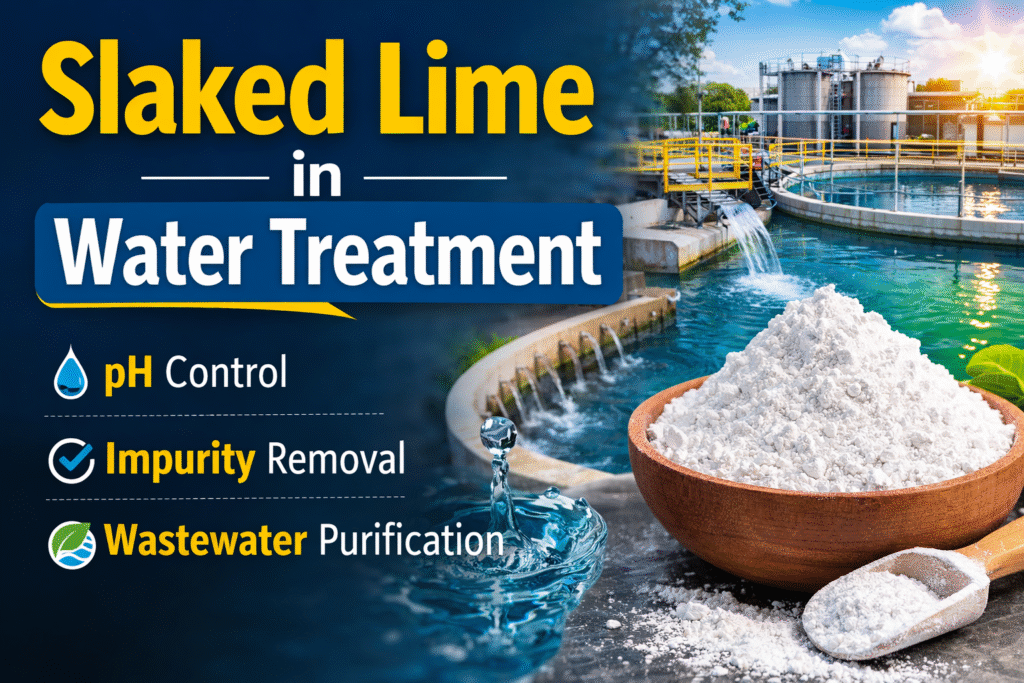
Slaked Lime in Water Treatment: Uses, Benefits and Process

Clean and safe water is essential for both industries and daily life. One of the most effective chemicals used in water treatment plants is Slaked Lime, also known as Calcium Hydroxide (Ca(OH)₂) or Hydrated Lime. Slaked lime is widely used in municipal water treatment plants, wastewater treatment systems, and industrial effluent treatment facilities. Its strong alkaline nature helps in neutralizing acidity, removing impurities, and controlling pH levels in water. Because of these properties, slaked lime plays a crucial role in purifying drinking water and treating industrial wastewater. What is Slaked Lime in Water Treatment? Slaked lime is a white alkaline powder produced by adding water to quicklime (calcium oxide). Chemical Reaction CaO + H₂O → Ca(OH)₂ This compound is highly effective in water purification processes because it can neutralize acids and help remove contaminants from water. Why Slaked Lime is Used in Water Treatment Slaked lime is commonly used in water treatment plants because it provides several important benefits. 1. pH Adjustment Many water sources become acidic due to industrial waste or natural processes. Slaked lime helps to increase the pH level of water, making it safe for treatment and distribution. 2. Water Softening Slaked lime is used in the lime softening process to remove hardness from water by eliminating excess calcium and magnesium ions. 3. Removal of Heavy Metals Hydrated lime helps precipitate harmful metals such as: Iron Lead Copper Zinc These metals can then be removed through sedimentation. 4. Removal of Suspended Impurities When slaked lime is added to water, it helps coagulate suspended particles, making them easier to filter out. 5. Neutralization of Acidic Wastewater Industrial wastewater often contains acidic substances. Slaked lime is used to neutralize acidity before releasing water into the environment. Slaked Lime in Wastewater Treatment Plants In industrial wastewater treatment, slaked lime is used for several purposes. Major Applications Neutralization of acidic effluents Removal of toxic metals Sludge treatment pH stabilization Industries such as textile, chemical, mining, paper, and steel plants use hydrated lime in their wastewater treatment systems. Slaked Lime in Municipal Water Treatment Municipal water treatment plants use slaked lime for: Drinking water purification Water softening Removal of impurities pH control This ensures that the water supplied to households meets safety and quality standards. Advantages of Using Slaked Lime in Water Treatment ✔ Highly effective pH control agent✔ Removes heavy metals and impurities✔ Cost-effective chemical treatment✔ Improves water clarity✔ Suitable for large-scale treatment plants Because of these advantages, slaked lime is one of the most commonly used chemicals in water treatment processes worldwide. Industries Using Slaked Lime for Water Treatment Several industries depend on hydrated lime for water purification. Major industries include: Chemical plants Paper mills Sugar factories Steel plants Mining industries Textile factories These industries use slaked lime to ensure environmentally safe wastewater disposal. Frequently Asked Questions (FAQs) 1. Why is slaked lime used in water treatment? Slaked lime is used to control pH levels, remove impurities, and eliminate heavy metals from water. 2. Is slaked lime safe for water treatment? Yes, when used correctly in treatment plants, slaked lime is safe and highly effective for purifying water. 3. What is the chemical formula of slaked lime? The chemical formula of slaked lime is Ca(OH)₂ (Calcium Hydroxide). 4. How does slaked lime remove hardness from water? Slaked lime reacts with dissolved minerals like calcium and magnesium, forming precipitates that can be removed. 5. What industries use lime for water treatment? Industries such as chemical manufacturing, steel, paper, sugar, and mining use hydrated lime for wastewater treatment. Slaked lime plays a crucial role in modern water treatment systems. Its ability to neutralize acids, remove heavy metals, and control pH levels makes it one of the most effective and economical chemicals used for water purification. With growing concerns about water pollution and environmental safety, the demand for high-quality hydrated lime for water treatment continues to increase worldwide.

hydrated-lime

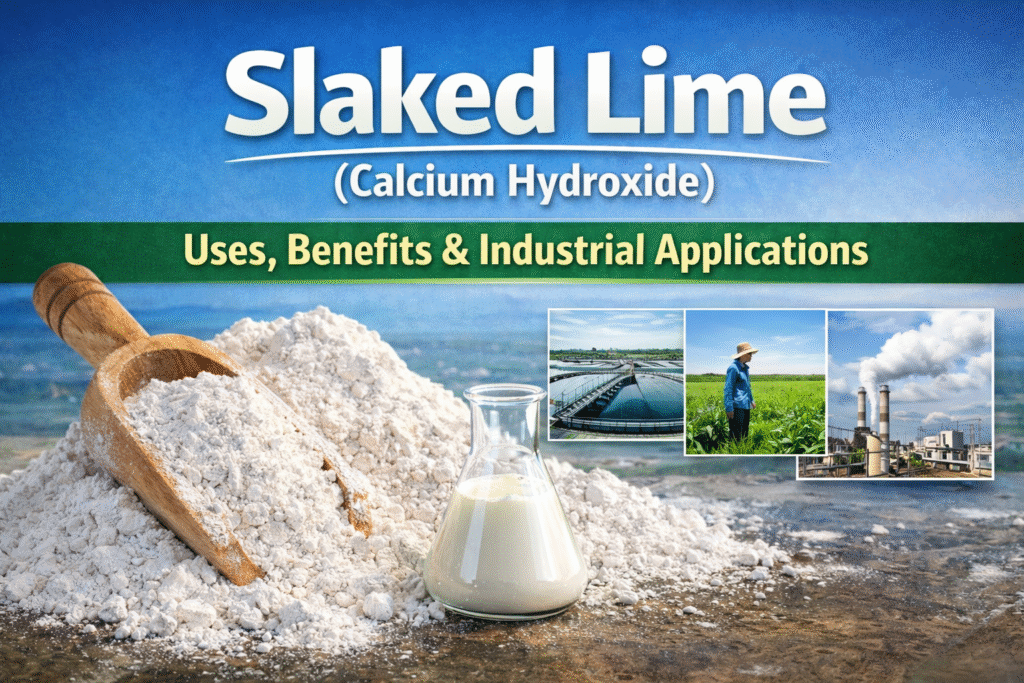
Slaked Lime (Calcium Hydroxide): Uses, Benefits & Industrial Applications

Slaked Lime, scientifically known as Calcium Hydroxide (Ca(OH)₂), is one of the most important industrial minerals used across multiple sectors. It is produced by adding water to quicklime (calcium oxide) in a process called hydration or slaking. This chemical compound appears as a fine white powder and is known for its strong alkaline nature. Because of its ability to neutralize acids, remove impurities, and control pH levels, slaked lime is widely used in industries such as water treatment, construction, agriculture, sugar processing, chemical manufacturing, and environmental protection. Today, slaked lime has become an essential material that supports many industries and environmental solutions worldwide. What is Slaked Lime? Slaked lime is a hydrated form of quicklime. When water is added to calcium oxide, it produces calcium hydroxide. Chemical Reaction CaO + H₂O → Ca(OH)₂ This reaction releases heat and forms hydrated lime powder, which is stable and easy to use in industrial processes. Properties of Slaked Lime Property Description Chemical Formula Ca(OH)₂ Appearance White powder Nature Strongly alkaline Solubility Slightly soluble in water pH Level Around 12 These properties make slaked lime ideal for neutralization, purification, and chemical reactions. Major Uses of Slaked Lime 1. Water Treatment Industry Slaked lime is widely used in municipal water treatment plants and industrial wastewater treatment systems. It helps to: Neutralize acidic water Remove heavy metals Improve water clarity Reduce hardness in water Because of these benefits, hydrated lime is a key chemical for clean and safe water purification. 2. Construction and Building Materials Slaked lime has been used in construction for centuries. Applications include: Lime mortar Plastering Whitewashing Soil stabilization It improves the strength, flexibility, and durability of construction materials. 3. Agriculture and Soil Treatment In agriculture, slaked lime helps farmers maintain balanced soil pH. Benefits include: Neutralizing acidic soil Improving soil structure Increasing nutrient availability Supporting healthy crop growth Healthy soil leads to better crop yield and productivity. 4. Sugar Industry The sugar industry uses slaked lime during the juice clarification process. It helps to: Remove impurities from sugar juice Improve sugar quality Increase purification efficiency This process ensures clean and high-quality sugar production. 5. Environmental Protection Slaked lime plays an important role in pollution control and environmental safety. It is used for: Treating industrial wastewater Neutralizing acidic waste Removing sulfur dioxide from flue gases Controlling industrial emissions Because of these capabilities, it supports sustainable industrial practices. 6. Chemical Manufacturing In chemical industries, slaked lime is used as a reactant and neutralizing agent. It is used to produce: Bleaching powder Calcium-based chemicals Various chemical intermediates Its chemical stability makes it very useful in many reactions. Advantages of Slaked Lime ✔ Cost-effective industrial chemical✔ Highly effective in neutralization✔ Environmentally beneficial✔ Widely available mineral✔ Suitable for multiple industries These advantages make slaked lime one of the most versatile industrial materials. Why Slaked Lime is Important for Industry Slaked lime supports many industries by improving product quality, protecting the environment, and increasing production efficiency. Industries rely on high-quality hydrated lime to ensure consistent chemical performance and reliable results. Companies like Vigyan Lime, with decades of experience in lime manufacturing, provide high-purity slaked lime suitable for various industrial applications. Frequently Asked Questions (FAQs) 1. What is slaked lime used for? Slaked lime is used in water treatment, agriculture, construction, sugar processing, environmental protection, and chemical manufacturing. 2. What is the chemical formula of slaked lime? The chemical formula of slaked lime is Ca(OH)₂ (Calcium Hydroxide). 3. How is slaked lime produced? Slaked lime is produced by adding water to quicklime (CaO) in a process called hydration. 4. Is slaked lime harmful? Slaked lime is strongly alkaline and should be handled with proper safety equipment. However, when used correctly in industrial processes, it is safe and highly effective. 5. What industries use slaked lime the most? Major industries include: Water treatment Sugar industry Construction Agriculture Chemical manufacturing Environmental treatment plants 6. What is the difference between quicklime and slaked lime? Quicklime is calcium oxide (CaO), while slaked lime is calcium hydroxide (Ca(OH)₂) produced by reacting quicklime with water. Slaked lime is an essential industrial chemical with a wide range of applications across multiple sectors. From purifying water and improving soil quality to supporting construction and chemical industries, this versatile compound plays a crucial role in modern industrial processes. With the increasing demand for environmental solutions and industrial efficiency, the importance of high-quality slaked lime continues to grow worldwide.

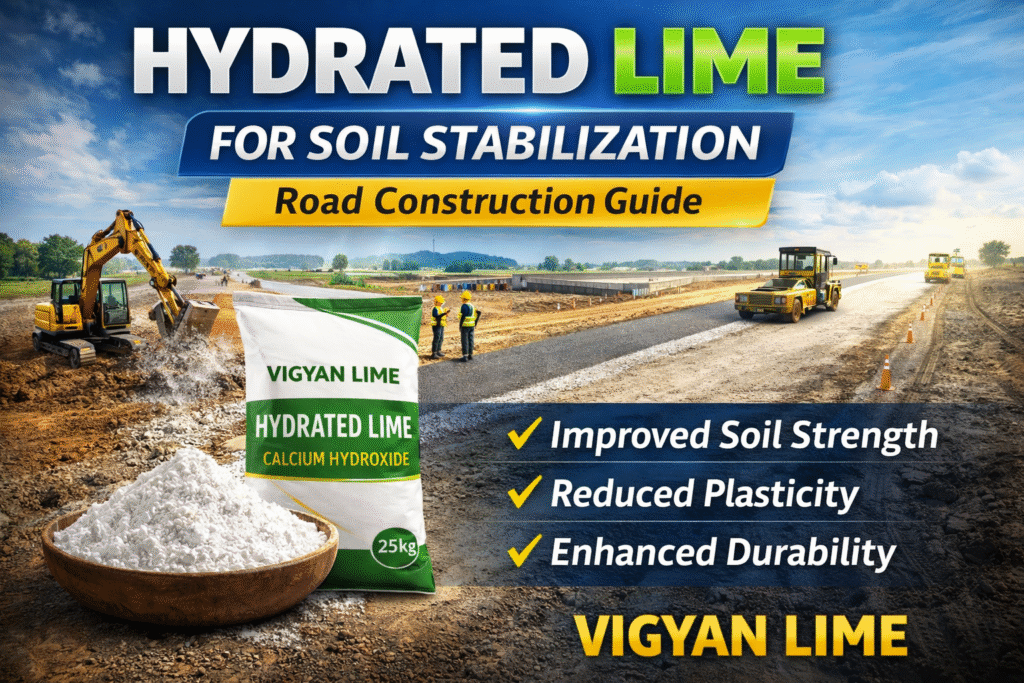
Hydrated Lime for Soil Stabilization
hydrated-lime

Hydrated Lime for Soil Stabilization – Complete Road Construction Guide | Vigyan Lime

Hydrated Lime for soil stabilization is one of the most reliable and cost-effective solutions used in modern road construction projects. Whether it is highways, state roads, rural roads, airport runways, or industrial pavements, hydrated lime plays a critical role in improving weak soil conditions. In India, many regions have clayey and highly plastic soils that are not suitable for direct road construction. Without proper stabilization, roads may suffer from cracking, rutting, swelling, and reduced lifespan. By adding high-quality Calcium Hydroxide (Ca(OH)₂), engineers can significantly enhance soil strength, durability, and long-term performance. This complete guide explains everything you need to know about using hydrated lime in soil stabilization for road construction. What is Hydrated Lime? Hydrated Lime, also known as Calcium Hydroxide, is produced by adding water to Quick Lime (Calcium Oxide). Chemical Reaction:CaO + H₂O → Ca(OH)₂ It is a fine white powder with strong alkaline properties. These alkaline characteristics make hydrated lime ideal for reacting with clay minerals in soil, improving its engineering properties. Why Soil Stabilization is Necessary in Road Construction Before laying a road, the subgrade soil must be strong enough to support traffic loads. Weak soil can cause: Uneven settlement Pavement cracking Surface deformation Water retention problems Reduced load-bearing capacity Soil stabilization improves the engineering performance of the soil and ensures a longer pavement life. How Hydrated Lime Stabilizes Soil Hydrated lime works through two major mechanisms: 1. Immediate Modification When hydrated lime is mixed with clay soil: Plasticity reduces Moisture content becomes manageable Workability improves Soil becomes friable and easier to compact This stage happens within hours. 2. Long-Term Stabilization (Pozzolanic Reaction) Over time, hydrated lime reacts chemically with silica and alumina present in clay soils. This reaction forms cementitious compounds that: Increase compressive strength Improve durability Enhance load-bearing capacity Reduce shrink-swell behavior This long-term reaction provides permanent stabilization. Types of Soils Suitable for Lime Stabilization Hydrated lime is most effective for: Clay soils Highly plastic soils Expansive soils Silty clay Black cotton soil It is not usually effective for sandy soils without clay content. Benefits of Hydrated Lime in Road Construction 1. Increased Soil Strength Hydrated lime significantly increases the Unconfined Compressive Strength (UCS) of soil, making it suitable for subgrade and sub-base layers. 2. Reduced Plasticity Plastic soils expand when wet and shrink when dry. Lime reduces plasticity index, minimizing cracking and deformation. 3. Improved Compaction Lime-treated soil becomes easier to compact, resulting in better density and stability. 4. Moisture Control Hydrated lime absorbs excess moisture and improves workability in wet conditions. 5. Enhanced Durability Stabilized soil resists: Freeze-thaw cycles Wet-dry cycles Traffic loads 6. Cost Savings Compared to removing and replacing poor soil, lime stabilization is more economical. Step-by-Step Process of Soil Stabilization Using Hydrated Lime Step 1: Soil Testing Laboratory tests determine: Plasticity index Moisture content Required lime percentage Soil classification Step 2: Lime Spreading Hydrated lime powder is uniformly spread over the prepared soil surface. Step 3: Mixing Mechanical mixers blend lime thoroughly into the soil. Step 4: Moisture Adjustment Water is added to achieve optimum moisture content. Step 5: Compaction Rollers compact the stabilized soil to required density. Step 6: Curing The treated layer is cured for proper pozzolanic reaction. Recommended Lime Percentage Typically, lime content ranges from: 3% to 8% by dry weight of soil Exact percentage depends on: Soil type Plasticity index Engineering requirements Applications in Road and Infrastructure Projects Hydrated lime is widely used in: National highways State highways Rural road projects Airport runways Industrial flooring Parking lots Railway embankments It is especially effective in regions with expansive clay soils. Technical Advantages in Pavement Design Using hydrated lime in subgrade offers: Higher CBR (California Bearing Ratio) Reduced pavement thickness requirement Increased fatigue life Reduced maintenance costs Engineers often prefer lime stabilization in flexible pavement design. Environmental Benefits Hydrated lime supports sustainable construction because: It reduces need for new borrow soil Minimizes excavation Lowers carbon footprint compared to full soil replacement Enhances long-term durability Additionally, lime-treated soil absorbs carbon dioxide over time. Comparison: Lime Stabilization vs Cement Stabilization Lime Stabilization Best for clay soils Improves plasticity Long-term chemical bonding Cost-effective for expansive soils Cement Stabilization Works for granular soils Provides immediate strength Higher material cost For clay-rich soils, hydrated lime is often the preferred choice. Quality Parameters for Soil Stabilization Grade Hydrated Lime When selecting hydrated lime for road construction, ensure: High Ca(OH)₂ purity Fine particle size Low insoluble matter Consistent reactivity Controlled moisture High-quality lime ensures uniform mixing and reliable performance. Why Choose Vigyan Lime for Soil Stabilization Projects? Vigyan Lime is a trusted manufacturer of high-purity hydrated lime suitable for infrastructure and road construction projects across India. With advanced production facilities and strict quality control, Vigyan Lime ensures consistent product performance for large-scale government and private projects. Manufacturing Units Jodhpur & Nagaur (Rajasthan)Udaipur (Rajasthan)Haldwani (Uttarakhand)Sataun (Himachal Pradesh) These strategically located units enable efficient supply to North, West, and Central India. Industries and Projects Served Road contractors Infrastructure companies Government tender projects Civil engineering firms Industrial developers Airport authorities Packaging Options 25 kg bags50 kg bagsBulk supplyCustomized packaging for project requirements Storage and Handling Guidelines Store in dry, moisture-free area Avoid direct exposure to rain Use protective gear during handling Ensure proper dust control measures Frequently Asked Questions What is the main purpose of hydrated lime in road construction?It stabilizes weak clay soils and increases strength. How long does lime stabilization last?It provides long-term stabilization due to chemical bonding. Is hydrated lime suitable for black cotton soil?Yes, it is highly effective for expansive black cotton soil. What percentage of lime is used in soil stabilization?Generally between 3% to 8%, depending on soil type. Hydrated Lime for soil stabilization is a proven and cost-effective solution for modern road construction projects. It enhances soil strength, reduces plasticity, improves durability, and increases pavement life. For infrastructure developers, road contractors, and civil engineers, choosing high-quality hydrated lime is critical for achieving reliable results. Vigyan Lime supplies premium-grade hydrated lime suitable for soil stabilization in highways, airport projects, and industrial

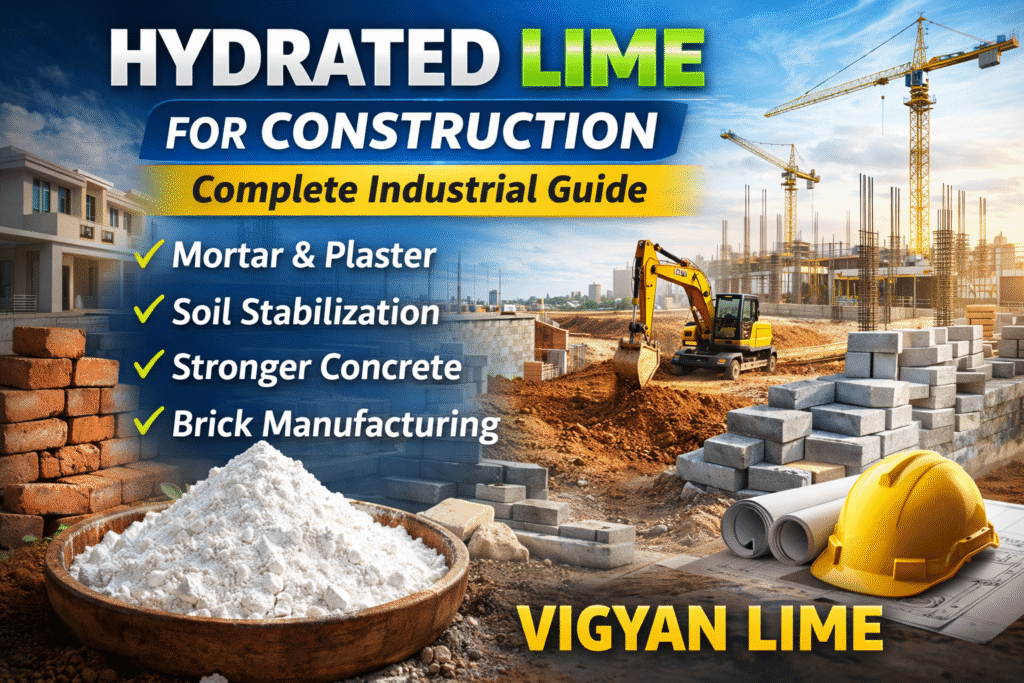
Hydrated Lime for Construction – Complete Industrial Guide (2026)
hydrated-lime

Hydrated Lime for Construction – Complete Industrial Guide (2026)

Why Hydrated Lime is Important in Construction Hydrated Lime for construction has been used for thousands of years in buildings, monuments, roads, and infrastructure projects. Even today, modern construction companies rely on high-quality hydrated lime to improve strength, durability, flexibility, and workability of construction materials. Also known as Calcium Hydroxide (Ca(OH)₂), hydrated lime enhances mortar performance, reduces cracking, improves bonding, and increases long-term structural stability. In India’s fast-growing infrastructure sector, builders and contractors prefer premium-grade hydrated lime to ensure high-quality construction standards. What is Hydrated Lime? Hydrated lime is produced by adding water to Quick Lime (Calcium Oxide). The chemical reaction forms Calcium Hydroxide. Chemical Formula: Ca(OH)₂Appearance: Fine white powderNature: Alkaline compoundReaction Type: Exothermic hydration reaction Due to its fine particle size and chemical reactivity, hydrated lime is highly suitable for construction applications. Role of Hydrated Lime in Construction Hydrated lime improves construction materials in multiple ways: Enhances plasticity of mortar Improves bonding strength Reduces shrinkage cracks Increases durability Provides water resistance Improves flexibility Enhances long-term performance Because of these properties, it is widely used in both traditional and modern construction systems. Major Applications of Hydrated Lime in Construction 1. Lime Mortar Hydrated lime is a key ingredient in lime mortar. It improves: Workability Adhesion to bricks and stones Resistance to weathering Breathability of walls Unlike pure cement mortar, lime mortar allows moisture evaporation, preventing trapped dampness. This is especially beneficial in heritage restoration and traditional buildings. 2. Cement-Lime Mortar Modern construction often uses a mixture of cement, sand, and hydrated lime. Benefits include: Better water retention Increased bond strength Improved flexibility Reduced cracking Smoother finish Cement-lime mortar is widely used in residential, commercial, and infrastructure projects. 3. Plastering Applications Hydrated lime enhances plaster quality by: Improving smoothness Reducing surface cracks Increasing durability Improving adhesion It gives a superior finish compared to ordinary cement plaster. 4. Soil Stabilization In road construction and foundation work, hydrated lime is used for soil stabilization. It helps in: Increasing soil strength Reducing plasticity Improving load-bearing capacity Reducing swelling in clay soils This makes it ideal for highways, airports, and industrial flooring projects. 5. Brick and Block Manufacturing Hydrated lime is used in manufacturing: Fly ash bricks AAC blocks Calcium silicate bricks It improves strength and dimensional stability of building materials. Advantages of Using Hydrated Lime in Construction Improved Workability Hydrated lime increases mortar plasticity, making it easier to apply and spread. Enhanced Durability Structures built with lime-modified mortar last longer due to reduced cracking. Crack Resistance Lime improves flexibility, allowing slight structural movement without cracking. Moisture Control Lime-based mortar allows walls to breathe, preventing moisture damage. Better Bonding It improves adhesion between bricks and mortar. Hydrated Lime vs Cement While cement provides high compressive strength, hydrated lime offers flexibility and crack resistance. Comparison: Cement High strength Quick setting Less flexible Hydrated Lime Flexible Better bonding Reduces cracking Improves workability The best construction results often come from combining cement and hydrated lime. Hydrated Lime in Heritage and Restoration Projects Historic buildings often use lime mortar instead of cement. Reason: Cement is too rigid Lime allows breathability Lime is compatible with old bricks and stones Hydrated lime plays a vital role in conservation and restoration projects. Technical Properties Important for Construction Grade Lime When selecting hydrated lime for construction, consider: High Ca(OH)₂ purity Fine particle size Low insoluble matter Consistent reactivity Controlled moisture content High-quality lime ensures consistent performance in mortar and plaster. Storage and Handling in Construction Sites Store in dry area Protect from moisture Use sealed packaging Avoid contamination Follow safety guidelines Proper storage maintains product quality. Environmental Benefits of Hydrated Lime in Construction Hydrated lime is environmentally beneficial because: It absorbs carbon dioxide over time Improves sustainability Reduces environmental impact Enhances long-term durability It supports green construction practices. Why Choose Vigyan Lime for Construction Grade Hydrated Lime? Vigyan Lime is a trusted manufacturer of high-purity hydrated lime in India. With advanced manufacturing processes and strict quality control, Vigyan Lime ensures consistent supply for large infrastructure and construction projects. Manufacturing Units Jodhpur & Nagaur (Rajasthan)Udaipur (Rajasthan)Haldwani (Uttarakhand)Sataun (Himachal Pradesh) These multiple units ensure wide distribution and timely delivery across India. Industries and Projects Served Residential construction Commercial buildings Highway projects Infrastructure development Heritage restoration Industrial flooring Block manufacturing units Packaging Options Available 25 kg bags50 kg bagsBulk supplyCustomized packing Quality Assurance Vigyan Lime focuses on: High purity standards Controlled manufacturing process Consistent chemical composition Reliable supply chain High-quality hydrated lime ensures better construction performance and reduced material wastage. How to Order Hydrated Lime for Construction For bulk supply, technical specifications, or pricing details, contact: Head OfficeG-37, Race CourseDehradun, Uttarakhand 248001 Email: info@vigyanlime.com Phone:+91-95685-01110, +91-95688-01110, +91-98370-55678 Frequently Asked Questions What is hydrated lime used for in construction?It is used in mortar, plaster, soil stabilization, and brick manufacturing. Does hydrated lime increase strength?Yes, when combined with cement, it improves bonding and durability. Is hydrated lime suitable for road construction?Yes, it is widely used for soil stabilization in road and highway projects. Why is lime better for heritage buildings?Because it allows breathability and reduces structural damage. Hydrated Lime for construction remains one of the most important materials in modern and traditional building systems. From mortar enhancement to soil stabilization, its role is essential in improving durability, flexibility, and long-term structural strength. Choosing a reliable manufacturer ensures consistent quality and better project outcomes. Vigyan Lime supplies high purity construction-grade hydrated lime suitable for residential, commercial, and infrastructure projects across India. If you are looking for bulk supply or technical assistance, contact Vigyan Lime today.
Why Choose Vigyan Lime for Sugar Industry Supply
hydrated-lime

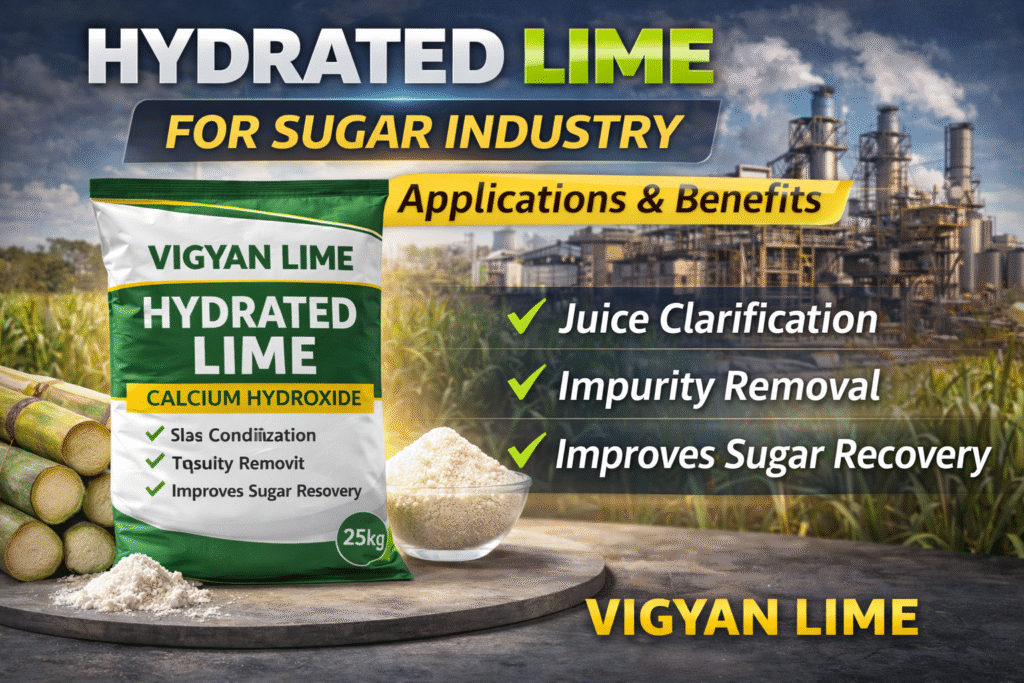
Hydrated Lime for Sugar Industry – Applications, Process & Benefits (2026)

Hydrated Lime for Sugar Industry is a critical processing chemical used in sugar manufacturing to purify sugarcane juice, remove impurities, and improve final sugar quality. Without proper lime treatment, sugar production would suffer from low recovery, poor color, and processing inefficiencies. Also known as Calcium Hydroxide (Ca(OH)₂), hydrated lime plays an essential role in juice clarification, pH adjustment, and removal of non-sugar impurities. In India, where sugar production is one of the largest agro-based industries, consistent supply of high-purity hydrated lime is crucial for maintaining quality standards and production efficiency. What is Hydrated Lime? Hydrated Lime is produced by adding water to Quick Lime (Calcium Oxide). Chemical Reaction:CaO + H₂O → Ca(OH)₂ It is a fine white alkaline powder with strong neutralizing properties. These properties make it ideal for controlling acidity and precipitating impurities in sugarcane juice. Role of Hydrated Lime in Sugar Manufacturing Process Sugar manufacturing involves multiple stages: Cane crushing Juice extraction Juice clarification Evaporation Crystallization Centrifugation Drying and packaging Hydrated lime is mainly used in the juice clarification stage, which is one of the most critical steps in sugar production. Major Applications of Hydrated Lime in Sugar Industry 1. Juice Clarification Raw sugarcane juice contains: Organic acids Proteins Coloring matter Suspended solids Colloidal impurities Hydrated lime is added to the juice to: Neutralize natural acids Raise pH level Coagulate impurities Facilitate sedimentation This results in clearer juice and improved sugar quality. 2. pH Adjustment Maintaining proper pH is essential during sugar processing. If pH is too low: Sugar inversion occurs Sucrose loss increases Recovery reduces Hydrated lime helps maintain optimum pH (generally around 7 to 7.2) during clarification, preventing sucrose degradation. 3. Removal of Non-Sugar Impurities Lime reacts with: Phosphates Organic acids Silica Proteins These reactions form insoluble compounds that settle as mud, which can be removed through filtration. This improves: Juice purity Color reduction Sugar crystallization efficiency 4. Sulphitation Process Support In sulphitation plants, hydrated lime works with sulfur dioxide gas to improve bleaching and clarification efficiency. It helps control: Color formation Chemical balance Final sugar brightness 5. Carbonation Process In carbonation process sugar plants, lime is used to react with carbon dioxide forming calcium carbonate, which traps impurities and settles out. This process enhances sugar purity and improves crystal quality. Benefits of Using Hydrated Lime in Sugar Industry Improved Sugar Recovery Proper pH control prevents sucrose loss, increasing overall sugar recovery. Better Juice Clarity Efficient impurity removal results in cleaner juice and better downstream processing. Improved Crystal Formation Clear juice improves crystallization, producing better-quality sugar. Reduced Processing Loss Prevents sucrose inversion and decomposition. Cost Efficiency Hydrated lime is economical and widely available compared to alternative chemicals. Quality Requirements for Sugar Industry Grade Hydrated Lime Sugar mills require high-quality lime with: High Ca(OH)₂ purity Low silica content Low magnesium content Fine particle size High reactivity Minimal insoluble matter Impure lime can cause: Poor clarification Increased mud formation Lower sugar recovery Hydrated Lime vs Quick Lime in Sugar Industry Quick Lime (CaO) is often used in some sugar plants and hydrated at site. Hydrated Lime (Ca(OH)₂) is preferred because: Ready to use Controlled hydration Safer handling Uniform quality Many modern sugar mills prefer hydrated lime for consistent performance. Environmental Benefits Hydrated lime helps: Neutralize acidic waste Improve effluent treatment Support environmental compliance Sugar industry generates wastewater that requires neutralization before discharge. Lime plays a vital role in this treatment. Challenges Without Proper Lime Quality Using low-grade lime may result in: Incomplete clarification High mud generation Sugar color problems Reduced recovery Increased operational cost Hence, selecting a reliable manufacturer is critical. Why Choose Vigyan Lime for Sugar Industry Supply? Vigyan Lime manufactures high-purity hydrated lime suitable for sugar mills across India. With advanced manufacturing facilities and strict quality control, Vigyan Lime ensures: Consistent purity High reactivity Reliable supply Bulk delivery capability Competitive pricing Manufacturing Units Jodhpur & Nagaur (Rajasthan)Udaipur (Rajasthan)Haldwani (Uttarakhand)Sataun (Himachal Pradesh) These locations ensure smooth supply to major sugar-producing regions. Industries Served Sugar mills Agro-processing plants Food-grade processing industries Distilleries Industrial processing units Packaging Options 25 kg bags50 kg bagsBulk supplyCustomized packaging Storage and Handling Store in dry area Avoid moisture exposure Use sealed packaging Follow industrial safety measures Frequently Asked Questions What is the main use of hydrated lime in sugar industry?It is used for juice clarification and pH control. Does hydrated lime improve sugar recovery?Yes, proper pH control reduces sucrose loss and increases recovery. What purity level is required for sugar mills?High Ca(OH)₂ purity with low impurities ensures best performance. Is hydrated lime used in sulphitation process?Yes, it supports bleaching and clarification. Hydrated Lime for Sugar Industry is an essential processing chemical that ensures efficient juice clarification, impurity removal, and improved sugar recovery. From pH control to carbonation and sulphitation processes, hydrated lime enhances sugar quality and plant efficiency. Choosing high-purity material from a trusted manufacturer ensures consistent and reliable results. Vigyan Lime supplies premium-grade hydrated lime suitable for sugar mills across India. For bulk orders and technical specifications, contact: Head OfficeG-37, Race CourseDehradun, Uttarakhand 248001 Email: info@vigyanlime.com Phone: +91-95685-01110, +91-95688-01110, +91-98370-55678
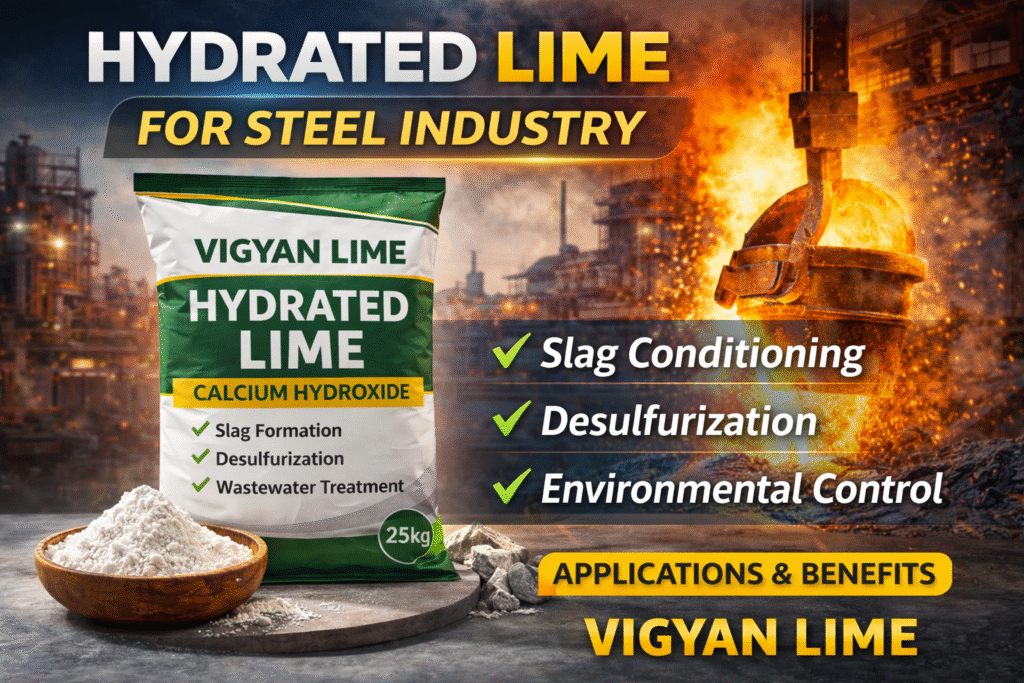
Hydrated Lime for Steel Industry – Applications & Benefits (2026)
Uncategorized

Hydrated Lime for Steel Industry – Applications & Benefits (2026)

Hydrated Lime for Steel Industry plays a crucial role in improving steel quality, controlling impurities, and ensuring smooth metallurgical operations. In modern steel plants, calcium-based materials are essential for refining, slag conditioning, gas treatment, and wastewater neutralization. Hydrated Lime, also known as Calcium Hydroxide (Ca(OH)₂), is widely used in integrated steel plants, mini steel plants, induction furnaces, and secondary metallurgy units. India is one of the largest steel producers in the world, and consistent supply of high-purity hydrated lime is critical for maintaining production efficiency and meeting environmental compliance standards. What is Hydrated Lime? Hydrated Lime is produced by adding water to Quick Lime (Calcium Oxide). Chemical Reaction:CaO + H₂O → Ca(OH)₂ It is a fine white alkaline powder with strong reactivity. Due to its high alkalinity and chemical stability, it is suitable for metallurgical and environmental applications in steel plants. Why Hydrated Lime is Important in the Steel Industry Steel production involves high-temperature processes that generate impurities such as: Sulfur Phosphorus Silica Heavy metals Acidic gases Hydrated lime helps in controlling these impurities and improving overall steel quality. Major Applications of Hydrated Lime in Steel Industry 1. Slag Formation and Conditioning During steelmaking, slag plays an important role in removing impurities from molten metal. Hydrated lime contributes to: Formation of basic slag Removal of silica and phosphorus Improved slag fluidity Better impurity separation Proper slag chemistry improves steel purity and reduces defects. 2. Desulfurization Process Sulfur negatively affects steel strength and weldability. Hydrated lime is used in desulfurization to: React with sulfur compounds Reduce sulfur content in molten iron Improve final steel quality Lower sulfur levels enhance mechanical properties. 3. pH Control in Steel Plant Wastewater Steel plants generate acidic wastewater containing: Iron particles Heavy metals Chemical residues Hydrated lime neutralizes acidic water and raises pH levels, making wastewater safe for treatment and discharge. 4. Flue Gas Treatment Steel furnaces emit gases such as: Sulfur dioxide Acidic fumes Hydrated lime is used in gas treatment systems to neutralize harmful emissions and meet pollution control standards. 5. Effluent Treatment Plants (ETP) In steel industry ETP systems, hydrated lime is used for: Heavy metal precipitation Sludge conditioning Chemical neutralization It ensures compliance with environmental regulations. 6. Sinter Plant Operations In sinter plants, lime helps improve agglomeration properties and supports better blast furnace performance. Benefits of Using Hydrated Lime in Steel Manufacturing Improved Steel Quality Removes impurities such as sulfur and phosphorus, leading to stronger and more durable steel. Enhanced Slag Efficiency Helps in forming stable and reactive slag for better impurity removal. Environmental Compliance Supports pollution control by neutralizing acidic gases and wastewater. Cost Efficiency Compared to other alkaline chemicals, hydrated lime is economical and widely available. Operational Stability Improves process control and consistency in steel plants. Technical Properties Required for Steel Industry Grade Hydrated Lime Steel plants require high-quality hydrated lime with: High Ca(OH)₂ purity Low silica content Fine particle size High reactivity Low moisture content Consistent chemical composition ensures predictable metallurgical performance. Hydrated Lime vs Quick Lime in Steel Industry Quick Lime (CaO) is mainly used in primary steelmaking for slag formation.Hydrated Lime (Ca(OH)₂) is more commonly used for: Environmental applications Gas treatment Wastewater treatment Secondary processes Both materials play important but different roles. Environmental and Sustainability Benefits Hydrated lime supports sustainable steel production by: Reducing harmful emissions Neutralizing acidic waste Lowering environmental impact Supporting regulatory compliance It plays a vital role in green steel initiatives. Challenges Without Proper Lime Quality Using low-quality hydrated lime may result in: Poor slag formation Incomplete desulfurization Higher chemical consumption Increased operational cost Equipment scaling issues Therefore, selecting a reliable manufacturer is critical. Why Choose Vigyan Lime for Steel Industry Supply? Vigyan Lime manufactures high-purity hydrated lime suitable for steel industry applications. With advanced production processes and strict quality control, Vigyan Lime ensures: Consistent Ca(OH)₂ purity Reliable supply chain Bulk delivery capability Technical support Manufacturing Units Jodhpur & Nagaur (Rajasthan)Udaipur (Rajasthan)Haldwani (Uttarakhand)Sataun (Himachal Pradesh) These strategically located facilities ensure efficient supply across North, West, and Central India. Industries Served Integrated steel plants Secondary steel units Rolling mills Sinter plants Induction furnace units Infrastructure steel producers Packaging Options 25 kg bags50 kg bagsBulk supplyCustomized packaging Storage and Handling Store in dry conditions Avoid moisture exposure Ensure dust control measures Follow industrial safety protocols Frequently Asked Questions What is the role of hydrated lime in steel production?It helps in impurity removal, slag conditioning, and wastewater neutralization. Is hydrated lime used in desulfurization?Yes, it reduces sulfur content in molten iron and steel. Why is purity important in steel industry lime?High purity ensures efficient reactions and better steel quality. Can hydrated lime help in pollution control?Yes, it neutralizes acidic gases and wastewater. Hydrated Lime for Steel Industry is a critical material that supports metallurgical efficiency, impurity removal, environmental compliance, and cost control. From slag conditioning to wastewater treatment, hydrated lime enhances steel quality and plant performance. Selecting high-purity material from a trusted manufacturer ensures consistent and reliable results. Vigyan Lime supplies premium-grade hydrated lime suitable for steel plants across India. For bulk orders and technical specifications, contact: Head OfficeG-37, Race CourseDehradun, Uttarakhand 248001 Email: info@vigyanlime.com Phone:+91-95685-01110+91-95688-01110+91-98370-55678

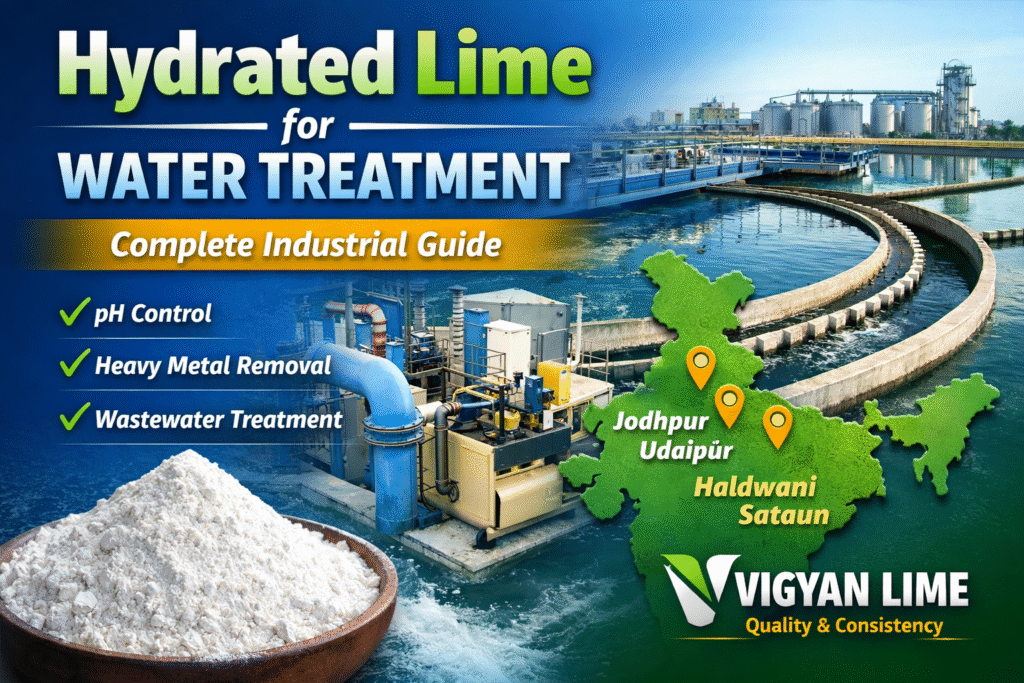
Hydrated Lime for Water Treatment – Complete Industrial Guide (2026)
hydrated-lime

Hydrated Lime for Water Treatment – Complete Industrial Guide (2026)

Why Hydrated Lime is Essential for Water Treatment Hydrated Lime for water treatment plays a critical role in maintaining safe and clean water across municipal plants, industrial facilities, and wastewater treatment systems. Also known as Calcium Hydroxide (Ca(OH)₂), hydrated lime is one of the most widely used chemicals for pH adjustment, heavy metal removal, softening, and sludge stabilization. In India and globally, water pollution and industrial discharge are increasing. To control contamination and ensure regulatory compliance, industries rely on high-quality hydrated lime. If you are searching for a reliable Hydrated Lime manufacturer in India, Vigyan Lime offers premium-grade material suitable for municipal water treatment plants, ETPs, STPs, and industrial purification systems. What is Hydrated Lime? Hydrated Lime, also called Slaked Lime, is produced by reacting Quick Lime (Calcium Oxide) with water. Chemical Reaction: CaO + H₂O → Ca(OH)₂ The result is a fine white powder known as Calcium Hydroxide. Key Properties: Chemical Formula: Ca(OH)₂ Appearance: Fine white powder Solubility: Slightly soluble in water Alkalinity: Strong alkaline compound pH Value: Around 12.4 (in saturated solution) These alkaline properties make hydrated lime ideal for water treatment applications. Why Hydrated Lime is Used in Water Treatment Water treatment requires chemicals that: Adjust pH levels Remove heavy metals Neutralize acidic waste Reduce turbidity Improve water clarity Control odors Hydrated lime performs all these functions effectively and economically. Major Applications of Hydrated Lime in Water Treatment 1. pH Adjustment Industrial wastewater is often acidic. Hydrated lime increases the pH level, neutralizing acidic effluents before discharge. Maintaining proper pH: Protects pipelines Prevents corrosion Ensures environmental compliance Improves chemical reactions 2. Heavy Metal Removal Heavy metals such as: Lead Zinc Chromium Nickel Cadmium are harmful to the environment. Hydrated lime reacts with dissolved metals, forming insoluble metal hydroxides that settle out as sludge. This process allows easy removal during sedimentation. 3. Water Softening Hard water contains calcium and magnesium ions. Hydrated lime helps remove hardness by precipitating these ions. Benefits: Reduces scaling Protects boilers Improves industrial efficiency Enhances soap performance 4. Sludge Stabilization In wastewater plants, sludge treatment is essential. Hydrated lime: Reduces pathogens Controls odor Improves dewatering Stabilizes biosolids 5. Fluoride and Phosphate Removal Hydrated lime helps in removing excess fluoride and phosphates from water, making it safe for consumption. Hydrated Lime in Different Water Treatment Systems Municipal Water Treatment Plants Cities use hydrated lime for: Clarification Coagulation support pH balancing Drinking water safety Industrial Effluent Treatment Plants (ETP) Industries like: Textile Paper Steel Sugar Chemical plants use hydrated lime to treat effluents before discharge. Sewage Treatment Plants (STP) Used for: Sludge conditioning Odor control Pathogen reduction Advantages of Using High Purity Hydrated Lime Choosing high-quality hydrated lime ensures: ✔ Faster reaction time✔ Lower consumption✔ Better settling properties✔ Reduced sludge volume✔ Cost efficiency Low-quality lime may cause: Incomplete reaction Higher dosing requirement Operational issues Hydrated Lime Dosing Methods Dry Powder Feeding Lime Slurry Preparation Automated Dosing Systems For large plants, slurry systems are more efficient and controlled. Storage and Handling Guidelines Store in dry conditions Avoid moisture exposure Use protective gear Maintain sealed packaging Prevent contamination Quality Parameters for Water Treatment Grade Hydrated Lime When purchasing hydrated lime, check: Available Ca(OH)₂ percentage Reactivity Particle size (mesh) Insoluble matter Moisture content High reactivity ensures efficient treatment with lower dosage. Environmental Compliance and Hydrated Lime Hydrated lime helps industries comply with: Pollution Control Board norms Environmental discharge standards Industrial wastewater regulations Its ability to neutralize harmful effluents makes it environmentally safe when used properly. Cost Efficiency of Hydrated Lime Compared to other alkaline chemicals, hydrated lime: Is economical Has wide availability Requires lower operational cost Offers stable performance This makes it the preferred chemical for large-scale water treatment. Why Choose Vigyan Lime for Hydrated Lime Supply? Vigyan Lime is a trusted manufacturer of high purity hydrated lime in India. Manufacturing Units Jodhpur & Nagaur (Rajasthan) Udaipur (Rajasthan) Haldwani (Uttarakhand) Sataun (Himachal Pradesh) With multiple production facilities, Vigyan Lime ensures: ✔ Consistent supply✔ High purity standards✔ Advanced manufacturing process✔ Bulk and customized packaging✔ Timely delivery across India Industries Served by Vigyan Lime Municipal Corporations Industrial ETP Plants Textile Industries Sugar Mills Chemical Industries Steel Plants Infrastructure Projects Packaging Options Available 25 kg bags 50 kg bags Jumbo bags Bulk supply How to Order Hydrated Lime for Water Treatment To place bulk orders or request technical specifications, contact: Contact Us Head Office:G-37, Race CourseDehradun, Uttarakhand – 248001 Email: info@vigyanlime.com, vigyanlime@gmail.com, vigyanlime@yahoo.com Phone:+91-95685-01110, +91-95688-01110, +91-98370-55678 Frequently Asked Questions (FAQ) Q1: What is the main use of hydrated lime in water treatment? It is used for pH adjustment, heavy metal removal, and water softening. Q2: Is hydrated lime safe for drinking water treatment? Yes, when used in controlled dosage under regulatory guidelines. Q3: What is the ideal purity level for water treatment grade hydrated lime? High Ca(OH)₂ content with low impurities ensures best performance. Q4: Can hydrated lime remove heavy metals? Yes, it precipitates heavy metals as insoluble hydroxides. Hydrated Lime for Water Treatment is an essential chemical for municipal and industrial purification systems. From pH control to heavy metal removal, it plays a vital role in ensuring environmental safety and regulatory compliance. Choosing a reliable manufacturer like Vigyan Lime ensures high purity, consistent supply, and efficient water treatment performance. If you are looking for bulk supply of premium Hydrated Lime in India, contact Vigyan Lime today.