Author name: vigyanlime@gmail.com

hydrated-lime

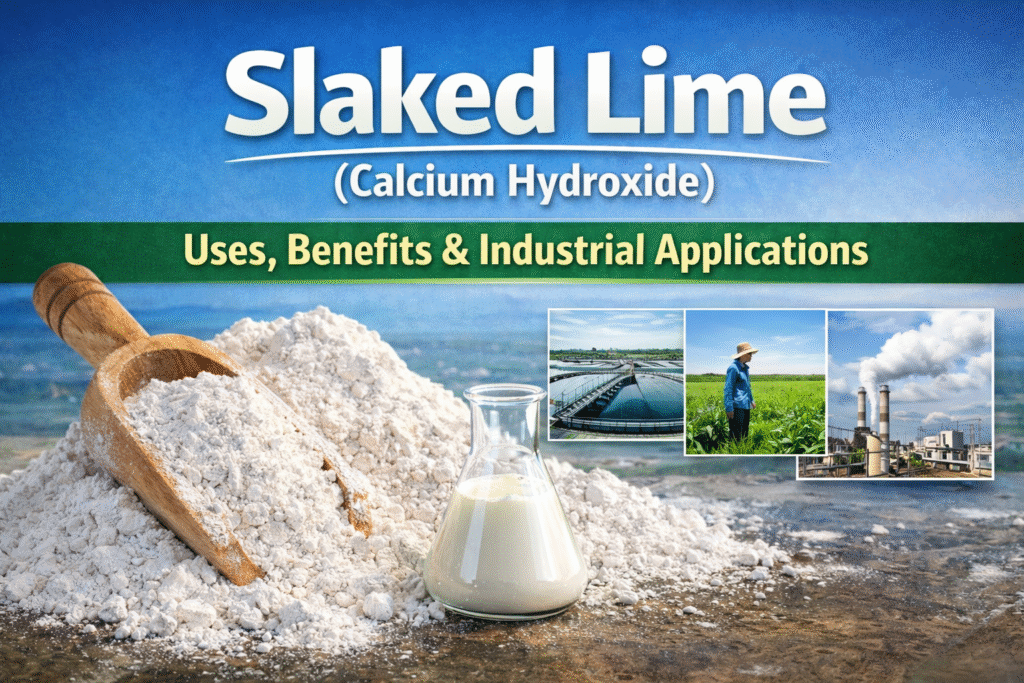
Slaked Lime (Calcium Hydroxide): Uses, Benefits & Industrial Applications

Slaked Lime, scientifically known as Calcium Hydroxide (Ca(OH)₂), is one of the most important industrial minerals used across multiple sectors. It is produced by adding water to quicklime (calcium oxide) in a process called hydration or slaking. This chemical compound appears as a fine white powder and is known for its strong alkaline nature. Because of its ability to neutralize acids, remove impurities, and control pH levels, slaked lime is widely used in industries such as water treatment, construction, agriculture, sugar processing, chemical manufacturing, and environmental protection. Today, slaked lime has become an essential material that supports many industries and environmental solutions worldwide. What is Slaked Lime? Slaked lime is a hydrated form of quicklime. When water is added to calcium oxide, it produces calcium hydroxide. Chemical Reaction CaO + H₂O → Ca(OH)₂ This reaction releases heat and forms hydrated lime powder, which is stable and easy to use in industrial processes. Properties of Slaked Lime Property Description Chemical Formula Ca(OH)₂ Appearance White powder Nature Strongly alkaline Solubility Slightly soluble in water pH Level Around 12 These properties make slaked lime ideal for neutralization, purification, and chemical reactions. Major Uses of Slaked Lime 1. Water Treatment Industry Slaked lime is widely used in municipal water treatment plants and industrial wastewater treatment systems. It helps to: Neutralize acidic water Remove heavy metals Improve water clarity Reduce hardness in water Because of these benefits, hydrated lime is a key chemical for clean and safe water purification. 2. Construction and Building Materials Slaked lime has been used in construction for centuries. Applications include: Lime mortar Plastering Whitewashing Soil stabilization It improves the strength, flexibility, and durability of construction materials. 3. Agriculture and Soil Treatment In agriculture, slaked lime helps farmers maintain balanced soil pH. Benefits include: Neutralizing acidic soil Improving soil structure Increasing nutrient availability Supporting healthy crop growth Healthy soil leads to better crop yield and productivity. 4. Sugar Industry The sugar industry uses slaked lime during the juice clarification process. It helps to: Remove impurities from sugar juice Improve sugar quality Increase purification efficiency This process ensures clean and high-quality sugar production. 5. Environmental Protection Slaked lime plays an important role in pollution control and environmental safety. It is used for: Treating industrial wastewater Neutralizing acidic waste Removing sulfur dioxide from flue gases Controlling industrial emissions Because of these capabilities, it supports sustainable industrial practices. 6. Chemical Manufacturing In chemical industries, slaked lime is used as a reactant and neutralizing agent. It is used to produce: Bleaching powder Calcium-based chemicals Various chemical intermediates Its chemical stability makes it very useful in many reactions. Advantages of Slaked Lime ✔ Cost-effective industrial chemical✔ Highly effective in neutralization✔ Environmentally beneficial✔ Widely available mineral✔ Suitable for multiple industries These advantages make slaked lime one of the most versatile industrial materials. Why Slaked Lime is Important for Industry Slaked lime supports many industries by improving product quality, protecting the environment, and increasing production efficiency. Industries rely on high-quality hydrated lime to ensure consistent chemical performance and reliable results. Companies like Vigyan Lime, with decades of experience in lime manufacturing, provide high-purity slaked lime suitable for various industrial applications. Frequently Asked Questions (FAQs) 1. What is slaked lime used for? Slaked lime is used in water treatment, agriculture, construction, sugar processing, environmental protection, and chemical manufacturing. 2. What is the chemical formula of slaked lime? The chemical formula of slaked lime is Ca(OH)₂ (Calcium Hydroxide). 3. How is slaked lime produced? Slaked lime is produced by adding water to quicklime (CaO) in a process called hydration. 4. Is slaked lime harmful? Slaked lime is strongly alkaline and should be handled with proper safety equipment. However, when used correctly in industrial processes, it is safe and highly effective. 5. What industries use slaked lime the most? Major industries include: Water treatment Sugar industry Construction Agriculture Chemical manufacturing Environmental treatment plants 6. What is the difference between quicklime and slaked lime? Quicklime is calcium oxide (CaO), while slaked lime is calcium hydroxide (Ca(OH)₂) produced by reacting quicklime with water. Slaked lime is an essential industrial chemical with a wide range of applications across multiple sectors. From purifying water and improving soil quality to supporting construction and chemical industries, this versatile compound plays a crucial role in modern industrial processes. With the increasing demand for environmental solutions and industrial efficiency, the importance of high-quality slaked lime continues to grow worldwide.
Hydrated Lime for Soil Stabilization
hydrated-lime

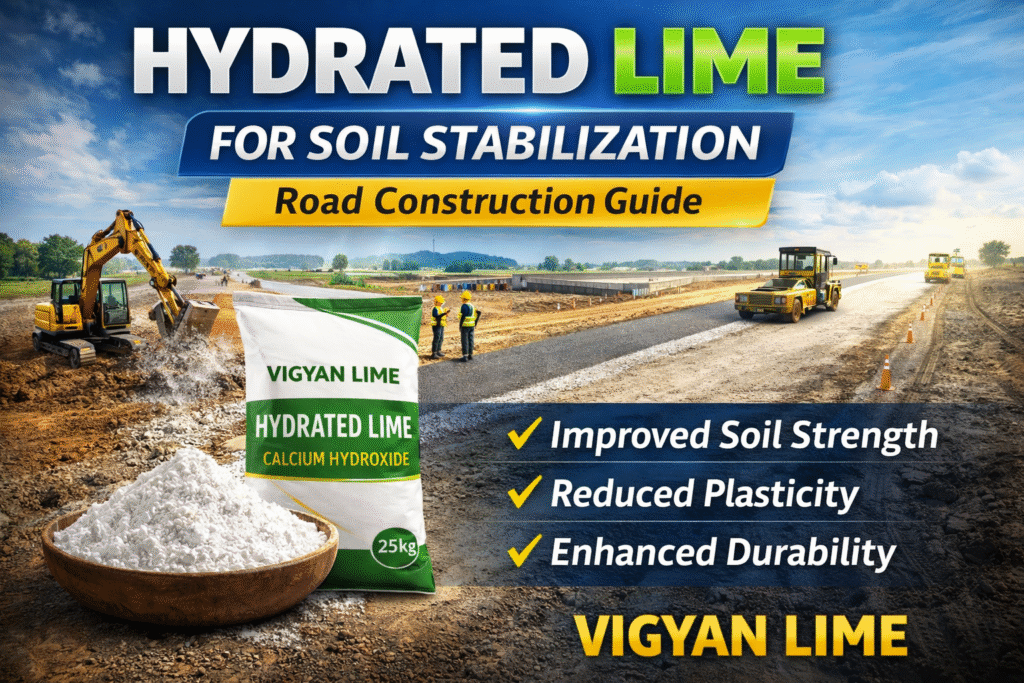
Hydrated Lime for Soil Stabilization – Complete Road Construction Guide | Vigyan Lime

Hydrated Lime for soil stabilization is one of the most reliable and cost-effective solutions used in modern road construction projects. Whether it is highways, state roads, rural roads, airport runways, or industrial pavements, hydrated lime plays a critical role in improving weak soil conditions. In India, many regions have clayey and highly plastic soils that are not suitable for direct road construction. Without proper stabilization, roads may suffer from cracking, rutting, swelling, and reduced lifespan. By adding high-quality Calcium Hydroxide (Ca(OH)₂), engineers can significantly enhance soil strength, durability, and long-term performance. This complete guide explains everything you need to know about using hydrated lime in soil stabilization for road construction. What is Hydrated Lime? Hydrated Lime, also known as Calcium Hydroxide, is produced by adding water to Quick Lime (Calcium Oxide). Chemical Reaction:CaO + H₂O → Ca(OH)₂ It is a fine white powder with strong alkaline properties. These alkaline characteristics make hydrated lime ideal for reacting with clay minerals in soil, improving its engineering properties. Why Soil Stabilization is Necessary in Road Construction Before laying a road, the subgrade soil must be strong enough to support traffic loads. Weak soil can cause: Uneven settlement Pavement cracking Surface deformation Water retention problems Reduced load-bearing capacity Soil stabilization improves the engineering performance of the soil and ensures a longer pavement life. How Hydrated Lime Stabilizes Soil Hydrated lime works through two major mechanisms: 1. Immediate Modification When hydrated lime is mixed with clay soil: Plasticity reduces Moisture content becomes manageable Workability improves Soil becomes friable and easier to compact This stage happens within hours. 2. Long-Term Stabilization (Pozzolanic Reaction) Over time, hydrated lime reacts chemically with silica and alumina present in clay soils. This reaction forms cementitious compounds that: Increase compressive strength Improve durability Enhance load-bearing capacity Reduce shrink-swell behavior This long-term reaction provides permanent stabilization. Types of Soils Suitable for Lime Stabilization Hydrated lime is most effective for: Clay soils Highly plastic soils Expansive soils Silty clay Black cotton soil It is not usually effective for sandy soils without clay content. Benefits of Hydrated Lime in Road Construction 1. Increased Soil Strength Hydrated lime significantly increases the Unconfined Compressive Strength (UCS) of soil, making it suitable for subgrade and sub-base layers. 2. Reduced Plasticity Plastic soils expand when wet and shrink when dry. Lime reduces plasticity index, minimizing cracking and deformation. 3. Improved Compaction Lime-treated soil becomes easier to compact, resulting in better density and stability. 4. Moisture Control Hydrated lime absorbs excess moisture and improves workability in wet conditions. 5. Enhanced Durability Stabilized soil resists: Freeze-thaw cycles Wet-dry cycles Traffic loads 6. Cost Savings Compared to removing and replacing poor soil, lime stabilization is more economical. Step-by-Step Process of Soil Stabilization Using Hydrated Lime Step 1: Soil Testing Laboratory tests determine: Plasticity index Moisture content Required lime percentage Soil classification Step 2: Lime Spreading Hydrated lime powder is uniformly spread over the prepared soil surface. Step 3: Mixing Mechanical mixers blend lime thoroughly into the soil. Step 4: Moisture Adjustment Water is added to achieve optimum moisture content. Step 5: Compaction Rollers compact the stabilized soil to required density. Step 6: Curing The treated layer is cured for proper pozzolanic reaction. Recommended Lime Percentage Typically, lime content ranges from: 3% to 8% by dry weight of soil Exact percentage depends on: Soil type Plasticity index Engineering requirements Applications in Road and Infrastructure Projects Hydrated lime is widely used in: National highways State highways Rural road projects Airport runways Industrial flooring Parking lots Railway embankments It is especially effective in regions with expansive clay soils. Technical Advantages in Pavement Design Using hydrated lime in subgrade offers: Higher CBR (California Bearing Ratio) Reduced pavement thickness requirement Increased fatigue life Reduced maintenance costs Engineers often prefer lime stabilization in flexible pavement design. Environmental Benefits Hydrated lime supports sustainable construction because: It reduces need for new borrow soil Minimizes excavation Lowers carbon footprint compared to full soil replacement Enhances long-term durability Additionally, lime-treated soil absorbs carbon dioxide over time. Comparison: Lime Stabilization vs Cement Stabilization Lime Stabilization Best for clay soils Improves plasticity Long-term chemical bonding Cost-effective for expansive soils Cement Stabilization Works for granular soils Provides immediate strength Higher material cost For clay-rich soils, hydrated lime is often the preferred choice. Quality Parameters for Soil Stabilization Grade Hydrated Lime When selecting hydrated lime for road construction, ensure: High Ca(OH)₂ purity Fine particle size Low insoluble matter Consistent reactivity Controlled moisture High-quality lime ensures uniform mixing and reliable performance. Why Choose Vigyan Lime for Soil Stabilization Projects? Vigyan Lime is a trusted manufacturer of high-purity hydrated lime suitable for infrastructure and road construction projects across India. With advanced production facilities and strict quality control, Vigyan Lime ensures consistent product performance for large-scale government and private projects. Manufacturing Units Jodhpur & Nagaur (Rajasthan)Udaipur (Rajasthan)Haldwani (Uttarakhand)Sataun (Himachal Pradesh) These strategically located units enable efficient supply to North, West, and Central India. Industries and Projects Served Road contractors Infrastructure companies Government tender projects Civil engineering firms Industrial developers Airport authorities Packaging Options 25 kg bags50 kg bagsBulk supplyCustomized packaging for project requirements Storage and Handling Guidelines Store in dry, moisture-free area Avoid direct exposure to rain Use protective gear during handling Ensure proper dust control measures Frequently Asked Questions What is the main purpose of hydrated lime in road construction?It stabilizes weak clay soils and increases strength. How long does lime stabilization last?It provides long-term stabilization due to chemical bonding. Is hydrated lime suitable for black cotton soil?Yes, it is highly effective for expansive black cotton soil. What percentage of lime is used in soil stabilization?Generally between 3% to 8%, depending on soil type. Hydrated Lime for soil stabilization is a proven and cost-effective solution for modern road construction projects. It enhances soil strength, reduces plasticity, improves durability, and increases pavement life. For infrastructure developers, road contractors, and civil engineers, choosing high-quality hydrated lime is critical for achieving reliable results. Vigyan Lime supplies premium-grade hydrated lime suitable for soil stabilization in highways, airport projects, and industrial

Hydrated Lime for Construction – Complete Industrial Guide (2026)
hydrated-lime

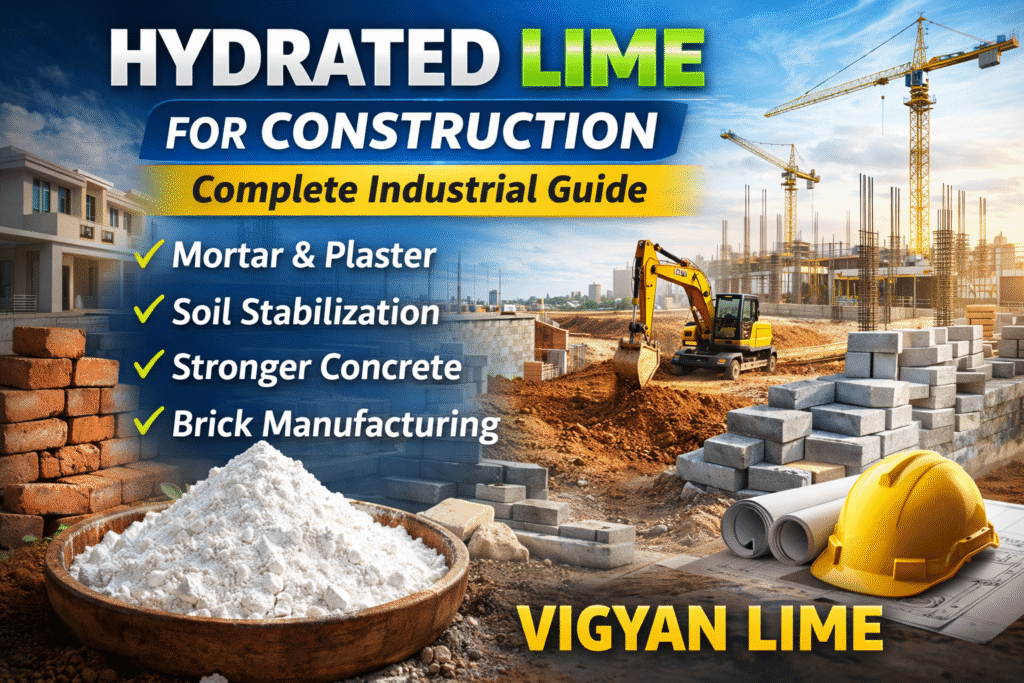
Hydrated Lime for Construction – Complete Industrial Guide (2026)

Why Hydrated Lime is Important in Construction Hydrated Lime for construction has been used for thousands of years in buildings, monuments, roads, and infrastructure projects. Even today, modern construction companies rely on high-quality hydrated lime to improve strength, durability, flexibility, and workability of construction materials. Also known as Calcium Hydroxide (Ca(OH)₂), hydrated lime enhances mortar performance, reduces cracking, improves bonding, and increases long-term structural stability. In India’s fast-growing infrastructure sector, builders and contractors prefer premium-grade hydrated lime to ensure high-quality construction standards. What is Hydrated Lime? Hydrated lime is produced by adding water to Quick Lime (Calcium Oxide). The chemical reaction forms Calcium Hydroxide. Chemical Formula: Ca(OH)₂Appearance: Fine white powderNature: Alkaline compoundReaction Type: Exothermic hydration reaction Due to its fine particle size and chemical reactivity, hydrated lime is highly suitable for construction applications. Role of Hydrated Lime in Construction Hydrated lime improves construction materials in multiple ways: Enhances plasticity of mortar Improves bonding strength Reduces shrinkage cracks Increases durability Provides water resistance Improves flexibility Enhances long-term performance Because of these properties, it is widely used in both traditional and modern construction systems. Major Applications of Hydrated Lime in Construction 1. Lime Mortar Hydrated lime is a key ingredient in lime mortar. It improves: Workability Adhesion to bricks and stones Resistance to weathering Breathability of walls Unlike pure cement mortar, lime mortar allows moisture evaporation, preventing trapped dampness. This is especially beneficial in heritage restoration and traditional buildings. 2. Cement-Lime Mortar Modern construction often uses a mixture of cement, sand, and hydrated lime. Benefits include: Better water retention Increased bond strength Improved flexibility Reduced cracking Smoother finish Cement-lime mortar is widely used in residential, commercial, and infrastructure projects. 3. Plastering Applications Hydrated lime enhances plaster quality by: Improving smoothness Reducing surface cracks Increasing durability Improving adhesion It gives a superior finish compared to ordinary cement plaster. 4. Soil Stabilization In road construction and foundation work, hydrated lime is used for soil stabilization. It helps in: Increasing soil strength Reducing plasticity Improving load-bearing capacity Reducing swelling in clay soils This makes it ideal for highways, airports, and industrial flooring projects. 5. Brick and Block Manufacturing Hydrated lime is used in manufacturing: Fly ash bricks AAC blocks Calcium silicate bricks It improves strength and dimensional stability of building materials. Advantages of Using Hydrated Lime in Construction Improved Workability Hydrated lime increases mortar plasticity, making it easier to apply and spread. Enhanced Durability Structures built with lime-modified mortar last longer due to reduced cracking. Crack Resistance Lime improves flexibility, allowing slight structural movement without cracking. Moisture Control Lime-based mortar allows walls to breathe, preventing moisture damage. Better Bonding It improves adhesion between bricks and mortar. Hydrated Lime vs Cement While cement provides high compressive strength, hydrated lime offers flexibility and crack resistance. Comparison: Cement High strength Quick setting Less flexible Hydrated Lime Flexible Better bonding Reduces cracking Improves workability The best construction results often come from combining cement and hydrated lime. Hydrated Lime in Heritage and Restoration Projects Historic buildings often use lime mortar instead of cement. Reason: Cement is too rigid Lime allows breathability Lime is compatible with old bricks and stones Hydrated lime plays a vital role in conservation and restoration projects. Technical Properties Important for Construction Grade Lime When selecting hydrated lime for construction, consider: High Ca(OH)₂ purity Fine particle size Low insoluble matter Consistent reactivity Controlled moisture content High-quality lime ensures consistent performance in mortar and plaster. Storage and Handling in Construction Sites Store in dry area Protect from moisture Use sealed packaging Avoid contamination Follow safety guidelines Proper storage maintains product quality. Environmental Benefits of Hydrated Lime in Construction Hydrated lime is environmentally beneficial because: It absorbs carbon dioxide over time Improves sustainability Reduces environmental impact Enhances long-term durability It supports green construction practices. Why Choose Vigyan Lime for Construction Grade Hydrated Lime? Vigyan Lime is a trusted manufacturer of high-purity hydrated lime in India. With advanced manufacturing processes and strict quality control, Vigyan Lime ensures consistent supply for large infrastructure and construction projects. Manufacturing Units Jodhpur & Nagaur (Rajasthan)Udaipur (Rajasthan)Haldwani (Uttarakhand)Sataun (Himachal Pradesh) These multiple units ensure wide distribution and timely delivery across India. Industries and Projects Served Residential construction Commercial buildings Highway projects Infrastructure development Heritage restoration Industrial flooring Block manufacturing units Packaging Options Available 25 kg bags50 kg bagsBulk supplyCustomized packing Quality Assurance Vigyan Lime focuses on: High purity standards Controlled manufacturing process Consistent chemical composition Reliable supply chain High-quality hydrated lime ensures better construction performance and reduced material wastage. How to Order Hydrated Lime for Construction For bulk supply, technical specifications, or pricing details, contact: Head OfficeG-37, Race CourseDehradun, Uttarakhand 248001 Email: info@vigyanlime.com Phone:+91-95685-01110, +91-95688-01110, +91-98370-55678 Frequently Asked Questions What is hydrated lime used for in construction?It is used in mortar, plaster, soil stabilization, and brick manufacturing. Does hydrated lime increase strength?Yes, when combined with cement, it improves bonding and durability. Is hydrated lime suitable for road construction?Yes, it is widely used for soil stabilization in road and highway projects. Why is lime better for heritage buildings?Because it allows breathability and reduces structural damage. Hydrated Lime for construction remains one of the most important materials in modern and traditional building systems. From mortar enhancement to soil stabilization, its role is essential in improving durability, flexibility, and long-term structural strength. Choosing a reliable manufacturer ensures consistent quality and better project outcomes. Vigyan Lime supplies high purity construction-grade hydrated lime suitable for residential, commercial, and infrastructure projects across India. If you are looking for bulk supply or technical assistance, contact Vigyan Lime today.

Why Choose Vigyan Lime for Sugar Industry Supply
hydrated-lime

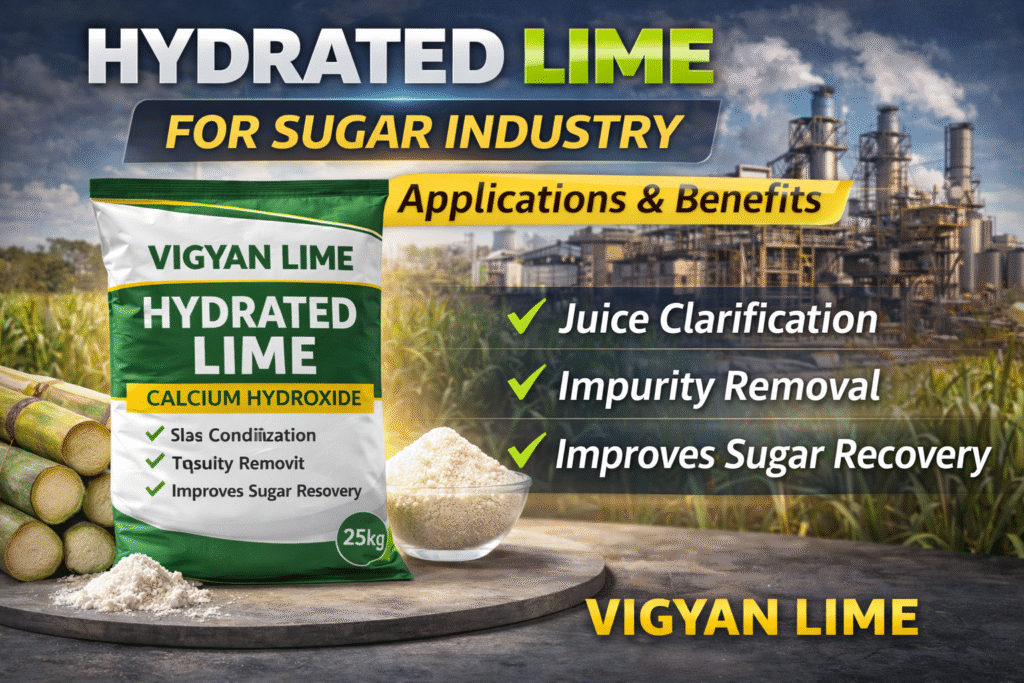
Hydrated Lime for Sugar Industry – Applications, Process & Benefits (2026)

Hydrated Lime for Sugar Industry is a critical processing chemical used in sugar manufacturing to purify sugarcane juice, remove impurities, and improve final sugar quality. Without proper lime treatment, sugar production would suffer from low recovery, poor color, and processing inefficiencies. Also known as Calcium Hydroxide (Ca(OH)₂), hydrated lime plays an essential role in juice clarification, pH adjustment, and removal of non-sugar impurities. In India, where sugar production is one of the largest agro-based industries, consistent supply of high-purity hydrated lime is crucial for maintaining quality standards and production efficiency. What is Hydrated Lime? Hydrated Lime is produced by adding water to Quick Lime (Calcium Oxide). Chemical Reaction:CaO + H₂O → Ca(OH)₂ It is a fine white alkaline powder with strong neutralizing properties. These properties make it ideal for controlling acidity and precipitating impurities in sugarcane juice. Role of Hydrated Lime in Sugar Manufacturing Process Sugar manufacturing involves multiple stages: Cane crushing Juice extraction Juice clarification Evaporation Crystallization Centrifugation Drying and packaging Hydrated lime is mainly used in the juice clarification stage, which is one of the most critical steps in sugar production. Major Applications of Hydrated Lime in Sugar Industry 1. Juice Clarification Raw sugarcane juice contains: Organic acids Proteins Coloring matter Suspended solids Colloidal impurities Hydrated lime is added to the juice to: Neutralize natural acids Raise pH level Coagulate impurities Facilitate sedimentation This results in clearer juice and improved sugar quality. 2. pH Adjustment Maintaining proper pH is essential during sugar processing. If pH is too low: Sugar inversion occurs Sucrose loss increases Recovery reduces Hydrated lime helps maintain optimum pH (generally around 7 to 7.2) during clarification, preventing sucrose degradation. 3. Removal of Non-Sugar Impurities Lime reacts with: Phosphates Organic acids Silica Proteins These reactions form insoluble compounds that settle as mud, which can be removed through filtration. This improves: Juice purity Color reduction Sugar crystallization efficiency 4. Sulphitation Process Support In sulphitation plants, hydrated lime works with sulfur dioxide gas to improve bleaching and clarification efficiency. It helps control: Color formation Chemical balance Final sugar brightness 5. Carbonation Process In carbonation process sugar plants, lime is used to react with carbon dioxide forming calcium carbonate, which traps impurities and settles out. This process enhances sugar purity and improves crystal quality. Benefits of Using Hydrated Lime in Sugar Industry Improved Sugar Recovery Proper pH control prevents sucrose loss, increasing overall sugar recovery. Better Juice Clarity Efficient impurity removal results in cleaner juice and better downstream processing. Improved Crystal Formation Clear juice improves crystallization, producing better-quality sugar. Reduced Processing Loss Prevents sucrose inversion and decomposition. Cost Efficiency Hydrated lime is economical and widely available compared to alternative chemicals. Quality Requirements for Sugar Industry Grade Hydrated Lime Sugar mills require high-quality lime with: High Ca(OH)₂ purity Low silica content Low magnesium content Fine particle size High reactivity Minimal insoluble matter Impure lime can cause: Poor clarification Increased mud formation Lower sugar recovery Hydrated Lime vs Quick Lime in Sugar Industry Quick Lime (CaO) is often used in some sugar plants and hydrated at site. Hydrated Lime (Ca(OH)₂) is preferred because: Ready to use Controlled hydration Safer handling Uniform quality Many modern sugar mills prefer hydrated lime for consistent performance. Environmental Benefits Hydrated lime helps: Neutralize acidic waste Improve effluent treatment Support environmental compliance Sugar industry generates wastewater that requires neutralization before discharge. Lime plays a vital role in this treatment. Challenges Without Proper Lime Quality Using low-grade lime may result in: Incomplete clarification High mud generation Sugar color problems Reduced recovery Increased operational cost Hence, selecting a reliable manufacturer is critical. Why Choose Vigyan Lime for Sugar Industry Supply? Vigyan Lime manufactures high-purity hydrated lime suitable for sugar mills across India. With advanced manufacturing facilities and strict quality control, Vigyan Lime ensures: Consistent purity High reactivity Reliable supply Bulk delivery capability Competitive pricing Manufacturing Units Jodhpur & Nagaur (Rajasthan)Udaipur (Rajasthan)Haldwani (Uttarakhand)Sataun (Himachal Pradesh) These locations ensure smooth supply to major sugar-producing regions. Industries Served Sugar mills Agro-processing plants Food-grade processing industries Distilleries Industrial processing units Packaging Options 25 kg bags50 kg bagsBulk supplyCustomized packaging Storage and Handling Store in dry area Avoid moisture exposure Use sealed packaging Follow industrial safety measures Frequently Asked Questions What is the main use of hydrated lime in sugar industry?It is used for juice clarification and pH control. Does hydrated lime improve sugar recovery?Yes, proper pH control reduces sucrose loss and increases recovery. What purity level is required for sugar mills?High Ca(OH)₂ purity with low impurities ensures best performance. Is hydrated lime used in sulphitation process?Yes, it supports bleaching and clarification. Hydrated Lime for Sugar Industry is an essential processing chemical that ensures efficient juice clarification, impurity removal, and improved sugar recovery. From pH control to carbonation and sulphitation processes, hydrated lime enhances sugar quality and plant efficiency. Choosing high-purity material from a trusted manufacturer ensures consistent and reliable results. Vigyan Lime supplies premium-grade hydrated lime suitable for sugar mills across India. For bulk orders and technical specifications, contact: Head OfficeG-37, Race CourseDehradun, Uttarakhand 248001 Email: info@vigyanlime.com Phone: +91-95685-01110, +91-95688-01110, +91-98370-55678

Hydrated Lime for Steel Industry – Applications & Benefits (2026)
Uncategorized

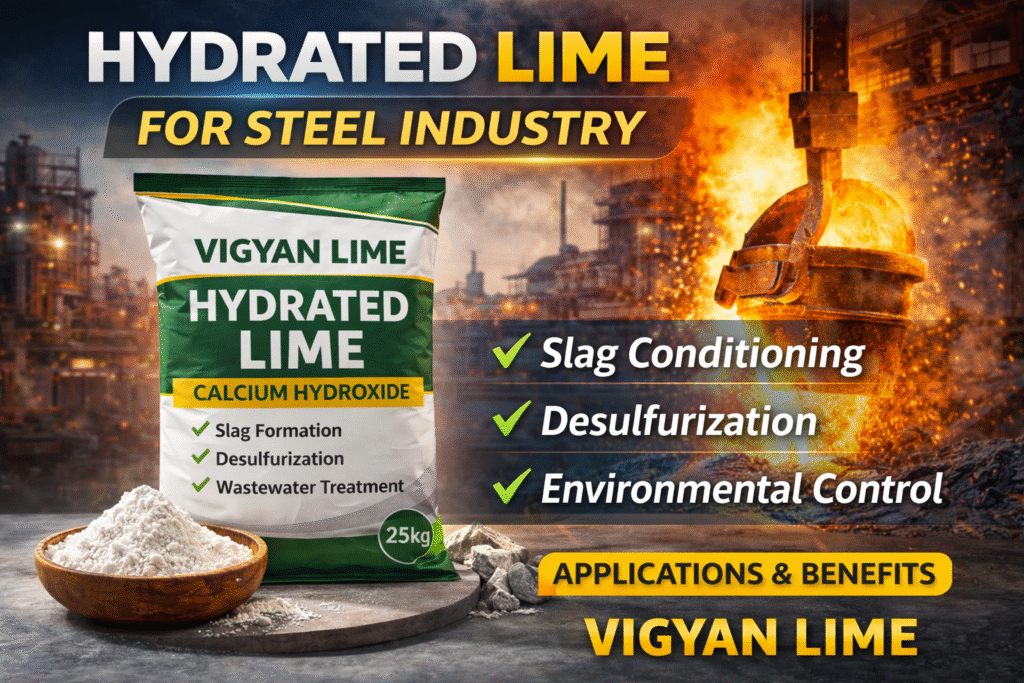
Hydrated Lime for Steel Industry – Applications & Benefits (2026)

Hydrated Lime for Steel Industry plays a crucial role in improving steel quality, controlling impurities, and ensuring smooth metallurgical operations. In modern steel plants, calcium-based materials are essential for refining, slag conditioning, gas treatment, and wastewater neutralization. Hydrated Lime, also known as Calcium Hydroxide (Ca(OH)₂), is widely used in integrated steel plants, mini steel plants, induction furnaces, and secondary metallurgy units. India is one of the largest steel producers in the world, and consistent supply of high-purity hydrated lime is critical for maintaining production efficiency and meeting environmental compliance standards. What is Hydrated Lime? Hydrated Lime is produced by adding water to Quick Lime (Calcium Oxide). Chemical Reaction:CaO + H₂O → Ca(OH)₂ It is a fine white alkaline powder with strong reactivity. Due to its high alkalinity and chemical stability, it is suitable for metallurgical and environmental applications in steel plants. Why Hydrated Lime is Important in the Steel Industry Steel production involves high-temperature processes that generate impurities such as: Sulfur Phosphorus Silica Heavy metals Acidic gases Hydrated lime helps in controlling these impurities and improving overall steel quality. Major Applications of Hydrated Lime in Steel Industry 1. Slag Formation and Conditioning During steelmaking, slag plays an important role in removing impurities from molten metal. Hydrated lime contributes to: Formation of basic slag Removal of silica and phosphorus Improved slag fluidity Better impurity separation Proper slag chemistry improves steel purity and reduces defects. 2. Desulfurization Process Sulfur negatively affects steel strength and weldability. Hydrated lime is used in desulfurization to: React with sulfur compounds Reduce sulfur content in molten iron Improve final steel quality Lower sulfur levels enhance mechanical properties. 3. pH Control in Steel Plant Wastewater Steel plants generate acidic wastewater containing: Iron particles Heavy metals Chemical residues Hydrated lime neutralizes acidic water and raises pH levels, making wastewater safe for treatment and discharge. 4. Flue Gas Treatment Steel furnaces emit gases such as: Sulfur dioxide Acidic fumes Hydrated lime is used in gas treatment systems to neutralize harmful emissions and meet pollution control standards. 5. Effluent Treatment Plants (ETP) In steel industry ETP systems, hydrated lime is used for: Heavy metal precipitation Sludge conditioning Chemical neutralization It ensures compliance with environmental regulations. 6. Sinter Plant Operations In sinter plants, lime helps improve agglomeration properties and supports better blast furnace performance. Benefits of Using Hydrated Lime in Steel Manufacturing Improved Steel Quality Removes impurities such as sulfur and phosphorus, leading to stronger and more durable steel. Enhanced Slag Efficiency Helps in forming stable and reactive slag for better impurity removal. Environmental Compliance Supports pollution control by neutralizing acidic gases and wastewater. Cost Efficiency Compared to other alkaline chemicals, hydrated lime is economical and widely available. Operational Stability Improves process control and consistency in steel plants. Technical Properties Required for Steel Industry Grade Hydrated Lime Steel plants require high-quality hydrated lime with: High Ca(OH)₂ purity Low silica content Fine particle size High reactivity Low moisture content Consistent chemical composition ensures predictable metallurgical performance. Hydrated Lime vs Quick Lime in Steel Industry Quick Lime (CaO) is mainly used in primary steelmaking for slag formation.Hydrated Lime (Ca(OH)₂) is more commonly used for: Environmental applications Gas treatment Wastewater treatment Secondary processes Both materials play important but different roles. Environmental and Sustainability Benefits Hydrated lime supports sustainable steel production by: Reducing harmful emissions Neutralizing acidic waste Lowering environmental impact Supporting regulatory compliance It plays a vital role in green steel initiatives. Challenges Without Proper Lime Quality Using low-quality hydrated lime may result in: Poor slag formation Incomplete desulfurization Higher chemical consumption Increased operational cost Equipment scaling issues Therefore, selecting a reliable manufacturer is critical. Why Choose Vigyan Lime for Steel Industry Supply? Vigyan Lime manufactures high-purity hydrated lime suitable for steel industry applications. With advanced production processes and strict quality control, Vigyan Lime ensures: Consistent Ca(OH)₂ purity Reliable supply chain Bulk delivery capability Technical support Manufacturing Units Jodhpur & Nagaur (Rajasthan)Udaipur (Rajasthan)Haldwani (Uttarakhand)Sataun (Himachal Pradesh) These strategically located facilities ensure efficient supply across North, West, and Central India. Industries Served Integrated steel plants Secondary steel units Rolling mills Sinter plants Induction furnace units Infrastructure steel producers Packaging Options 25 kg bags50 kg bagsBulk supplyCustomized packaging Storage and Handling Store in dry conditions Avoid moisture exposure Ensure dust control measures Follow industrial safety protocols Frequently Asked Questions What is the role of hydrated lime in steel production?It helps in impurity removal, slag conditioning, and wastewater neutralization. Is hydrated lime used in desulfurization?Yes, it reduces sulfur content in molten iron and steel. Why is purity important in steel industry lime?High purity ensures efficient reactions and better steel quality. Can hydrated lime help in pollution control?Yes, it neutralizes acidic gases and wastewater. Hydrated Lime for Steel Industry is a critical material that supports metallurgical efficiency, impurity removal, environmental compliance, and cost control. From slag conditioning to wastewater treatment, hydrated lime enhances steel quality and plant performance. Selecting high-purity material from a trusted manufacturer ensures consistent and reliable results. Vigyan Lime supplies premium-grade hydrated lime suitable for steel plants across India. For bulk orders and technical specifications, contact: Head OfficeG-37, Race CourseDehradun, Uttarakhand 248001 Email: info@vigyanlime.com Phone:+91-95685-01110+91-95688-01110+91-98370-55678

Hydrated Lime for Water Treatment – Complete Industrial Guide (2026)
hydrated-lime

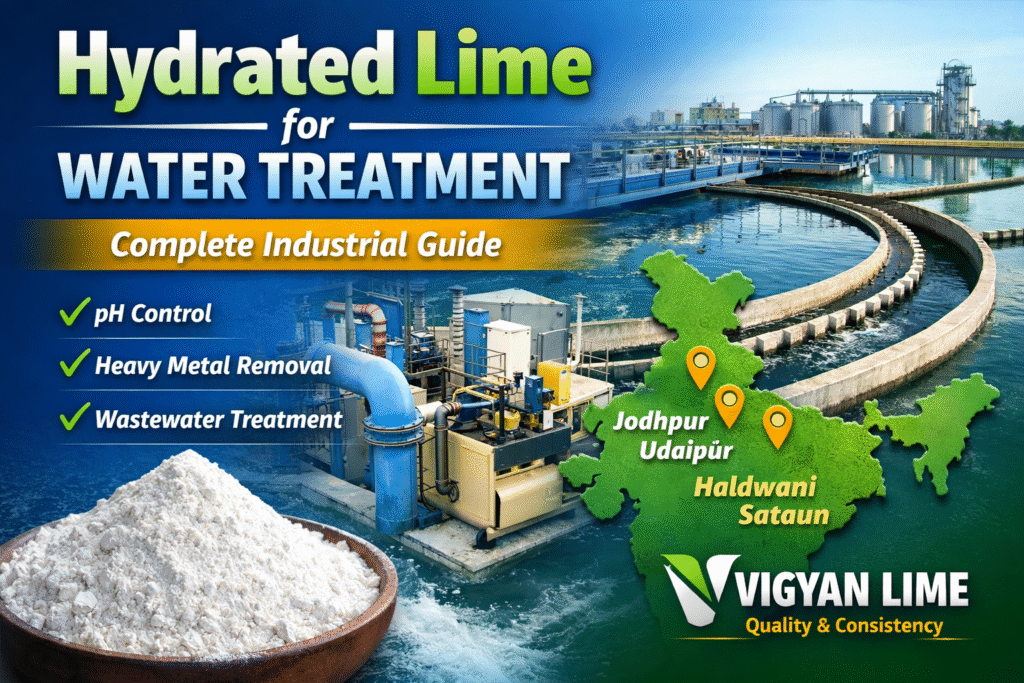
Hydrated Lime for Water Treatment – Complete Industrial Guide (2026)

Why Hydrated Lime is Essential for Water Treatment Hydrated Lime for water treatment plays a critical role in maintaining safe and clean water across municipal plants, industrial facilities, and wastewater treatment systems. Also known as Calcium Hydroxide (Ca(OH)₂), hydrated lime is one of the most widely used chemicals for pH adjustment, heavy metal removal, softening, and sludge stabilization. In India and globally, water pollution and industrial discharge are increasing. To control contamination and ensure regulatory compliance, industries rely on high-quality hydrated lime. If you are searching for a reliable Hydrated Lime manufacturer in India, Vigyan Lime offers premium-grade material suitable for municipal water treatment plants, ETPs, STPs, and industrial purification systems. What is Hydrated Lime? Hydrated Lime, also called Slaked Lime, is produced by reacting Quick Lime (Calcium Oxide) with water. Chemical Reaction: CaO + H₂O → Ca(OH)₂ The result is a fine white powder known as Calcium Hydroxide. Key Properties: Chemical Formula: Ca(OH)₂ Appearance: Fine white powder Solubility: Slightly soluble in water Alkalinity: Strong alkaline compound pH Value: Around 12.4 (in saturated solution) These alkaline properties make hydrated lime ideal for water treatment applications. Why Hydrated Lime is Used in Water Treatment Water treatment requires chemicals that: Adjust pH levels Remove heavy metals Neutralize acidic waste Reduce turbidity Improve water clarity Control odors Hydrated lime performs all these functions effectively and economically. Major Applications of Hydrated Lime in Water Treatment 1. pH Adjustment Industrial wastewater is often acidic. Hydrated lime increases the pH level, neutralizing acidic effluents before discharge. Maintaining proper pH: Protects pipelines Prevents corrosion Ensures environmental compliance Improves chemical reactions 2. Heavy Metal Removal Heavy metals such as: Lead Zinc Chromium Nickel Cadmium are harmful to the environment. Hydrated lime reacts with dissolved metals, forming insoluble metal hydroxides that settle out as sludge. This process allows easy removal during sedimentation. 3. Water Softening Hard water contains calcium and magnesium ions. Hydrated lime helps remove hardness by precipitating these ions. Benefits: Reduces scaling Protects boilers Improves industrial efficiency Enhances soap performance 4. Sludge Stabilization In wastewater plants, sludge treatment is essential. Hydrated lime: Reduces pathogens Controls odor Improves dewatering Stabilizes biosolids 5. Fluoride and Phosphate Removal Hydrated lime helps in removing excess fluoride and phosphates from water, making it safe for consumption. Hydrated Lime in Different Water Treatment Systems Municipal Water Treatment Plants Cities use hydrated lime for: Clarification Coagulation support pH balancing Drinking water safety Industrial Effluent Treatment Plants (ETP) Industries like: Textile Paper Steel Sugar Chemical plants use hydrated lime to treat effluents before discharge. Sewage Treatment Plants (STP) Used for: Sludge conditioning Odor control Pathogen reduction Advantages of Using High Purity Hydrated Lime Choosing high-quality hydrated lime ensures: ✔ Faster reaction time✔ Lower consumption✔ Better settling properties✔ Reduced sludge volume✔ Cost efficiency Low-quality lime may cause: Incomplete reaction Higher dosing requirement Operational issues Hydrated Lime Dosing Methods Dry Powder Feeding Lime Slurry Preparation Automated Dosing Systems For large plants, slurry systems are more efficient and controlled. Storage and Handling Guidelines Store in dry conditions Avoid moisture exposure Use protective gear Maintain sealed packaging Prevent contamination Quality Parameters for Water Treatment Grade Hydrated Lime When purchasing hydrated lime, check: Available Ca(OH)₂ percentage Reactivity Particle size (mesh) Insoluble matter Moisture content High reactivity ensures efficient treatment with lower dosage. Environmental Compliance and Hydrated Lime Hydrated lime helps industries comply with: Pollution Control Board norms Environmental discharge standards Industrial wastewater regulations Its ability to neutralize harmful effluents makes it environmentally safe when used properly. Cost Efficiency of Hydrated Lime Compared to other alkaline chemicals, hydrated lime: Is economical Has wide availability Requires lower operational cost Offers stable performance This makes it the preferred chemical for large-scale water treatment. Why Choose Vigyan Lime for Hydrated Lime Supply? Vigyan Lime is a trusted manufacturer of high purity hydrated lime in India. Manufacturing Units Jodhpur & Nagaur (Rajasthan) Udaipur (Rajasthan) Haldwani (Uttarakhand) Sataun (Himachal Pradesh) With multiple production facilities, Vigyan Lime ensures: ✔ Consistent supply✔ High purity standards✔ Advanced manufacturing process✔ Bulk and customized packaging✔ Timely delivery across India Industries Served by Vigyan Lime Municipal Corporations Industrial ETP Plants Textile Industries Sugar Mills Chemical Industries Steel Plants Infrastructure Projects Packaging Options Available 25 kg bags 50 kg bags Jumbo bags Bulk supply How to Order Hydrated Lime for Water Treatment To place bulk orders or request technical specifications, contact: Contact Us Head Office:G-37, Race CourseDehradun, Uttarakhand – 248001 Email: info@vigyanlime.com, vigyanlime@gmail.com, vigyanlime@yahoo.com Phone:+91-95685-01110, +91-95688-01110, +91-98370-55678 Frequently Asked Questions (FAQ) Q1: What is the main use of hydrated lime in water treatment? It is used for pH adjustment, heavy metal removal, and water softening. Q2: Is hydrated lime safe for drinking water treatment? Yes, when used in controlled dosage under regulatory guidelines. Q3: What is the ideal purity level for water treatment grade hydrated lime? High Ca(OH)₂ content with low impurities ensures best performance. Q4: Can hydrated lime remove heavy metals? Yes, it precipitates heavy metals as insoluble hydroxides. Hydrated Lime for Water Treatment is an essential chemical for municipal and industrial purification systems. From pH control to heavy metal removal, it plays a vital role in ensuring environmental safety and regulatory compliance. Choosing a reliable manufacturer like Vigyan Lime ensures high purity, consistent supply, and efficient water treatment performance. If you are looking for bulk supply of premium Hydrated Lime in India, contact Vigyan Lime today.

Uncategorized

Slaked Lime – Ip Grade: 7 Powerful Benefits, Uses & Quality Standards You Must Know

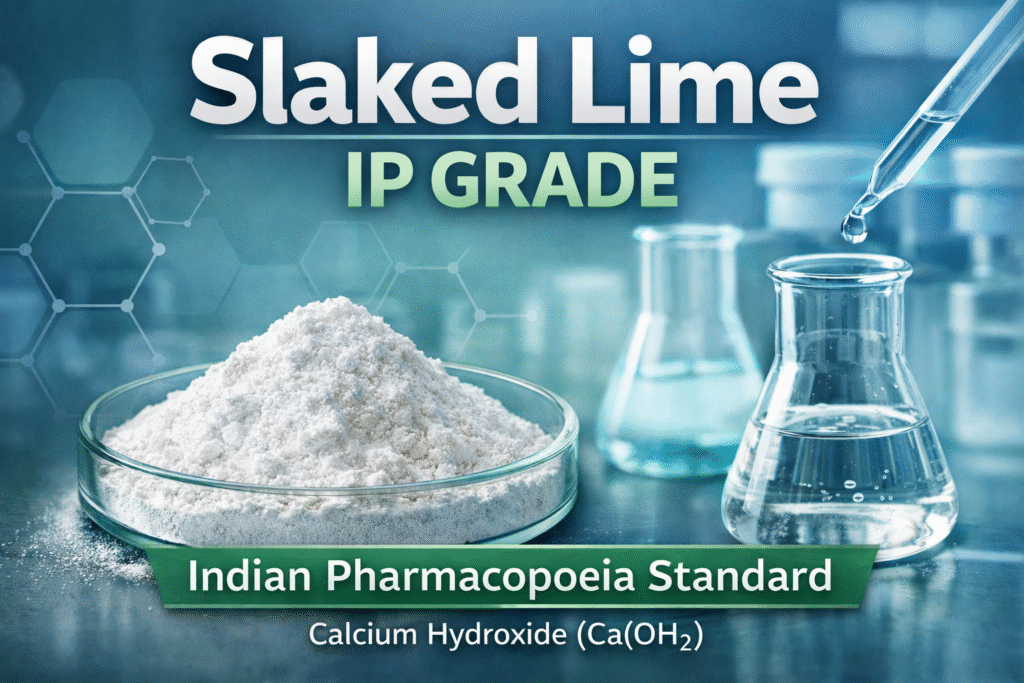
Introduction to Slaked Lime – Ip Grade Slaked Lime – Ip Grade is a highly purified form of calcium hydroxide used in pharmaceutical, food, and specialized industrial applications. Because it meets strict quality standards under the Indian Pharmacopoeia (IP), it is considered safe for medical and regulated uses. If you’re searching for Slaked Lime – Ip Grade for business, manufacturing, or supply purposes, understanding its properties, benefits, and standards is essential. Let’s break it down in simple terms. What is Slaked Lime? Slaked lime is chemically known as calcium hydroxide (Ca(OH)₂). It is produced when quicklime (calcium oxide) reacts with water in a controlled process. Chemical Composition and Formula Chemical Name: Calcium Hydroxide Chemical Formula: Ca(OH)₂ Molecular Weight: 74.09 g/mol Appearance: White powder Odor: Odorless Solubility: Slightly soluble in water When mixed with water, it forms limewater — a mild alkaline solution. Manufacturing Process The process is simple but must be carefully controlled: Limestone (CaCO₃) is heated to produce quicklime (CaO). Quicklime reacts with water. This reaction forms calcium hydroxide. The material is then purified and tested for IP compliance. For IP Grade material, the purification and testing stages are extremely strict. Understanding IP Grade Standards What Does IP Stand For? IP stands for Indian Pharmacopoeia, which sets quality standards for medicines and pharmaceutical ingredients in India. You can learn more about pharmacopoeial standards at the official Indian Pharmacopoeia Commission website:👉 https://ipc.gov.in Pharmaceutical Quality Parameters Slaked Lime – Ip Grade must meet strict laboratory standards. Purity Requirements High calcium hydroxide content Low insoluble matter Controlled moisture levels Heavy Metal Limits IP Grade ensures: Minimal heavy metals Absence of harmful contaminants Controlled arsenic levels This makes it suitable for medicinal and food applications. Key Properties of Slaked Lime – Ip Grade Physical Properties Fine white powder Smooth texture Slightly alkaline taste Stable under dry storage Chemical Characteristics Strong alkaline nature Reacts with acids Absorbs carbon dioxide from air Forms calcium carbonate over time Because of these properties, Slaked Lime – Ip Grade must be stored carefully. Industrial and Pharmaceutical Uses Use in Medicine Slaked Lime – Ip Grade is widely used in: Antacid formulations Dental products Calcium supplements Topical medicinal preparations Its high purity ensures it is safe for pharmaceutical formulations. Use in Food Industry In regulated quantities, it is used for: Pickling processes Food preservation pH regulation Sugar refining However, only IP or food-grade lime should be used. Use in Chemical Processing It is also applied in: Water treatment Neutralization processes Effluent treatment plants Chemical manufacturing Benefits of Using Slaked Lime – Ip Grade Here are 7 powerful advantages: High purity and consistent quality Safe for pharmaceutical use Low contamination levels Stable chemical composition Reliable performance in formulations Meets government standards Suitable for export markets Because it meets IP standards, buyers trust its quality. Storage and Handling Guidelines Proper storage is essential: Keep in airtight containers Store in dry, cool place Avoid exposure to air and moisture Use protective gloves and masks Exposure to carbon dioxide can reduce effectiveness. Safety and Precautions Even though Slaked Lime – Ip Grade is purified, it is alkaline and must be handled carefully. Precautions include: Avoid inhalation Prevent skin contact Use safety goggles Wash hands after handling If exposed, rinse with water immediately. Slaked Lime – Ip Grade vs Industrial Grade Feature IP Grade Industrial Grade Purity High Moderate Heavy Metals Strictly Controlled May Vary Pharmaceutical Use Yes No Testing Mandatory Limited IP Grade is suitable for sensitive applications, while industrial grade is used mainly for construction and water treatment. Packaging and Supply Options Slaked Lime – Ip Grade is available in: 25 kg HDPE bags 50 kg moisture-proof bags Custom bulk packaging Laboratory packs Proper labeling and batch testing reports should be provided by suppliers. Market Demand and Pricing Factors Pricing depends on: Purity level Packaging type Bulk quantity Transportation cost Compliance certification Pharmaceutical demand increases pricing compared to industrial grade. How to Choose a Reliable Supplier Look for: IP certification Batch testing reports GMP compliance Export documentation Transparent pricing Always request a Certificate of Analysis (COA). Frequently Asked Questions (FAQs) 1. What is Slaked Lime – Ip Grade used for? It is used in pharmaceuticals, food processing, and chemical industries where high purity is required. 2. Is Slaked Lime – Ip Grade safe for consumption? Only when used in approved pharmaceutical or food applications under regulated conditions. 3. What is the difference between IP Grade and normal lime? IP Grade meets strict purity and contamination standards. 4. How should Slaked Lime – Ip Grade be stored? Store in airtight containers away from moisture and air. 5. Can it be used in water treatment? Yes, but industrial grade is more commonly used for that purpose. 6. Does Slaked Lime – Ip Grade expire? It does not expire quickly but may lose effectiveness if exposed to air and carbon dioxide. Slaked Lime – Ip Grade is a highly refined and quality-controlled form of calcium hydroxide used in pharmaceutical, food, and specialized industrial sectors. Because it meets Indian Pharmacopoeia standards, it ensures safety, purity, and reliability. If you are a manufacturer, distributor, or exporter, choosing certified Slaked Lime – Ip Grade can improve product quality, compliance, and market reputation. Always buy from verified suppliers and ensure proper storage to maintain effectiveness.

hydrated-lime

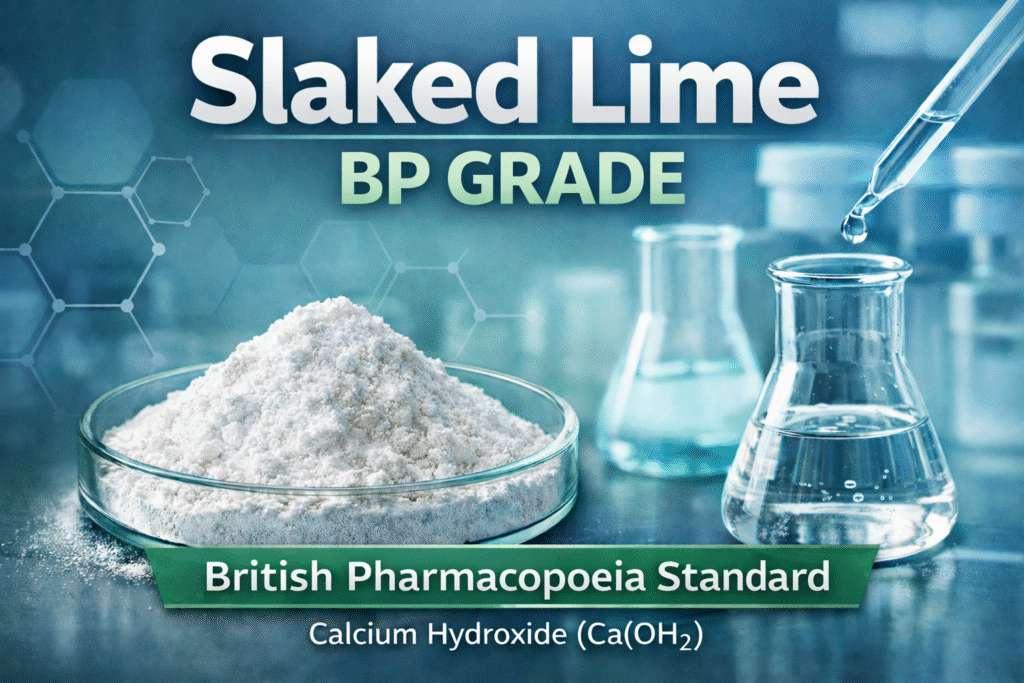
Slaked Lime BP Grade | Calcium Hydroxide BP Standard

Home About Us Applications Why Choose Us Sustainable Home About Us Applications Why Choose Us Sustainable Slaked Lime BP Grade | Calcium Hydroxide BP Standard In the pharmaceutical world, trust is built on standards. When a raw material complies with the British Pharmacopoeia (BP), it means it has passed strict quality benchmarks recognized internationally. Slaked Lime – BP Grade, also known as Calcium Hydroxide BP, is a highly purified form of hydrated lime manufactured and tested according to British Pharmacopoeia specifications. It is widely used in pharmaceutical, dental, and regulated chemical applications where precision, safety, and compliance are essential. This is not ordinary lime — it is a carefully processed pharmaceutical-grade ingredient designed for industries where quality cannot be compromised. What is Slaked Lime – BP Grade? Slaked Lime is chemically known as Calcium Hydroxide (Ca(OH)₂). It is produced by adding water to quicklime under controlled conditions: CaO + H₂O → Ca(OH)₂ When manufactured as BP Grade, it must meet defined parameters for: Assay (purity level) Heavy metal limits Insoluble matter Chlorides and sulfates Loss on drying Controlled alkalinity Each batch is tested and documented to ensure compliance with British Pharmacopoeia standards. Why BP Grade Matters For pharmaceutical companies supplying to international markets, BP compliance provides: ✔ International credibility✔ Regulatory acceptance✔ Export suitability✔ Consistent chemical performance When exporting finished medicines to Europe or Commonwealth countries, using BP-compliant raw materials simplifies regulatory approvals and audits. Key Features of BP Grade Calcium Hydroxide High chemical purity Strict impurity control Heavy metals within defined limits Fine and uniform particle size Strong alkaline stability Batch-to-batch consistency COA (Certificate of Analysis) with BP reference Applications of Slaked Lime – BP Grade 1. Pharmaceutical Formulations Used in: Antacid preparations pH adjustment systems Medicinal chemical synthesis Controlled neutralization reactions Its alkaline nature makes it effective for acidity control and formulation stability. 3. Dental Applications BP Grade Calcium Hydroxide plays a critical role in: Root canal treatments Pulp capping procedures Dental cement formulations Cavity lining materials Its high pH creates an antibacterial environment, helping protect dental pulp. 3. Regulated Chemical & Laboratory Use Because of its defined purity, BP Grade Slaked Lime is suitable for: Analytical laboratory testing Pharmaceutical R&D Controlled manufacturing environments Technical Specifications (Typical) Chemical Name: Calcium Hydroxide Formula: Ca(OH)₂ Molecular Weight: 74.09 g/mol Standard: British Pharmacopoeia (BP) Appearance: Fine white powder Solubility: Slightly soluble in water pH (Saturated Solution): ~12.4 Manufacturing Process of BP Grade Slaked Lime Producing BP Grade material requires precision at every step: Selection of high-purity limestone Controlled calcination to produce high-quality quicklime Precision hydration process Micronization for uniform particle size Multi-stage laboratory testing Moisture-proof hygienic packaging Every batch is validated before release. Difference Between Industrial & BP Grade Lime Parameter Industrial Grade BP Grade Purity Moderate High (BP Standard) Heavy Metal Control Basic Strict Documentation Limited Full COA Application Construction, Water Pharmaceutical Choosing the correct grade protects your product quality and brand reputation. Packaging & Supply 25 kg HDPE bags with inner liner Export-compliant packaging Bulk supply options Customized packing on request Proper storage ensures long shelf life and stability. Why Quality Really Matters In pharmaceutical manufacturing, a single impurity can affect: Drug stability Patient safety Regulatory approval Brand credibility Behind every pharmaceutical product is a chain of responsible sourcing. Choosing BP Grade Slaked Lime means choosing reliability, precision, and long-term compliance. Frequently Asked Questions What does BP Grade mean? BP Grade means the product meets the quality standards defined in the British Pharmacopoeia. Is BP Grade suitable for export? Yes, BP compliance is widely accepted in international pharmaceutical markets. Do you provide documentation? Yes, BP Grade material is supplied with Certificate of Analysis (COA). Factory Addresses Jodhpur & Nagour (Rajasthan) Udaipur (Rajasthan) Haldwani (Uttarakhand) Sataun (Himachal Pradesh) Contact Numbers General & Orders: +91 95685-01110 Accounts & GST: +91 90685-01110 Quality Related: +91 95686-01110 Billing & Dispatch: +91 90689-01110 Sales & Exports: +91 95688-01110 Email info@vigyanlime.com vigyanlime@yahoo.com vigyanlime@gmail.com

hydrated-lime

Slaked Lime IP Grade | Calcium Hydroxide IP Standard

Home About Us Applications Why Choose Us Sustainable Home About Us Applications Why Choose Us Sustainable Slaked Lime IP Grade | Calcium Hydroxide IP Standard In the pharmaceutical industry, compliance with pharmacopoeial standards is essential. Every raw material must meet defined specifications to ensure safety, purity, and consistency. Slaked Lime – IP Grade, also known as Calcium Hydroxide IP, is manufactured and tested according to the standards defined in the Indian Pharmacopoeia (IP). It is specially processed for use in pharmaceutical formulations, dental applications, and regulated industries where strict quality control is mandatory. IP Grade Slaked Lime is not just hydrated lime — it is a precision-tested pharmaceutical ingredient. What is Slaked Lime – IP Grade? Slaked Lime is chemically known as Calcium Hydroxide (Ca(OH)₂). It is produced by controlled hydration of quicklime (calcium oxide): CaO + H₂O → Ca(OH)₂ When manufactured as IP Grade, the product is: Tested as per Indian Pharmacopoeia specifications Controlled for heavy metals Checked for acid insoluble matter Verified for assay purity Monitored for loss on drying Supplied with Certificate of Analysis (COA) Key Features of IP Grade Calcium Hydroxide High chemical purity Low impurities Strict heavy metal limits Fine particle size Stable alkaline properties Batch-to-batch consistency Regulatory documentation support These properties make it suitable for sensitive pharmaceutical applications. Applications of Slaked Lime – IP Grade   1. Pharmaceutical Formulations Used in: Antacid preparations pH adjustment in medicinal formulations Chemical intermediates Topical pharmaceutical solutions Its alkaline nature helps neutralize acidity and maintain product stability. 2. Dental Applications IP Grade Calcium Hydroxide is widely used in: Root canal treatments Pulp capping Dental liners Cavity filling materials Its high pH provides antibacterial properties, helping in infection control. 3. Laboratory & Research Use Chemical reagent applications Controlled experiments Analytical testing Because of its defined purity, it ensures predictable results. Why IP Grade Matters In pharmaceutical manufacturing, even small deviations can cause: Product rejection Regulatory non-compliance Safety risks Financial losses Using IP Grade Slaked Lime ensures: ✔ Compliance with Indian regulations✔ Standardized chemical properties✔ Safety assurance✔ Reliable documentation Technical Specifications (Typical) Chemical Name: Calcium Hydroxide Formula: Ca(OH)₂ Molecular Weight: 74.09 g/mol Appearance: Fine white powder Standard: Indian Pharmacopoeia (IP) Solubility: Slightly soluble in water pH (Saturated Solution): ~12.4 Manufacturing Process of IP Grade Slaked Lime Selection of high-purity limestone Controlled calcination to produce quicklime Precision hydration process Advanced micronization Multi-stage quality testing Sealed hygienic packaging Every batch undergoes strict laboratory verification before dispatch. Packaging & Supply Options 25 kg HDPE bags with inner liner Bulk packaging options Export-compliant packaging Custom packaging on request Proper moisture protection ensures long shelf life. Difference Between Industrial & IP Grade Lime Parameter Industrial Grade IP Grade Purity Moderate High (As per IP) Heavy Metals Not tightly controlled Strictly controlled Documentation Basic COA with IP compliance Application Construction & Water Pharmaceutical Choosing the correct grade prevents compliance issues. Why Choose a Reliable Manufacturer? A reliable IP Grade supplier ensures: Pharmacopeial compliance Batch traceability Laboratory-tested quality Consistent supply Regulatory support For pharmaceutical buyers, quality assurance is more important than price. Frequently Asked Questions What does IP Grade mean? IP Grade means the product meets standards defined in the Indian Pharmacopoeia. Is IP Grade suitable for pharmaceutical use? Yes, it is specifically manufactured for pharmaceutical applications. Can IP Grade be exported? Yes, subject to regulatory requirements of the importing country. Slaked Lime – IP Grade is a highly purified form of calcium hydroxide manufactured under strict pharmaceutical standards. It ensures safety, compliance, and consistency for regulated applications. If you are sourcing raw materials for pharmaceutical or dental use, always choose IP Grade Slaked Lime from a trusted manufacturer to ensure quality and regulatory peace of mind. Factory Addresses Jodhpur & Nagour (Rajasthan) Udaipur (Rajasthan) Haldwani (Uttarakhand) Sataun (Himachal Pradesh) Contact Numbers General & Orders: +91 95685-01110 Accounts & GST: +91 90685-01110 Quality Related: +91 95686-01110 Billing & Dispatch: +91 90689-01110 Sales & Exports: +91 95688-01110 Email info@vigyanlime.com vigyanlime@yahoo.com vigyanlime@gmail.com

hydrated-lime

Slaked Lime Pharma Grade | Calcium Hydroxide IP BP USP

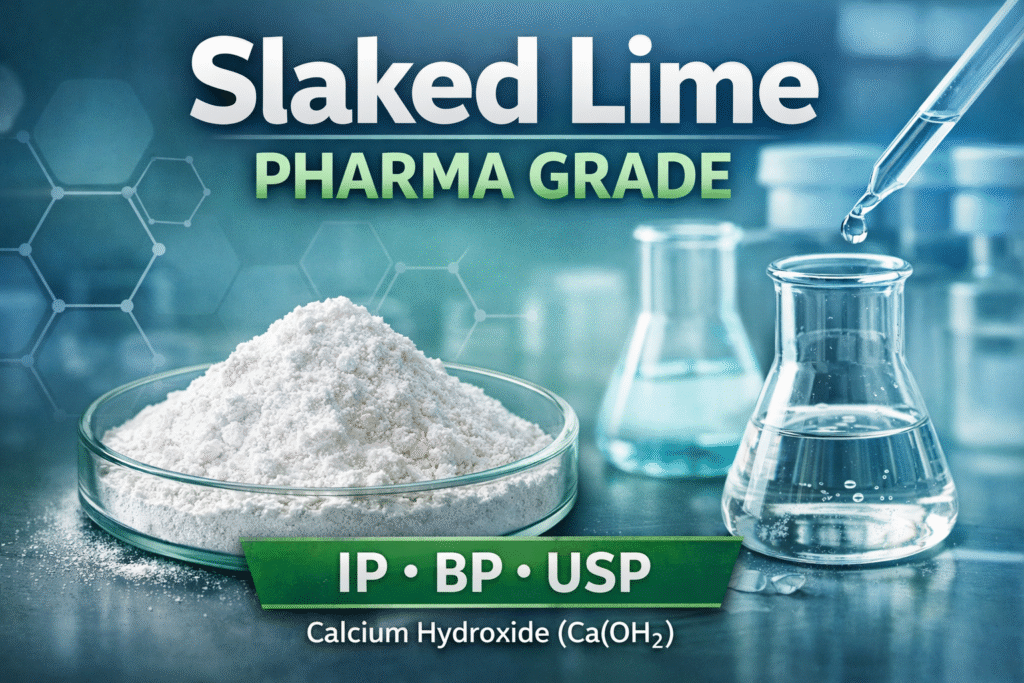
Home About Us Applications Why Choose Us Sustainable Home About Us Applications Why Choose Us Sustainable Slaked Lime – Pharma Grade (Calcium Hydroxide IP / BP / USP) In the pharmaceutical industry, purity is not optional — it is mandatory. Every ingredient must meet strict standards for safety, consistency, and regulatory compliance. Slaked Lime – Pharma Grade, also known as Pharmaceutical Grade Calcium Hydroxide (Ca(OH)₂), is a highly purified alkaline compound manufactured under controlled conditions and tested as per IP, BP, and USP standards. Since 1948, Vigyan Lime has been a trusted manufacturer of high-purity lime and industrial minerals, supplying regulated industries across India and overseas markets. What is Slaked Lime – Pharma Grade? Slaked lime is produced by hydrating quicklime (Calcium Oxide) with controlled water addition: CaO + H₂O → Ca(OH)₂ Pharma grade calcium hydroxide differs from industrial grade due to: High assay purity Strict heavy metal control Low insoluble impurities Microbiological safety Controlled particle size Full documentation & traceability This ensures suitability for pharmaceutical and regulated applications. Why Pharma Grade Quality is Critical In pharmaceutical manufacturing: Even minor impurities can affect product stability Heavy metals must remain within strict limits Batch consistency is essential Compliance documentation is mandatory Pharma Grade Slaked Lime undergoes: Assay testing Loss on drying test Acid insoluble matter test Heavy metal analysis Microbial testing COA verification before dispatch Applications of Pharma Grade Slaked Lime 1. Pharmaceutical Formulations Used in: Antacid preparations pH adjustment in formulations Chemical intermediate manufacturing Topical solutions Its strong alkaline nature helps maintain controlled pH environments. 2. Dental Applications Calcium hydroxide is widely used in: Root canal treatment Pulp capping Dental cement Cavity lining Its antibacterial properties help protect tooth pulp and prevent infection. 3. Regulated Food & Processing Applications Where permitted by regulatory standards, pharma grade lime may be used in: Sugar refining Pickling processes Corn processing (nixtamalization) Food-grade processing environments For more insight into food-grade calcium compounds, you may also read: Calcium Carbonate FCC Grade – Benefits, Uses & Standards Calcium Carbonate FCC Grade – Complete Food Grade Guide (Internal linking recommended for SEO strength.) Difference Between Industrial & Pharma Grade Lime Parameter Industrial Grade Pharma Grade Purity Moderate Very High Heavy Metals Variable Strictly Controlled Microbial Safety Not mandatory Mandatory Documentation Basic Detailed COA Application Construction, water treatment Pharma & regulated use Using the correct grade ensures regulatory approval and product safety. Manufacturing Process at Vigyan Lime At Vigyan Lime, pharma grade slaked lime is manufactured using: Selection of high-purity limestone Controlled calcination process Precision hydration Advanced micronization Multi-stage sieving Laboratory testing Hygienic moisture-proof packaging Each batch is validated before dispatch. Technical Specifications (Typical) Chemical Formula: Ca(OH)₂ Molecular Weight: 74.09 g/mol Appearance: Fine white powder Purity: As per IP / BP / USP pH (Saturated Solution): ~12.4 Packaging: 25 kg HDPE bags with liner Industries Served Vigyan Lime supplies to critical industries including: Pharma Food Processing Construction Agriculture Water Treatment About Vigyan Lime Since 1948, Vigyan Lime has been a trusted manufacturer of high-purity lime and industrial minerals, serving critical industries across India and overseas. Products Hydrated Lime Quick Lime Calcium Carbonate Dolomite Powder Kaolin Powder China Clay Talcum Powder Manufacturing Units Jodhpur & Nagaur (Rajasthan) Udaipur (Rajasthan) Haldwani (Uttarakhand) Sataun (Himachal Pradesh) Why Choose Vigyan Lime? ✔ 75+ Years of Industry Experience✔ Multi-Location Manufacturing✔ Consistent Quality Control✔ Regulatory Compliance Support✔ Bulk & Export Supply✔ Strong Industry Reputation We understand that pharma clients require precision, documentation, and reliability — and we deliver exactly that. Frequently Asked Questions Is pharma grade slaked lime safe? Yes, when manufactured and tested as per pharmacopeial standards. Do you provide COA? Yes, each batch is supplied with a Certificate of Analysis. Can it be exported? Yes, export documentation and bulk supply options are available. Contact Us – Vigyan Lime Head Office:G-37, Race CourseDehradun, Uttarakhand – 248001 📧 info@vigyanlime.com📞 +91-95685-01110📞 +91-95688-01110📞 +91-98370-55678 Factory Addresses Jodhpur & Nagour (Rajasthan) Udaipur (Rajasthan) Haldwani (Uttarakhand) Sataun (Himachal Pradesh) Contact Numbers General & Orders: +91 95685-01110 Accounts & GST: +91 90685-01110 Quality Related: +91 95686-01110 Billing & Dispatch: +91 90689-01110 Sales & Exports: +91 95688-01110 Email info@vigyanlime.com vigyanlime@yahoo.com vigyanlime@gmail.com