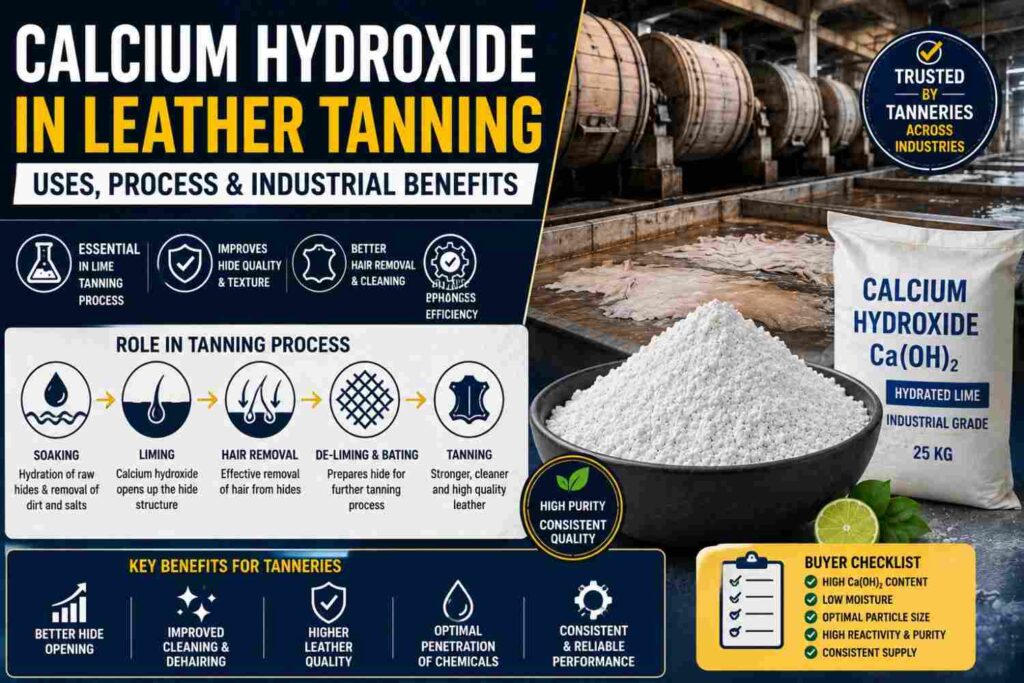
Calcium Hydroxide in Leather Tanning: Uses, Process & Benefits
Calcium Hydroxide in Leather Tanning: Uses, Process & Industrial Benefits Calcium Hydroxide in Leather Tanning plays an important role in the early processing of hides and skins, particularly during the beamhouse stages that prepare the material for subsequent tanning. Leather manufacturers do not begin with a clean, uniform collagen material. Raw hides contain hair, epidermal tissue, natural fats, interfibrillary proteins and other components that must be removed or modified before tanning chemicals can penetrate the hide structure effectively. Hydrated lime, also known as calcium hydroxide or slaked lime, has traditionally been used to create the strongly alkaline conditions required during liming. Its role is not simply to “remove hair.” In properly controlled leather processing, calcium hydroxide contributes to hide swelling, fibre opening, removal of unwanted non-collagenous material and preparation of the collagen structure for later operations. Conventional tannery systems often use lime together with sulfide-based chemicals for unhairing. The sulfide chemistry acts strongly on keratin and hair structures, while calcium hydroxide helps maintain the alkaline environment and contributes to the opening-up effect on the hide. For tannery procurement teams, this means lime quality should be evaluated not only on price or nominal calcium content but also on purity, consistency, particle characteristics, handling behaviour and suitability for the actual beamhouse process. For an overview of the wider industrial parameters used to evaluate hydrated lime, see our guide to Calcium Hydroxide Specifications. What Is Calcium Hydroxide in Leather Tanning? Calcium hydroxide, Ca(OH)₂, is an alkaline mineral material commonly known as hydrated lime or slaked lime. In leather production, it is principally associated with liming and related beamhouse operations. After hides have been soaked and rehydrated, they must be prepared so that the collagen fibre network becomes accessible for subsequent processing. Traditional lime-based beamhouse treatment helps: Establish strongly alkaline conditions Promote hide swelling Assist removal of unwanted proteins Contribute to fibre-bundle opening Support unhairing systems Prepare hides for fleshing, deliming and further processing The exact recipe varies according to hide type, leather type, tannery technology and whether the plant uses conventional hair-burn, hair-save, enzymatic or other lower-impact processing systems. Calcium hydroxide should therefore be treated as a process chemical whose performance depends on the complete tannery formulation, rather than as a stand-alone universal treatment. Why Tanneries Use Hydrated Lime A raw hide has a dense biological structure. If the fibre bundles remained in their original tightly associated condition, penetration of tanning, retanning, dyeing and fatliquoring chemicals would be more difficult. One of the objectives of liming is therefore to modify and open the structure sufficiently for downstream processing. Leather chemistry literature describes calcium hydroxide treatment as contributing to hydrolytic changes in non-structural proteins and other hide constituents while promoting opening of the collagen fibre structure. For the tannery, this can help create a more suitable substrate for later manufacturing stages. The importance of lime lies in the combination of: Alkalinity + swelling + structural opening + process support. This is why hydrated lime remains relevant even though modern tanneries may modify traditional recipes to improve environmental performance or reduce sulfide and lime consumption. For broader industrial uses beyond leather, see Slaked Lime and Calcium Hydroxide Uses. Role of Lime in the Liming Process Liming is carried out after soaking and before later beamhouse operations such as deliming and bating. The exact sequence varies between plants, but a simplified processing flow may look like: Raw Hide → Soaking → Unhairing/Liming → Fleshing → Deliming → Bating → Pickling → Tanning During liming, calcium hydroxide creates an alkaline environment that changes the physical and chemical condition of the hide. The objectives commonly include: Swelling of the hide Removal or modification of interfibrillary substances Loosening of epidermal structures Fibre-bundle opening Preparation for mechanical and chemical operations that follow Official and technical descriptions of leather processing identify lime together with sulfide as a conventional combination used during unhairing and liming. The effectiveness of this stage influences the character of the material entering later tannery operations. Hair Removal and Hide Preparation One point deserves clarification: Calcium hydroxide does not always act as the sole hair-removal chemical. In many conventional tannery processes, sodium sulfide or related sulfide chemistry performs a major part of the attack on keratin and hair structures. Hydrated lime supports the process by maintaining the strongly alkaline conditions and contributing to swelling and structural modification of the hide. Depending on the tannery process, hair may either be chemically destroyed or recovered using hair-save techniques. This distinction is increasingly important because dissolved hair and sulfide-containing effluent can create a significant wastewater-treatment burden. Modern leather-processing research has therefore developed hair-save, enzyme-assisted and even lime-free or sulfide-free technologies for certain applications. India’s CSIR-Central Leather Research Institute, for example, describes enzymatic dehairing and lime-free fibre-opening technologies as alternatives to conventional lime/sulfide processing. For a supplier, this means the correct approach is not to tell every tannery that one grade or one dosage works universally. The buyer’s actual beamhouse process should guide material selection. How Calcium Hydroxide Helps Open the Hide Structure “Opening up” is one of the most important concepts in leather liming. The collagen in a hide is arranged in a complex fibrous structure. Under alkaline liming conditions, the hide swells and the fibre bundles become more separated. This structural change improves access to the collagen network. A properly prepared hide can then interact more effectively with subsequent processing chemicals. Scientific leather literature describes liming as splitting the collagen structure at the fibril-bundle level and identifies this opening-up effect as important to the production of suitably soft leather. The objective is controlled modification. Too little treatment may leave the structure insufficiently opened. Excessive or poorly controlled alkaline treatment may damage the hide or alter the final leather characteristics. Therefore, the performance of hydrated lime cannot be separated from: Time Temperature Chemical concentration Hide type Agitation Water conditions Other beamhouse chemicals Lime Soaking and Processing Conditions Industrial lime performance depends heavily on processing conditions. Two tanneries using the same calcium hydroxide may obtain different results because their process parameters