Author name: vigyanlime@gmail.com

Calcium Hydroxide in Leather Tanning: Uses, Process & Benefits
Uncategorized

Calcium Hydroxide in Leather Tanning: Uses, Process & Benefits

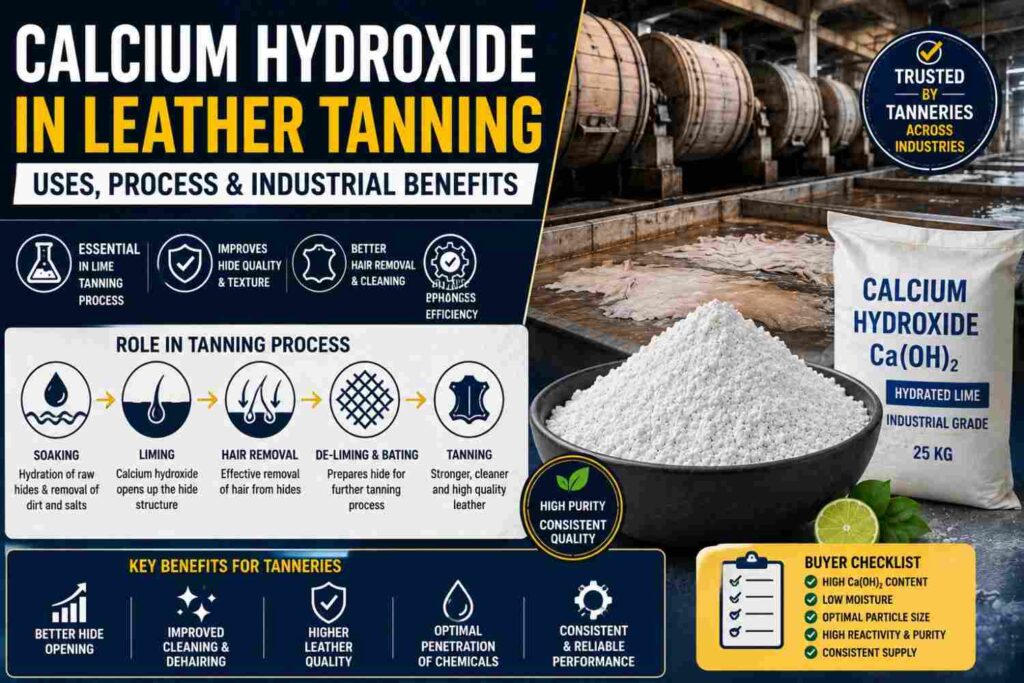
Calcium Hydroxide in Leather Tanning: Uses, Process & Industrial Benefits Calcium Hydroxide in Leather Tanning plays an important role in the early processing of hides and skins, particularly during the beamhouse stages that prepare the material for subsequent tanning. Leather manufacturers do not begin with a clean, uniform collagen material. Raw hides contain hair, epidermal tissue, natural fats, interfibrillary proteins and other components that must be removed or modified before tanning chemicals can penetrate the hide structure effectively. Hydrated lime, also known as calcium hydroxide or slaked lime, has traditionally been used to create the strongly alkaline conditions required during liming. Its role is not simply to “remove hair.” In properly controlled leather processing, calcium hydroxide contributes to hide swelling, fibre opening, removal of unwanted non-collagenous material and preparation of the collagen structure for later operations. Conventional tannery systems often use lime together with sulfide-based chemicals for unhairing. The sulfide chemistry acts strongly on keratin and hair structures, while calcium hydroxide helps maintain the alkaline environment and contributes to the opening-up effect on the hide. For tannery procurement teams, this means lime quality should be evaluated not only on price or nominal calcium content but also on purity, consistency, particle characteristics, handling behaviour and suitability for the actual beamhouse process. For an overview of the wider industrial parameters used to evaluate hydrated lime, see our guide to Calcium Hydroxide Specifications. What Is Calcium Hydroxide in Leather Tanning? Calcium hydroxide, Ca(OH)₂, is an alkaline mineral material commonly known as hydrated lime or slaked lime. In leather production, it is principally associated with liming and related beamhouse operations. After hides have been soaked and rehydrated, they must be prepared so that the collagen fibre network becomes accessible for subsequent processing. Traditional lime-based beamhouse treatment helps: Establish strongly alkaline conditions Promote hide swelling Assist removal of unwanted proteins Contribute to fibre-bundle opening Support unhairing systems Prepare hides for fleshing, deliming and further processing The exact recipe varies according to hide type, leather type, tannery technology and whether the plant uses conventional hair-burn, hair-save, enzymatic or other lower-impact processing systems. Calcium hydroxide should therefore be treated as a process chemical whose performance depends on the complete tannery formulation, rather than as a stand-alone universal treatment. Why Tanneries Use Hydrated Lime A raw hide has a dense biological structure. If the fibre bundles remained in their original tightly associated condition, penetration of tanning, retanning, dyeing and fatliquoring chemicals would be more difficult. One of the objectives of liming is therefore to modify and open the structure sufficiently for downstream processing. Leather chemistry literature describes calcium hydroxide treatment as contributing to hydrolytic changes in non-structural proteins and other hide constituents while promoting opening of the collagen fibre structure. For the tannery, this can help create a more suitable substrate for later manufacturing stages. The importance of lime lies in the combination of: Alkalinity + swelling + structural opening + process support. This is why hydrated lime remains relevant even though modern tanneries may modify traditional recipes to improve environmental performance or reduce sulfide and lime consumption. For broader industrial uses beyond leather, see Slaked Lime and Calcium Hydroxide Uses. Role of Lime in the Liming Process Liming is carried out after soaking and before later beamhouse operations such as deliming and bating. The exact sequence varies between plants, but a simplified processing flow may look like: Raw Hide → Soaking → Unhairing/Liming → Fleshing → Deliming → Bating → Pickling → Tanning During liming, calcium hydroxide creates an alkaline environment that changes the physical and chemical condition of the hide. The objectives commonly include: Swelling of the hide Removal or modification of interfibrillary substances Loosening of epidermal structures Fibre-bundle opening Preparation for mechanical and chemical operations that follow Official and technical descriptions of leather processing identify lime together with sulfide as a conventional combination used during unhairing and liming. The effectiveness of this stage influences the character of the material entering later tannery operations. Hair Removal and Hide Preparation One point deserves clarification: Calcium hydroxide does not always act as the sole hair-removal chemical. In many conventional tannery processes, sodium sulfide or related sulfide chemistry performs a major part of the attack on keratin and hair structures. Hydrated lime supports the process by maintaining the strongly alkaline conditions and contributing to swelling and structural modification of the hide. Depending on the tannery process, hair may either be chemically destroyed or recovered using hair-save techniques. This distinction is increasingly important because dissolved hair and sulfide-containing effluent can create a significant wastewater-treatment burden. Modern leather-processing research has therefore developed hair-save, enzyme-assisted and even lime-free or sulfide-free technologies for certain applications. India’s CSIR-Central Leather Research Institute, for example, describes enzymatic dehairing and lime-free fibre-opening technologies as alternatives to conventional lime/sulfide processing. For a supplier, this means the correct approach is not to tell every tannery that one grade or one dosage works universally. The buyer’s actual beamhouse process should guide material selection. How Calcium Hydroxide Helps Open the Hide Structure “Opening up” is one of the most important concepts in leather liming. The collagen in a hide is arranged in a complex fibrous structure. Under alkaline liming conditions, the hide swells and the fibre bundles become more separated. This structural change improves access to the collagen network. A properly prepared hide can then interact more effectively with subsequent processing chemicals. Scientific leather literature describes liming as splitting the collagen structure at the fibril-bundle level and identifies this opening-up effect as important to the production of suitably soft leather. The objective is controlled modification. Too little treatment may leave the structure insufficiently opened. Excessive or poorly controlled alkaline treatment may damage the hide or alter the final leather characteristics. Therefore, the performance of hydrated lime cannot be separated from: Time Temperature Chemical concentration Hide type Agitation Water conditions Other beamhouse chemicals Lime Soaking and Processing Conditions Industrial lime performance depends heavily on processing conditions. Two tanneries using the same calcium hydroxide may obtain different results because their process parameters
Calcium-Hydroxide-Reactivity-What-Industrial-Buyers-Should-Know
hydrated-lime

Calcium Hydroxide Reactivity: Factors That Affect Industrial Performance

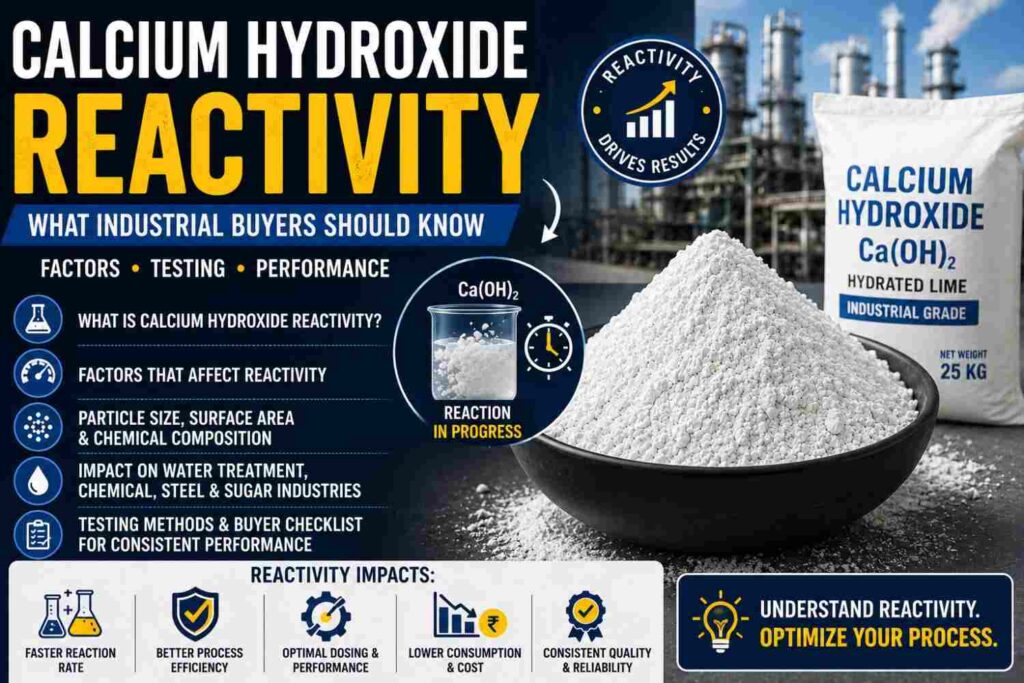
Calcium Hydroxide Reactivity: What Industrial Buyers Should Know Calcium Hydroxide Reactivity is an important but frequently misunderstood characteristic of hydrated lime. Industrial buyers often begin their evaluation with chemical purity. That is reasonable: calcium hydroxide assay, moisture, insoluble matter and other chemical parameters can determine whether a material is suitable for a particular application. But purity alone does not tell the complete story. Two hydrated lime products can have similar calcium hydroxide content and still behave differently when introduced into water, acid, process liquor or another reacting medium. One product may disperse and respond quickly, while another may require more mixing or contact time before achieving the same process result. The difference can come from particle size, surface area, agglomeration, free moisture, manufacturing conditions, storage history, chemical composition and the conditions inside the customer’s process. For an overview of the parameters that normally form the starting point of industrial evaluation, see our detailed guide to Calcium Hydroxide Specifications. For serious industrial procurement, however, the next question should be: How does the calcium hydroxide actually perform when it enters the process? That is where reactivity becomes important. What Is Calcium Hydroxide Reactivity? In practical industrial terms, calcium hydroxide reactivity describes how readily and how quickly hydrated lime participates in the required reaction under defined conditions. There is an important qualification in that sentence: under defined conditions. Reactivity is not a single universal property that can always be represented by one number. A hydrated lime reacting with an acidic solution is operating under very different conditions from calcium hydroxide dispersed in water for pH adjustment, used in a chemical synthesis process, introduced into a sugar clarification system or employed in an environmental treatment application. The measured response can depend on: What calcium hydroxide is reacting with Concentration of the reacting medium Solid-to-liquid ratio Temperature Mixing intensity Contact time Particle-size distribution Available surface area Chemical composition Test endpoint A statement such as “high-reactivity hydrated lime” is therefore most meaningful when the supplier can explain how that reactivity is being measured. It is also important not to confuse hydrated lime reactivity with quicklime slaking rate. Quicklime is calcium oxide, CaO. Its reaction with water produces calcium hydroxide and releases heat. Hydrated lime, Ca(OH)₂, has already undergone that hydration step. Therefore, the speed at which quicklime slakes and the speed or effectiveness with which finished calcium hydroxide reacts in an industrial process are related to different stages of lime chemistry and should not automatically be treated as the same specification. Why Reactivity Matters in Industrial Processing In many applications, calcium hydroxide is purchased because it must produce a chemical effect. The buyer is not purchasing assay alone. They may need the material to: Raise pH Supply alkalinity Neutralize acidity Participate in precipitation React with process contaminants Support chemical conversion Prepare a lime slurry or lime milk Assist a purification or clarification process How rapidly the usable calcium hydroxide becomes available can affect the amount of residence time, mixing and reagent required to reach the target process condition. This becomes particularly important in continuous plants. A laboratory process may allow several minutes for complete mixing and reaction. A high-throughput industrial line may offer a considerably shorter effective contact period. A product that eventually reaches the required endpoint may still behave differently from one that reaches that endpoint more rapidly. The relevance of reactivity therefore depends on the application. Our broader guide to Slaked Lime and Calcium Hydroxide Uses explains why different industries evaluate calcium hydroxide against different operating requirements. Factors Affecting Calcium Hydroxide Reactivity There is rarely one isolated parameter responsible for the performance of hydrated lime. Reactivity is better understood as the result of several interacting physical and chemical characteristics. Factor Why It Can Matter Particle size Influences exposed area and dissolution behaviour Specific surface area Determines how much surface is available for interaction Agglomeration Can reduce the effective surface immediately exposed Chemical purity Determines how much useful calcium hydroxide is present Carbonation Can reduce available Ca(OH)₂ by formation of calcium carbonate Free moisture Can influence storage, agglomeration and powder handling Mixing conditions Affect contact between lime and reacting medium Temperature Can change dissolution and reaction conditions Process chemistry Acid concentration, ions, pH and other species affect behaviour Storage history Exposure to air, moisture and CO₂ can alter the material The important point for procurement is that reactivity should not be judged from one specification in isolation. Effect of Particle Size on Calcium Hydroxide Reactivity Particle size is one of the first physical characteristics to examine when discussing hydrated lime reactivity. Smaller particles generally provide more external surface per unit mass than very coarse particles. When reaction depends on contact between a solid calcium hydroxide particle and a surrounding liquid or gas phase, increased accessible surface can improve the opportunity for interaction. In aqueous applications, dissolution is particularly relevant. Calcium hydroxide must become available in the reacting phase before its calcium and hydroxide ions can perform the desired chemical function. However, simply specifying a mesh number does not provide a complete picture. Two products described by the same nominal mesh may still have different: D10, D50 and D90 values Fine-particle fractions Oversize particles Agglomeration Particle morphology Surface area For this reason, industrial buyers working with fast reactions or tightly controlled dosing systems should consider reviewing particle-size distribution rather than relying exclusively on mesh. Our dedicated article on Hydrated Lime Particle Size explains these differences in greater detail. Effect of Surface Area Particle size and surface area are related, but they are not identical specifications. Specific surface area describes how much particle surface is available per unit mass of material. For calcium hydroxide, this can be particularly relevant because reaction takes place at or through interfaces between the lime particles and the surrounding process medium. A fine hydrated lime with an open, accessible particle structure may therefore behave differently from a material with a lower accessible surface area. BET surface-area testing is one method used to characterize the surface area of powders. However, buyers should

Calcium Hydroxide Bulk Density: Industrial Handling & Dosing Guide
hydrated-lime

Calcium Hydroxide Bulk Density: Industrial Handling & Dosing Guide

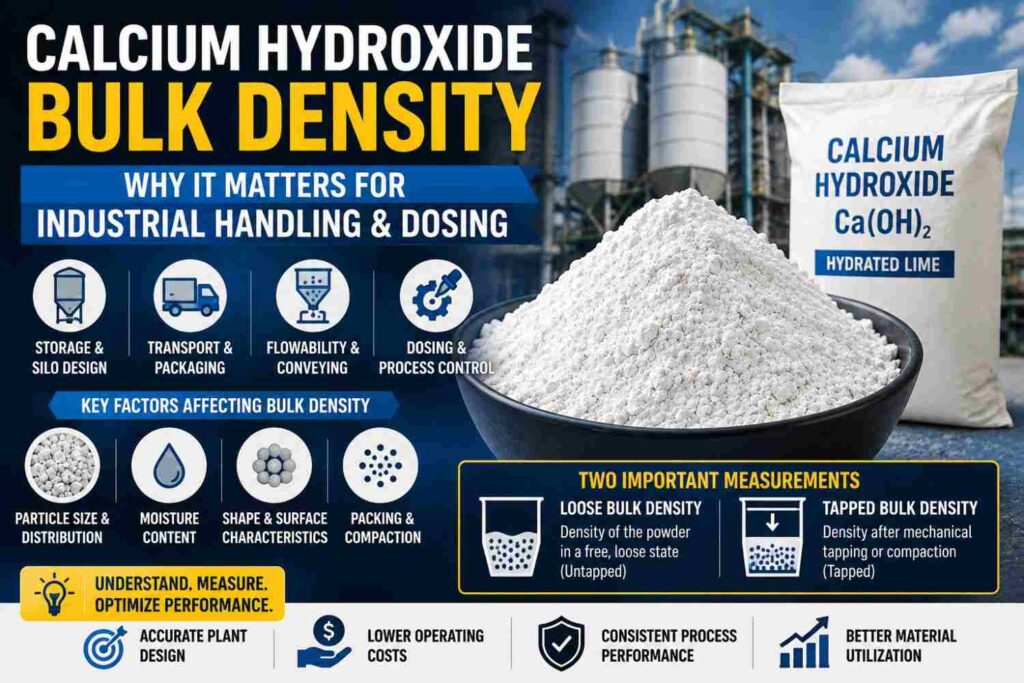
Calcium Hydroxide Bulk Density: Why It Matters for Industrial Handling and Dosing Calcium Hydroxide Bulk Density is one of those specifications that can appear secondary on a technical data sheet until the material reaches a silo, screw feeder, pneumatic conveying line or automated dosing system. Two batches of calcium hydroxide may show comparable chemical purity on their certificates of analysis, yet behave quite differently when unloaded, stored, transferred or dosed. One may occupy more space, another may compact more readily, while another may feed differently through the same screw or hopper. For industrial buyers, this is why evaluating calcium hydroxide only by assay, whiteness or mesh size can leave an important part of the material’s practical behaviour unexplained. Bulk density connects the powder itself with the equipment expected to handle it. For a wider understanding of the chemical and physical parameters commonly reviewed when purchasing hydrated lime, see our guide to Calcium Hydroxide Specifications. What Does Calcium Hydroxide Bulk Density Mean? Bulk density describes the mass of a powder occupying a given bulk volume. That volume does not consist only of solid calcium hydroxide particles. It also includes the spaces between those particles. This distinction is important. A container that appears completely filled with hydrated lime still contains numerous microscopic and macroscopic voids within the powder bed. The amount of empty space depends on how the particles arrange themselves, their size distribution, shape, surface characteristics, agglomeration and degree of consolidation. Bulk density is therefore not simply a chemical property of Ca(OH)₂. It is a powder-handling property. It may commonly be expressed in units such as kg/m³, g/cm³ or g/mL, depending on the industry and test procedure. There is no single universal Calcium Hydroxide Bulk Density value that should be applied to every hydrated lime product. Actual results can vary according to manufacturing process, particle characteristics, moisture condition, sample preparation, storage history and test method. Bulk Density vs Particle Density vs True Density These terms are sometimes used interchangeably in commercial discussions, but they describe different concepts. Property What the Volume Includes Why It Matters Loose / Untapped Bulk Density Particles plus spaces between particles in a loosely filled condition Packaging, initial filling, storage volume and volumetric feeding Tapped Bulk Density Powder after controlled mechanical settling or tapping Compaction tendency and behaviour after vibration or transport Particle Density Density associated with individual particles, depending on how internal pores are treated by the measurement method Material characterisation rather than direct silo capacity Material / Solid Density Density of the solid material excluding inter-particle spaces Fundamental material property, but not representative of bulk powder behaviour The term true density is also widely encountered, although its exact meaning can vary with the measurement technique and industry. For purchasing and plant handling, bulk density is normally much more useful than theoretical solid density because equipment handles a bulk powder bed, not an ideal block of solid calcium hydroxide. Why Bulk Density Matters in Hydrated Lime Bulk density determines how much mass of hydrated lime occupies a particular space. That simple relationship affects several operations: Silo and hopper capacity Bag and jumbo-bag fill volume Truck or container utilisation Volumetric feeder output Screw feeder calibration Pneumatic conveying behaviour Intermediate hopper sizing Automated dosing accuracy Inventory calculations based on vessel volume This becomes especially important in plants consuming hydrated lime continuously. Water treatment, environmental control, steel processing, construction-material production and chemical manufacturing may all use calcium hydroxide differently, but each operation benefits from predictable powder behaviour. Application requirements themselves also vary considerably. Our overview of Slaked Lime and Calcium Hydroxide Uses explains why material selection should consider the actual process rather than purity alone. Loose Bulk Density vs Tapped Bulk Density A supplier stating simply “bulk density” without explaining the measurement condition may leave the buyer with incomplete information. Loose Bulk Density Loose or untapped bulk density represents the powder after it has been introduced into the measuring container with minimal intentional consolidation. This condition can be relevant to fresh filling and some packaging calculations. Tapped Bulk Density Tapped bulk density is determined after the powder has been subjected to a defined tapping or settling procedure. The particles rearrange and usually occupy less volume as the powder bed consolidates. The difference between loose and tapped conditions provides useful insight into how much the powder can settle. That matters because calcium hydroxide may experience vibration during: Road transportation Bag handling Conveyor movement Silo filling Plant operation Mechanical feeding A bag filled at the plant and a bag opened after a long truck journey may therefore not present exactly the same powder-bed condition. For critical applications, buyers should specify whether their required value refers to loose, untapped or tapped bulk density rather than using the phrase “bulk density” without qualification. How Particle Size Affects Calcium Hydroxide Bulk Density Particle size is closely connected with powder packing, but the relationship is not as simple as “finer powder always means higher” or “finer powder always means lower” bulk density. Particle-size distribution matters alongside: Particle shape Agglomeration Surface texture Percentage of fines Manufacturing route Milling or classification Storage history Fine particles can occupy spaces between larger particles in some distributions, while very fine cohesive powders may form loose structures or agglomerates that create additional void space. This is one reason mesh specification alone cannot fully predict handling behaviour. For a deeper discussion, see Hydrated Lime Particle Size. Particle size should therefore be evaluated together with bulk density when the calcium hydroxide will be used in controlled feeding, pneumatic transport or automated dosing systems. Moisture, Storage and Bulk-Density Measurements Moisture can influence powder handling even when the chemical specification remains within the buyer’s acceptable limits. Changes in moisture condition may affect: Particle cohesion Agglomeration Flow behaviour Packing Wall adhesion Hopper discharge Repeatability of bulk-density testing Storage conditions also matter. A sample taken immediately after manufacture may not behave identically to material that has remained under load in a bulk bag or storage vessel for an extended period. This does not mean every change

https://slakedlimes.com/slaked-lime-calcium-hydroxide-uses-applications/
Uncategorized

Hydrated Lime Particle Size: Why It Matters in Industrial Applications

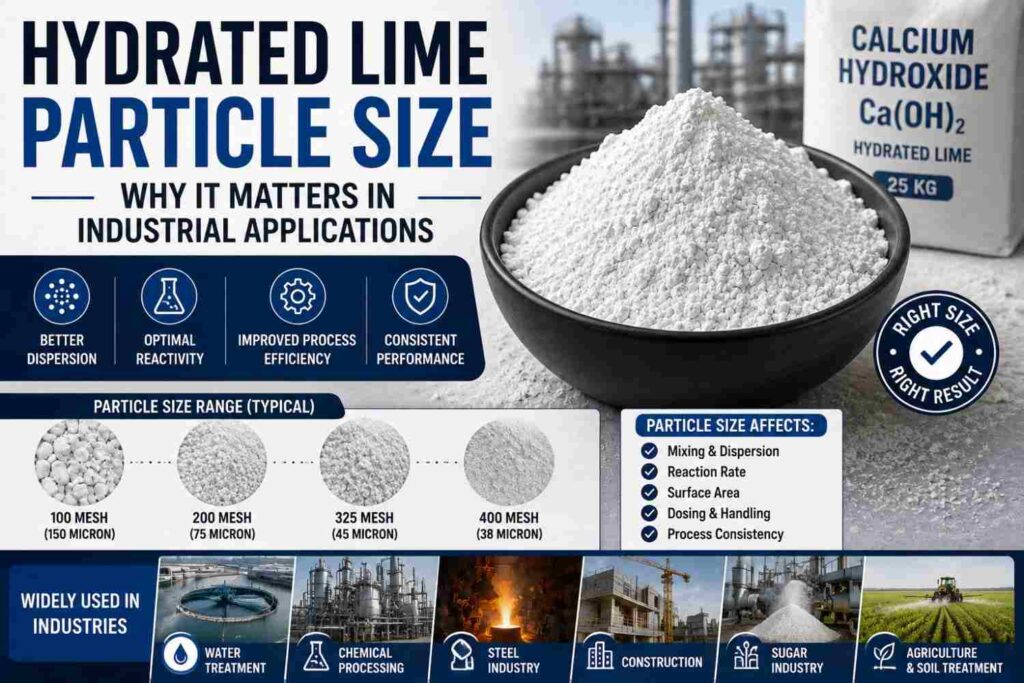
Hydrated Lime Particle Size: Why It Matters in Industrial Applications When industrial buyers evaluate hydrated lime, chemical purity is usually one of the first things they check. But purity is only part of the picture. Hydrated lime particle size can also influence how the material behaves during handling, mixing, dispersion and processing. Depending on the application, manufacturers may require a relatively fine and consistent material, while other processes may have less demanding particle-size requirements. This is why particle size should not be treated as a simple number on a product specification sheet. For manufacturers purchasing calcium hydroxide in regular quantities, the more useful question is not simply “How fine is the hydrated lime?” but rather: “Is the particle-size characteristic suitable and consistent for my process?” That distinction can make a significant difference when moving from laboratory testing to continuous industrial production. What Is Hydrated Lime Particle Size? Hydrated lime, also known as calcium hydroxide or slaked lime, is normally supplied as a dry powder. Particle size refers to the dimensions of the individual particles within that powder. In practical industrial specifications, particle size may be expressed using different methods, including: Microns Mesh Percentage passing through a specified sieve Particle-size distribution These measurements are not always interchangeable. For example, a specification expressed in mesh describes sieve-based fineness, while a micron measurement refers directly to particle dimensions. Buyers should therefore check how the supplier defines and measures particle size before comparing two products. Why Does Hydrated Lime Particle Size Matter? The size and distribution of particles can affect how hydrated lime behaves in an industrial process. Depending on the application, particle characteristics can influence: Mixing Dispersion Handling Feeding Surface area Reaction behaviour Process consistency Material utilisation However, finer does not automatically mean better. A very fine material may be desirable for one application but unnecessary for another. The correct specification should be determined by the actual process rather than by the smallest particle size available. Particle Size vs Particle-Size Distribution These two terms are often used together, but they describe different things. Particle Size This refers to the size of individual particles or a defined measurement representing particle size. Particle-Size Distribution This describes how the particle sizes are distributed throughout the material. A powder can contain particles across a range of sizes rather than having every particle exactly the same size. This is why a specification stating only one particle-size value may not provide enough information for some technical applications. For demanding industrial processes, understanding the particle-size distribution of hydrated lime can provide a more useful picture of the material. How Is Hydrated Lime Particle Size Measured? Different analytical methods may be used depending on the required specification and laboratory setup. Common approaches can include: Sieve Analysis The material is passed through sieves with defined openings to determine the percentage retained or passing through each sieve. This is commonly associated with mesh-based specifications. Laser Diffraction Laser diffraction can be used to determine particle-size distributions over a range of particle sizes. It can provide more detailed information about the distribution than a simple sieve result. Other Laboratory Methods The appropriate method depends on the product, application, particle-size range and required standard. For industrial purchasing, the important point is to ensure that the test method is clearly defined. Two suppliers may report apparently similar particle-size values while using different measurement methods. What Does Mesh Size Mean? Mesh is commonly used in the powder and mineral industry to describe material fineness. In simple terms, mesh relates to the number of openings in a sieve over a defined length. As a general concept, a higher mesh number indicates a finer sieve opening. But buyers should be careful when comparing mesh and micron specifications because the relationship is not simply: Higher mesh = exactly X microns The actual relationship depends on the applicable sieve standard and measurement convention. Therefore, if a customer requires a particular fineness, it is better to specify the actual test requirement or particle-size parameter rather than relying only on a general phrase such as “fine powder.” Does Finer Hydrated Lime Always Mean Better Quality? No. This is one of the most common assumptions buyers can make. A finer hydrated lime may offer advantages in certain applications, but finer material can also affect: Handling Dust generation Storage Feeding Processing behaviour Cost The optimum particle size is therefore a balance between technical requirements and practical processing conditions. A manufacturer should choose the grade that performs properly in the intended process rather than automatically selecting the finest available product. Hydrated Lime Particle Size and Surface Area Particle size can influence the surface area available for interaction with other materials. Generally, reducing particle size increases the available surface area relative to the same mass of larger particles. This can be relevant in processes where contact between calcium hydroxide and another material is important. However, actual process performance depends on more than particle size. Other factors can include: Chemical composition Porosity Moisture Mixing conditions Temperature Reaction time Process design Therefore, particle size should always be evaluated as part of the complete product specification. Hydrated Lime Particle Size in Water Treatment Water-treatment applications can involve dosing hydrated lime into water or wastewater systems for processes such as pH adjustment and chemical treatment. Particle characteristics can influence how the material behaves during mixing and dosing. A suitable product needs to work effectively with the customer’s equipment and treatment process. However, particle size alone does not determine treatment performance. The buyer should also evaluate: Chemical purity Reactivity Dosing requirements Moisture Residue Process conditions Our existing Hydrated Lime for Water Treatment article covers the broader application. For ETP and STP applications, our Hydrated Lime Water Treatment Guide provides more application-focused information. Hydrated Lime Particle Size in Chemical Processing Chemical manufacturers may require specific particle characteristics depending on how calcium hydroxide is introduced into their process. A fine and consistent powder may be useful where controlled mixing and reaction are important. But the appropriate specification will vary from one chemical process to

Calcium Hydroxide Specifications: Key Parameters Industrial Buyers Should Check
hydrated-lime

Calcium Hydroxide Specifications: Key Parameters Industrial Buyers Should Check

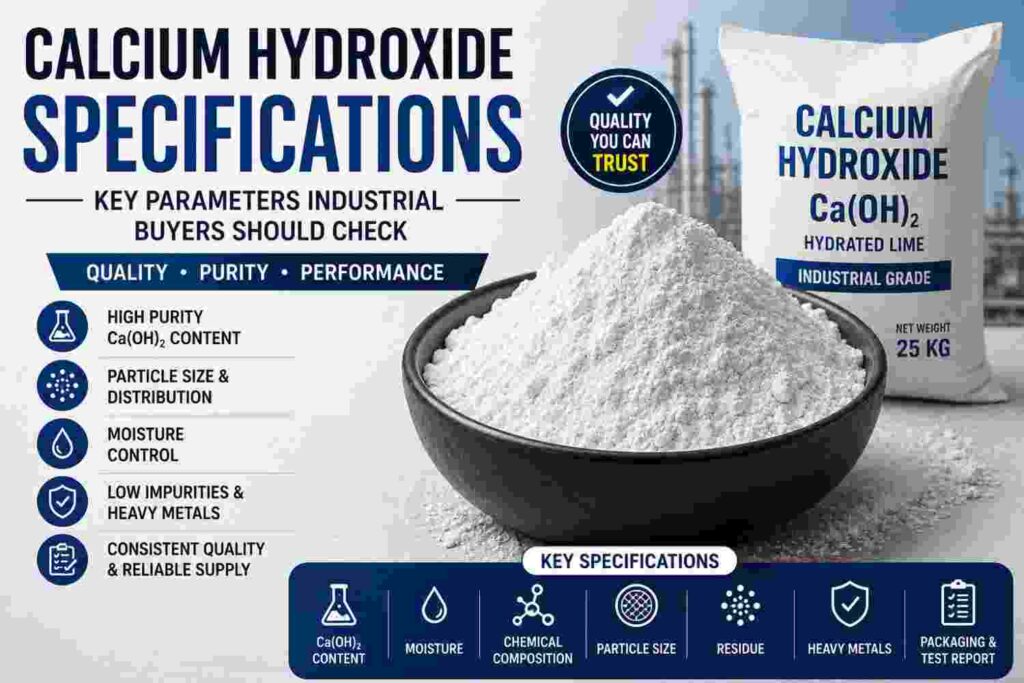
Calcium Hydroxide Specifications: Key Parameters Industrial Buyers Should Check When buying calcium hydroxide for industrial use, the product name alone does not tell the complete story. Calcium hydroxide, also known as hydrated lime or slaked lime, is used across several industries, but the requirements can vary considerably from one application to another. A buyer purchasing material for water treatment may have different priorities from a manufacturer using calcium hydroxide in chemical processing, food applications, construction or metallurgy. This is why calcium hydroxide specifications should be reviewed before approving a product or supplier. Purity, particle size, moisture, chemical composition, residue and other quality parameters can influence how the material performs during processing. For large-volume industrial procurement, consistency from batch to batch is equally important. The right approach is not simply to ask, “What is the price per tonne?” It is to first establish what specification the application actually requires. What Is Calcium Hydroxide? Calcium hydroxide is an inorganic compound with the chemical formula Ca(OH)₂. It is commonly produced by adding water to quick lime, or calcium oxide (CaO), in a controlled process known as slaking. The material is commonly referred to by several names: Calcium hydroxide Hydrated lime Slaked lime Caustic lime Although these names are often used interchangeably, buyers should still confirm the exact product specification and grade before procurement. If you want to understand its applications first, our detailed guide on slaked lime and calcium hydroxide uses provides a broader overview. Why Calcium Hydroxide Specifications Matter Industrial manufacturers generally need predictable raw materials. If the characteristics of calcium hydroxide change significantly between batches, the production process may also change. Depending on the application, this can affect reaction behaviour, dosing, dispersion, processing efficiency or the quality of the finished product. A proper specification helps both the buyer and supplier establish a clear quality benchmark. It can cover parameters such as: Calcium hydroxide content Calcium oxide and related chemical composition Magnesium and other impurities Iron content Moisture Particle size Residue Heavy metals where applicable Physical appearance Packaging requirements Not every application requires every parameter to have the same limit. The specification should be matched to the intended use. 1. Calcium Hydroxide Purity Purity is one of the first parameters industrial buyers should consider. Higher purity material may be required when the presence of unwanted minerals or chemical impurities could affect the manufacturing process or final product. However, the phrase “high purity” should always be supported by a defined specification. Instead of relying only on a supplier’s marketing description, buyers should ask for the actual analytical specification and relevant test report. Depending on the application, the specification may define the minimum calcium hydroxide content and limits for other components. For specialised applications, the required purity can be significantly different from that of a general industrial grade. 2. Chemical Composition Calcium hydroxide is not evaluated only by its main component. Industrial buyers may also need to understand the levels of other chemical constituents present in the product. Depending on the application, a specification may include parameters related to: Calcium Magnesium Iron Silica Aluminium Other mineral components Moisture Insoluble matter The importance of each parameter depends on where the material will be used. For example, a manufacturer working with a sensitive formulation may have tighter requirements for certain impurities than a buyer using hydrated lime in a general construction application. 3. Particle Size Particle size is another important part of calcium hydroxide specifications. Calcium hydroxide is available in different particle-size characteristics, and the appropriate range depends on the intended application. Particle size can influence: Handling Dispersion Mixing Surface area Reaction behaviour Processing characteristics Buyers should therefore avoid selecting a product solely because it is described as “fine powder.” A proper technical specification should provide measurable information about the particle size or particle-size distribution where relevant. 4. Particle-Size Distribution Particle size and particle-size distribution are related, but they are not exactly the same thing. A single particle-size value does not necessarily describe the complete material. Particle-size distribution provides information about how the particles are spread across different size ranges. This can become particularly relevant when a manufacturer requires predictable processing behaviour. For applications where fine and uniform material is important, the buyer should discuss the required particle-size distribution with the supplier rather than relying on a general product description. 5. Moisture Content Moisture is another parameter that should not be overlooked. Calcium hydroxide is a dry powdered material, and its moisture level can influence handling, storage and processing. Excess moisture may affect: Flowability Storage behaviour Material handling Weighing and dosing Packaging condition Processing consistency The acceptable moisture level depends on the product grade and application. For this reason, buyers should review the moisture specification and understand how it is measured. 6. Residue and Insoluble Matter Some applications require control over the amount of material that remains undissolved or does not pass through a specified sieve. Residue or insoluble matter can therefore be an important quality parameter. The exact test method and acceptable limit should be defined according to the intended application and applicable specification. This becomes particularly important when calcium hydroxide is being used in processes where unwanted solid particles could interfere with downstream operations. 7. Heavy Metals and Trace Impurities For certain applications, trace elements can be more important than they are for general industrial use. Food, pharmaceutical and other sensitive applications may have specific requirements concerning heavy metals or other impurities. The buyer should therefore identify which parameters are relevant to the final application before selecting a grade. A supplier should be able to provide appropriate quality documentation where such controls are part of the product specification. Do not assume that an industrial-grade calcium hydroxide automatically meets food or pharmaceutical requirements. The applicable grade and compliance documentation must be verified separately. For example, Vigyan Lime’s existing content on pharma-grade slaked lime and calcium hydroxide covers a different specification and regulatory context from general industrial calcium hydroxide. 8. Whiteness and Appearance Physical appearance can also be relevant depending on the application. A consistent

Hydrated Lime for Water Treatment: ETP & STP Guide
hydrated-lime

Hydrated Lime for Water Treatment: ETP & STP Guide

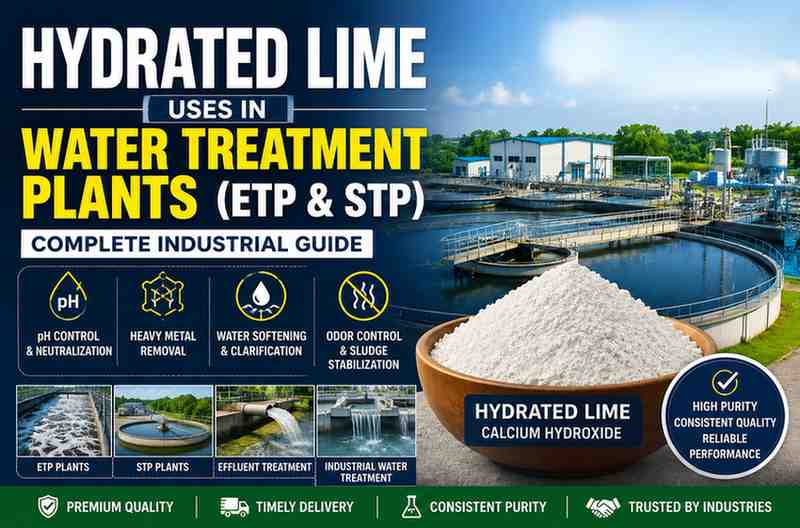
Hydrated Lime for Water Treatment: Complete Industrial Guide for ETP & STP Plants An effluent treatment plant rarely attracts attention when it is running well. The pH remains steady, metal concentrations stay within limits, the clarifier produces a clean overflow and the filter press delivers a manageable cake. The problems begin when the chemistry changes. An acidic batch enters the equalisation tank. A plating line releases chelated metals. A food-processing plant begins a new cleaning cycle. A textile unit changes dyes. Within minutes, the chemical demand can be very different from what the dosing system saw during the previous shift. This is where hydrated lime for water treatment earns its place. Also known as calcium hydroxide or slaked lime, it is used in industrial ETPs and municipal STPs for pH correction, acid neutralisation, heavy-metal precipitation, water softening, phosphorus removal, sludge conditioning and alkaline stabilization. In India, general discharge standards commonly prescribe a pH range of 5.5 to 9.0, although the applicable limit may differ under sector-specific standards, State Pollution Control Board consents or local discharge conditions. Reaching that final pH is not simply a matter of adding alkali until a meter displays the desired number. pH is logarithmic, and it does not by itself reveal how much acidity or buffering capacity is present in the wastewater. A plant may therefore have an acceptable pH reading and still consume a surprisingly large quantity of alkali. Another wastewater stream may show a very low pH but require relatively little chemical. The distinction between pH and acidity or alkalinity is one of the most important lessons in chemical treatment. This guide examines the chemistry, operating practice, dosage calculation and purchasing criteria behind industrial hydrated lime applications in ETP and STP systems. What Is Hydrated Lime? Hydrated lime is the common industrial name for calcium hydroxide, Ca(OH)₂. It is produced by adding a controlled quantity of water to quicklime, or calcium oxide: CaO + H₂O → Ca(OH)₂ + heat The controlled reaction is called hydration or slaking. When completed correctly, it converts reactive quicklime into a fine, dry alkaline powder. In a treatment plant, hydrated lime is normally mixed with water to form a suspension known as lime slurry or milk of lime. It is not usually dosed as a true solution because calcium hydroxide has limited solubility. Continuous agitation is therefore needed to prevent settling and maintain a reasonably uniform feed concentration. EPA operating guidance similarly describes lime as a slurry-fed treatment chemical and warns that poor handling can affect process performance, effluent quality and maintenance cost. Table 1: Industrial Profile of Hydrated Lime Parameter Hydrated Lime Characteristic Relevance to a Water Treatment Plant Chemical name Calcium hydroxide Formula Ca(OH)₂ Physical form Fine, dry alkaline powder Plant feed form Normally a continuously agitated slurry Main contribution Hydroxide ions and calcium ions Principal applications pH adjustment, neutralisation, precipitation, softening and sludge treatment Solubility behaviour Slightly soluble; excess material remains suspended Theoretical neutralising value About 1.35 kg of CaCO₃ equivalent per kg of pure Ca(OH)₂ Main operating concern Settling, scale, dust, grit and inconsistent slurry concentration Main buying concern Assay, reactivity, fineness, insolubles, moisture and batch consistency Calcium hydroxide is recognised as an important water treatment chemical for precipitative softening and pH adjustment. Its chemistry allows one mole of Ca(OH)₂ to release two hydroxide equivalents, although actual plant utilisation is lower than the theoretical value because of purity, dispersion, reaction time and wastewater composition. Why Do Water Treatment Plants Use Hydrated Lime?   Hydrated lime is not a single-purpose neutralising chemical. Its value comes from the way several treatment effects can occur together. A dose intended to increase pH may also precipitate metals. The resulting calcium carbonate and metal hydroxide particles may assist floc formation. The same treatment may alter sludge structure and improve—or, under different conditions, complicate—dewatering. Table 2: Hydrated Lime Functions in Water and Wastewater Treatment Treatment Objective Chemical or Physical Action Critical Control Point Common Plant Risk Acid neutralisation Hydroxide ions consume acidity Acidity load and final pH Overdosing or delayed pH response Heavy-metal removal Dissolved metals form insoluble hydroxides Metal-specific optimum pH Redissolution or chelation Water softening Calcium carbonate and magnesium hydroxide precipitate Hardness, alkalinity and pH Scaling and excess sludge Coagulation support Precipitates create solids and sweep floc Mixing and settling Fine carryover Phosphorus removal Calcium phosphate or associated precipitates form pH and phosphate concentration High chemical consumption Sludge conditioning Mineral solids modify cake structure Dose and dewatering test Increased cake quantity Alkaline stabilization Elevated pH suppresses biological activity pH and contact time Ammonia release Odour management Reduced putrefaction under high-pH conditions Ventilation and pH retention Ammonia odour at high pH EPA technical guidance identifies chemical coagulation, phosphate precipitation, pH adjustment and sludge stabilization among the established wastewater-treatment uses of lime. 1. pH Correction and Acid Neutralisation When hydrated lime enters water, the dissolved portion releases hydroxide ions: Ca(OH)₂ ⇌ Ca²⁺ + 2OH⁻ These hydroxide ions react with acidity. In an ETP, the acidity may come from mineral acids, acidic salts, process intermediates, acidic cleaning solutions, fermentation products or dissolved carbon dioxide. The practical objective is not merely to “raise pH”. It may be to: protect a biological treatment stage from acidic shock; create the correct pH for metal precipitation; improve coagulation; reduce corrosion; meet the permitted outlet pH; or provide alkalinity consumed by a downstream process. A properly designed system uses both flow and pH information. Large, variable plants may benefit from feed-forward control based on influent flow or acidity, followed by feedback correction using a downstream pH sensor. One sensor placed immediately beside the lime injection point is rarely enough. Undispersed lime particles and local high-pH zones can mislead the controller, while the bulk water remains insufficiently treated. 2. Heavy-Metal Removal Many dissolved metals become less soluble as metal hydroxides when pH rises: M²⁺ + 2OH⁻ → M(OH)₂ ↓ The precipitated solids can then be removed by clarification, dissolved-air flotation, filtration or membrane separation. Hydrated lime is widely used for this purpose in metal finishing, electroplating, galvanising,

Top Slaked Lime Manufacturer in India – High Quality Hydrated Lime Supplier
hydrated-lime

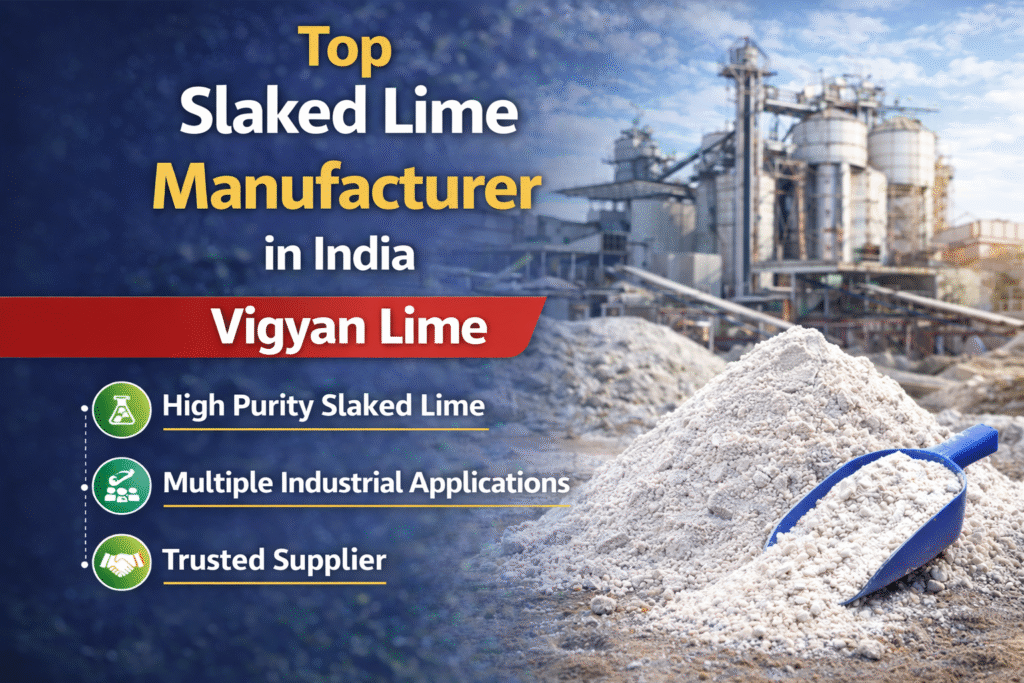
Top Slaked Lime Manufacturer in India – High Quality Hydrated Lime Supplier

India has a rapidly growing demand for slaked lime (calcium hydroxide) across industries such as water treatment, construction, agriculture, steel, sugar, chemicals, and environmental protection. Because of these wide applications, industries require high-purity hydrated lime from reliable manufacturers who can supply consistent quality and large volumes. If you are searching for a Top Slaked Lime Manufacturer in India, choosing an experienced company with modern manufacturing facilities and strict quality standards is essential. One such trusted name in the lime industry is Vigyan Lime, a company known for its high-quality lime products and decades of expertise. What is Slaked Lime? Slaked lime, chemically known as calcium hydroxide (Ca(OH)₂), is produced when quicklime (calcium oxide) reacts with water. This process is known as hydration. The result is a fine white powder widely used in industrial processes due to its alkaline nature, chemical stability, and neutralizing properties. Industries rely on slaked lime for: Neutralizing acidic solutions Water purification Soil treatment in agriculture Sugar refining Environmental pollution control Because of these applications, industries prefer sourcing from reliable hydrated lime manufacturers in India. Importance of Choosing the Right Slaked Lime Manufacturer Not all lime suppliers provide the same level of quality. Industrial processes often require high purity calcium hydroxide with consistent particle size and controlled moisture levels. A professional manufacturer ensures: High purity lime products Controlled manufacturing process Reliable bulk supply Industry-specific grades Strict quality testing This is why many industries prefer working with established lime manufacturers like Vigyan Lime. Vigyan Lime – A Trusted Slaked Lime Manufacturer in India Vigyan Lime is one of the leading manufacturers and suppliers of slaked lime, hydrated lime, quicklime, and industrial lime products in India. Established with a strong commitment to quality and innovation, the company has built a reputation for delivering consistent and high-performance lime products for multiple industries. Key Highlights Decades of industry experience High-purity hydrated lime production Large manufacturing capacity Modern processing units Reliable bulk supply for industries Industries across India trust Vigyan Lime for its quality assurance, technical expertise, and dependable supply chain. Manufacturing Units To ensure smooth production and nationwide supply, Vigyan Lime operates multiple manufacturing units across India: Jodhpur (Rajasthan) Nagaur (Rajasthan) Udaipur (Rajasthan) Haldwani (Uttarakhand) Sataun (Himachal Pradesh) These strategic locations allow the company to supply high-quality slaked lime to industries across North India and other regions efficiently. Applications of Slaked Lime in Various Industries Water Treatment Slaked lime is widely used in water purification and wastewater treatment plants. It helps neutralize acidity, remove impurities, and improve water quality. Construction Industry In construction, hydrated lime is used for: Lime mortar Lime plaster Whitewashing Soil stabilization It improves strength, durability, and workability of building materials. Agriculture Farmers use slaked lime to correct soil acidity and improve soil fertility, which helps crops grow better. Sugar Industry In sugar manufacturing, lime is used for juice clarification and purification during processing. Environmental Protection Hydrated lime is also used in flue gas treatment, pollution control systems, and industrial waste neutralization. Why Industries Choose Vigyan Lime There are several reasons why Vigyan Lime is considered a top slaked lime manufacturer in India. High Purity Lime Products The company produces lime with excellent chemical composition and consistent quality. Reliable Bulk Supply Large manufacturing capacity ensures uninterrupted supply for industrial clients. Multiple Manufacturing Units Strategically located plants help in faster distribution across India. Industry Expertise With years of experience, the company understands the specific requirements of different industries. Contact Vigyan Lime If you are looking for a reliable slaked lime manufacturer or bulk hydrated lime supplier in India, Vigyan Lime offers high-quality products and dependable service. Head Office G-37, Race CourseDehradun, Uttarakhand – 248001 Phone +91-95685-01110+91-95688-01110+91-98370-55678 Email info@vigyanlime.com Manufacturing Units Jodhpur & Nagaur (Rajasthan) Udaipur (Rajasthan) Haldwani (Uttarakhand) Sataun (Himachal Pradesh) Frequently Asked Questions (FAQ) What is slaked lime used for? Slaked lime is used in water treatment, construction, agriculture, sugar refining, chemical processing, and environmental protection. What is the chemical formula of slaked lime? The chemical formula of slaked lime is Ca(OH)₂ (Calcium Hydroxide). Which industries use hydrated lime? Hydrated lime is used in steel plants, water treatment facilities, agriculture, construction, sugar mills, paper industry, and chemical plants. How to choose the best slaked lime manufacturer in India? You should check the manufacturer’s experience, product purity, manufacturing capacity, and quality control standards. Why choose Vigyan Lime for slaked lime supply? Vigyan Lime offers high-quality hydrated lime, multiple manufacturing units, and reliable industrial supply, making it a trusted partner for many industries.

bulk-hydrated-lime-supplier-india
hydrated-lime

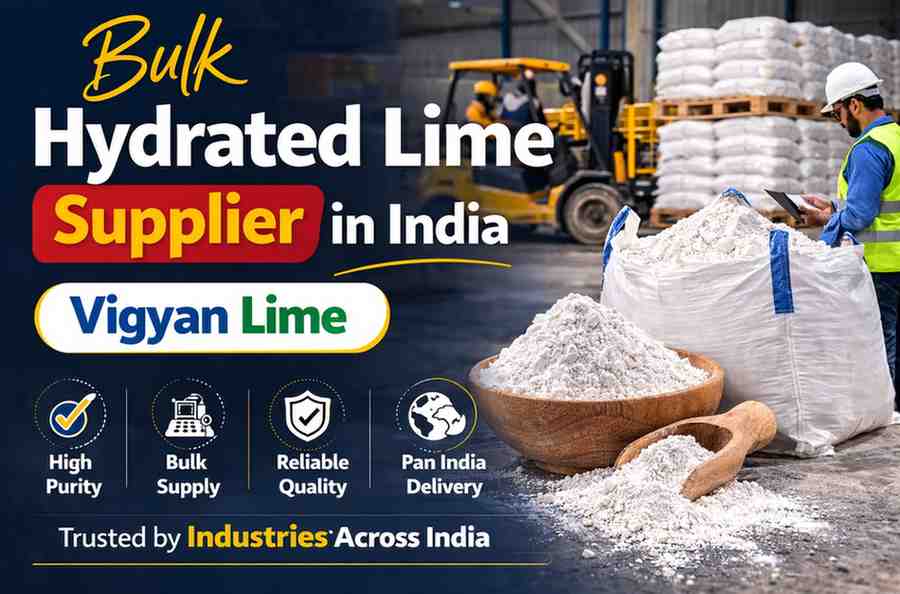
Bulk Hydrated Lime Supplier in India – Vigyan Lime

Hydrated Lime, also known as Calcium Hydroxide (Ca(OH)₂), is one of the most important industrial chemicals used across multiple sectors. From water treatment and construction to agriculture, sugar production, and environmental protection, hydrated lime plays a crucial role in many industrial processes. Industries that require large quantities of lime depend on reliable manufacturers who can provide bulk hydrated lime with consistent purity and quality. Choosing the right supplier ensures smooth industrial operations and better process efficiency. In India, Vigyan Lime has established itself as a trusted bulk hydrated lime supplier, providing high-quality lime products to industries across the country. Hydrated Lime in Construction What is Hydrated Lime? Hydrated lime is a fine white powder produced by adding water to quicklime (calcium oxide). Chemical Reaction CaO + H₂O → Ca(OH)₂ The resulting compound, calcium hydroxide, has strong alkaline properties and is widely used for neutralization, purification, and chemical processing. Calcium Hydroxide (Food Grade) Importance of Bulk Hydrated Lime Supply Many industries require hydrated lime in large quantities for continuous production and treatment processes. Bulk supply is important for: Large industrial water treatment plants Sugar manufacturing units Construction and infrastructure projects Chemical processing industries Environmental treatment facilities Reliable bulk supply ensures that industries maintain consistent production without supply interruptions. Industries That Use Bulk Hydrated Lime Water Treatment Industry One of the largest consumers of hydrated lime is the water treatment sector. It is used for: pH control Heavy metal removal Water softening Wastewater treatment Calcium Hydroxide for Agriculture Construction Industry In construction, hydrated lime is used in: Lime mortar Plastering materials Soil stabilization Road construction Agriculture Farmers and agricultural industries use hydrated lime for soil treatment and pH balance, helping improve soil fertility. Sugar Industry Hydrated lime is an important chemical used in the sugar clarification process, helping remove impurities during sugar production. Environmental Applications Bulk hydrated lime is used in environmental processes such as: Neutralizing acidic waste Flue gas treatment Industrial wastewater treatment Why Choose Vigyan Lime? Industries require a reliable partner when sourcing bulk hydrated lime. Vigyan Lime focuses on delivering high-quality lime products with consistent purity and reliable supply. Key advantages ✔ High purity hydrated lime✔ Consistent particle size and quality✔ Reliable bulk supply across India✔ Competitive pricing for industrial buyers✔ Suitable for multiple industrial applications Because of these qualities, Vigyan Lime is recognized as a trusted bulk hydrated lime supplier in India. top hydrated lime manufacturer in India Packaging and Bulk Supply Options Vigyan Lime provides hydrated lime in different packaging and bulk supply formats to meet industrial requirements. Common options include: Industrial bulk bags Large sacks for industrial use Custom packaging based on client requirements This flexibility allows industries to receive lime in the most convenient format for their operations. Frequently Asked Questions (FAQs) 1. What is hydrated lime used for? Hydrated lime is used in water treatment, construction, agriculture, sugar production, and environmental protection. 2. What is the chemical formula of hydrated lime? The chemical formula of hydrated lime is Ca(OH)₂ (Calcium Hydroxide). 3. Why do industries buy hydrated lime in bulk? Bulk supply helps industries maintain continuous production and reduce supply disruptions. 4. Why choose Vigyan Lime for bulk hydrated lime supply? Vigyan Lime provides high-purity hydrated lime with reliable bulk supply for industrial customers. Hydrated lime is a crucial industrial material used in various sectors due to its strong alkaline properties and purification capabilities. Industries that require large quantities depend on reliable suppliers who can provide consistent product quality. With its experience, quality manufacturing, and dependable supply chain, Vigyan Lime has become a trusted bulk hydrated lime supplier in India, supporting industries with high-quality lime products.

hydrated-lime-manufacturer-water-treatment
hydrated-lime

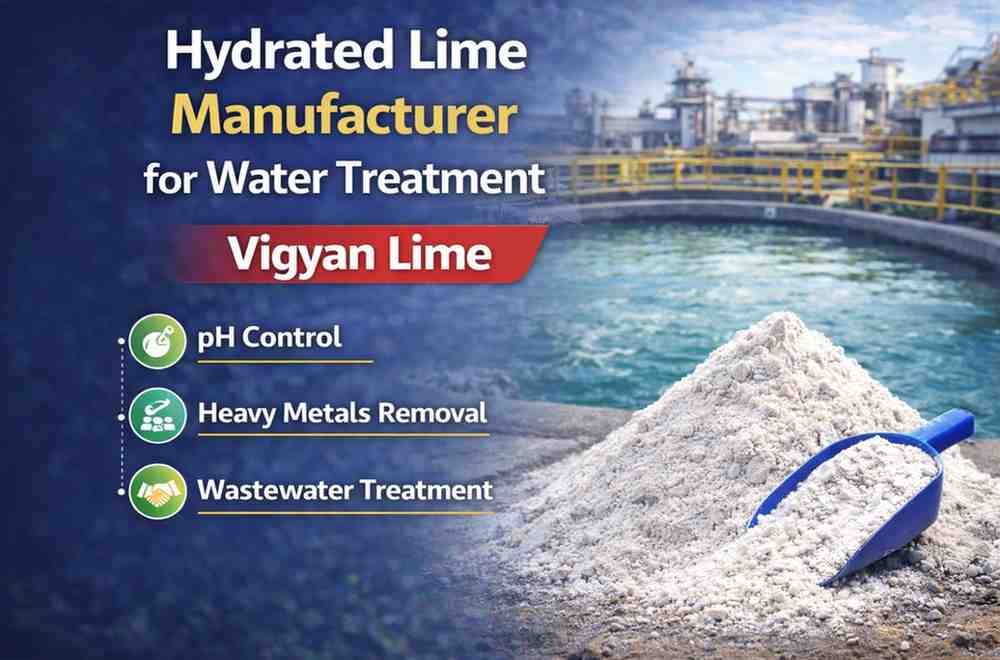
Hydrated Lime Manufacturer for Water Treatment – Vigyan Lime

Water treatment is one of the most important processes for ensuring safe drinking water and protecting the environment. Industries and municipal water plants use several chemicals to purify water, and Hydrated Lime (Calcium Hydroxide – Ca(OH)₂) is one of the most widely used. Hydrated lime plays a crucial role in pH control, water softening, heavy metal removal, and wastewater treatment. Because water treatment systems require reliable and consistent chemical quality, industries often look for a trusted hydrated lime manufacturer for water treatment applications. In India, Vigyan Lime has built a strong reputation as a reliable manufacturer and supplier of high-purity hydrated lime used in water treatment plants and industrial processes. Calcium Hydroxide (Food Grade) What is Hydrated Lime? Hydrated lime is a fine white alkaline powder produced by adding water to quicklime (calcium oxide). Chemical Reaction CaO + H₂O → Ca(OH)₂ The resulting compound, calcium hydroxide, is widely used in water treatment because it helps neutralize acids and remove impurities from water. Importance of Hydrated Lime in Water Treatment Hydrated lime is an essential chemical in both municipal water treatment plants and industrial wastewater treatment systems. It helps improve water quality by: Adjusting pH levels Removing harmful metals Softening hard water Neutralizing acidic wastewater These processes make hydrated lime one of the most effective chemicals used in water purification systems. Hydrated Lime in Construction Applications of Hydrated Lime in Water Treatment 1. pH Control Water treatment plants use hydrated lime to increase the pH level of acidic water, making it suitable for further purification processes. 2. Removal of Heavy Metals Hydrated lime helps precipitate heavy metals such as: Iron Lead Copper Zinc These metals can then be removed through sedimentation or filtration. 3. Water Softening Hydrated lime is commonly used in lime softening processes to remove excess calcium and magnesium from water. This reduces water hardness and improves water quality. Calcium Hydroxide for Agriculture 4. Wastewater Treatment Industries generate wastewater that often contains acidic chemicals and contaminants. Hydrated lime helps neutralize this wastewater before it is released into the environment. Industries That Use Hydrated Lime for Water Treatment Several industries depend on hydrated lime for water purification and wastewater treatment, including: Chemical industries Paper and pulp mills Steel plants Textile industries Mining operations Municipal water treatment plants Why Choose Vigyan Lime? When selecting a hydrated lime manufacturer for water treatment applications, industries require consistent quality and reliable supply. Vigyan Lime focuses on producing high-quality lime products suitable for industrial and environmental applications. Key advantages ✔ High purity hydrated lime✔ Consistent particle size and quality✔ Reliable industrial supply✔ Competitive pricing✔ Suitable for water treatment processes These qualities make Vigyan Lime a trusted hydrated lime manufacturer for water treatment applications in India. Applications of Vigyan Lime Hydrated Lime Hydrated lime manufactured by Vigyan Lime is widely used in: Drinking water purification Wastewater treatment plants Industrial effluent treatment Chemical processing Environmental pollution control top hydrated lime manufacturer in India Frequently Asked Questions (FAQs) 1. Why is hydrated lime used in water treatment? Hydrated lime helps neutralize acidic water, remove heavy metals, and adjust pH levels, improving water quality. 2. What is the chemical formula of hydrated lime? The chemical formula is Ca(OH)₂ (Calcium Hydroxide). 3. Is hydrated lime used in wastewater treatment? Yes, hydrated lime is widely used for neutralizing industrial wastewater and removing contaminants. 4. Why choose Vigyan Lime for water treatment lime? Vigyan Lime provides high-purity hydrated lime suitable for water purification and industrial treatment systems. Conclusion Hydrated lime is an essential chemical in modern water treatment systems because of its ability to neutralize acidity, remove impurities, and improve water quality. Industries and municipalities depend on reliable suppliers to ensure consistent performance in water purification processes. With its focus on quality manufacturing and dependable supply, Vigyan Lime is a trusted hydrated lime manufacturer for water treatment applications in India.

Top Slaked Lime Manufacturer in India – Vigyan Lime
hydrated-lime

Top Slaked Lime Manufacturer in India – Vigyan Lime

Slaked Lime, also known as Calcium Hydroxide (Ca(OH)₂) or Hydrated Lime, is an important industrial chemical widely used in sectors such as water treatment, construction, agriculture, sugar manufacturing, steel processing, and environmental protection. Because of its strong alkaline nature and purification properties, slaked lime is used for pH control, neutralization of acidic substances, and removal of impurities in industrial processes. As industries depend on consistent quality materials, choosing a reliable slaked lime manufacturer in India becomes essential. Among the trusted names in the lime industry, Vigyan Lime has built a strong reputation as a top slaked lime manufacturer in India, providing high-quality lime products to a wide range of industries. About Vigyan Lime Vigyan Lime is a well-known manufacturer of lime and calcium-based industrial minerals with decades of experience in the industry. The company focuses on producing high-purity slaked lime that meets the requirements of modern industrial applications. With advanced manufacturing processes and strict quality control, Vigyan Lime ensures that its products maintain consistent quality, purity, and performance. Key strengths of Vigyan Lime include: High purity slaked lime production Advanced manufacturing technology Consistent particle size and quality Reliable industrial supply Serving industries across India Because of these strengths, Vigyan Lime is recognized as a trusted slaked lime manufacturer and supplier. What is Slaked Lime? Slaked lime is a white alkaline powder produced by adding water to quicklime (calcium oxide). Chemical Reaction CaO + H₂O → Ca(OH)₂ This compound is widely used in industries because of its ability to neutralize acids, control pH levels, and remove impurities from various materials and liquids. Industries That Use Slaked Lime Water Treatment Industry One of the largest uses of slaked lime is in water purification and wastewater treatment plants. Applications include: pH adjustment Heavy metal removal Water softening Neutralization of acidic wastewater Top hydrated lime manufacturer in India Construction Industry Slaked lime is used in construction materials such as: Lime mortar Plastering Soil stabilization It improves the strength, flexibility, and durability of building materials. Agriculture Farmers use slaked lime for soil treatment and pH correction, which helps improve soil fertility and crop productivity. Sugar Industry In sugar manufacturing, slaked lime is used during the juice clarification process to remove impurities. Environmental Applications Slaked lime plays an important role in pollution control and environmental protection, including: Neutralizing acidic industrial waste Treating industrial emissions Supporting wastewater treatment systems Why Choose Vigyan Lime? Industries prefer Vigyan Lime because of its product quality, reliability, and industry experience. Key advantages ✔ High purity slaked lime✔ Consistent particle size✔ Reliable industrial supply✔ Competitive pricing✔ Suitable for multiple industrial applications These qualities make Vigyan Lime a preferred slaked lime manufacturer in India. Applications of Slaked Lime Slaked lime produced by Vigyan Lime is used in several industrial processes including: Water treatment plants Wastewater treatment facilities Construction materials Agriculture soil treatment Sugar manufacturing Environmental pollution control Calcium Hydroxide for Agriculture Frequently Asked Questions (FAQs) 1. What is slaked lime used for? Slaked lime is used in water treatment, construction, agriculture, sugar production, and environmental protection. 2. What is the chemical formula of slaked lime? The chemical formula of slaked lime is Ca(OH)₂ (Calcium Hydroxide). 3. Is slaked lime the same as hydrated lime? Yes. Slaked lime and hydrated lime refer to the same compound. 4. Why choose Vigyan Lime as a slaked lime manufacturer? Vigyan Lime provides high-quality slaked lime with consistent purity and reliable industrial supply. Slaked lime is a critical industrial material used across multiple sectors because of its alkaline properties and purification capabilities. Industries require reliable manufacturers that can provide consistent product quality and supply. With its commitment to quality and advanced manufacturing processes, Vigyan Lime has established itself as one of the top slaked lime manufacturers in India, supplying high-quality lime products to industries across the country.