Hydrated Lime for Water Treatment: Complete Industrial Guide for ETP & STP Plants
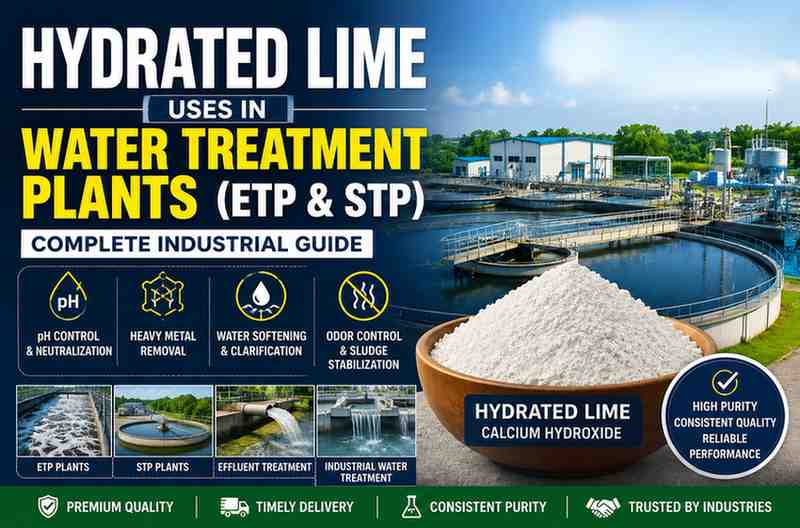
An effluent treatment plant rarely attracts attention when it is running well. The pH remains steady, metal concentrations stay within limits, the clarifier produces a clean overflow and the filter press delivers a manageable cake.
The problems begin when the chemistry changes.
An acidic batch enters the equalisation tank. A plating line releases chelated metals. A food-processing plant begins a new cleaning cycle. A textile unit changes dyes. Within minutes, the chemical demand can be very different from what the dosing system saw during the previous shift.
This is where hydrated lime for water treatment earns its place. Also known as calcium hydroxide or slaked lime, it is used in industrial ETPs and municipal STPs for pH correction, acid neutralisation, heavy-metal precipitation, water softening, phosphorus removal, sludge conditioning and alkaline stabilization.
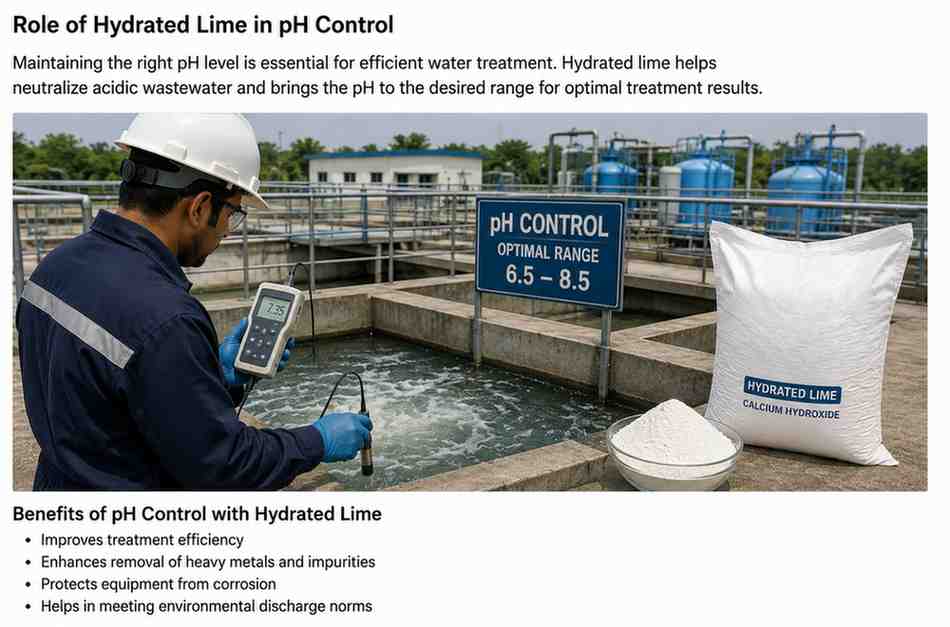
In India, general discharge standards commonly prescribe a pH range of 5.5 to 9.0, although the applicable limit may differ under sector-specific standards, State Pollution Control Board consents or local discharge conditions. Reaching that final pH is not simply a matter of adding alkali until a meter displays the desired number. pH is logarithmic, and it does not by itself reveal how much acidity or buffering capacity is present in the wastewater.
A plant may therefore have an acceptable pH reading and still consume a surprisingly large quantity of alkali. Another wastewater stream may show a very low pH but require relatively little chemical. The distinction between pH and acidity or alkalinity is one of the most important lessons in chemical treatment.
This guide examines the chemistry, operating practice, dosage calculation and purchasing criteria behind industrial hydrated lime applications in ETP and STP systems.
What Is Hydrated Lime?
Hydrated lime is the common industrial name for calcium hydroxide, Ca(OH)₂. It is produced by adding a controlled quantity of water to quicklime, or calcium oxide:
CaO + H₂O → Ca(OH)₂ + heat
The controlled reaction is called hydration or slaking. When completed correctly, it converts reactive quicklime into a fine, dry alkaline powder.
In a treatment plant, hydrated lime is normally mixed with water to form a suspension known as lime slurry or milk of lime. It is not usually dosed as a true solution because calcium hydroxide has limited solubility. Continuous agitation is therefore needed to prevent settling and maintain a reasonably uniform feed concentration. EPA operating guidance similarly describes lime as a slurry-fed treatment chemical and warns that poor handling can affect process performance, effluent quality and maintenance cost.
Table 1: Industrial Profile of Hydrated Lime
| Parameter | Hydrated Lime Characteristic | Relevance to a Water Treatment Plant |
|---|---|---|
| Chemical name | Calcium hydroxide | |
| Formula | Ca(OH)₂ | |
| Physical form | Fine, dry alkaline powder | |
| Plant feed form | Normally a continuously agitated slurry | |
| Main contribution | Hydroxide ions and calcium ions | |
| Principal applications | pH adjustment, neutralisation, precipitation, softening and sludge treatment | |
| Solubility behaviour | Slightly soluble; excess material remains suspended | |
| Theoretical neutralising value | About 1.35 kg of CaCO₃ equivalent per kg of pure Ca(OH)₂ | |
| Main operating concern | Settling, scale, dust, grit and inconsistent slurry concentration | |
| Main buying concern | Assay, reactivity, fineness, insolubles, moisture and batch consistency |
Calcium hydroxide is recognised as an important water treatment chemical for precipitative softening and pH adjustment. Its chemistry allows one mole of Ca(OH)₂ to release two hydroxide equivalents, although actual plant utilisation is lower than the theoretical value because of purity, dispersion, reaction time and wastewater composition.
Why Do Water Treatment Plants Use Hydrated Lime?
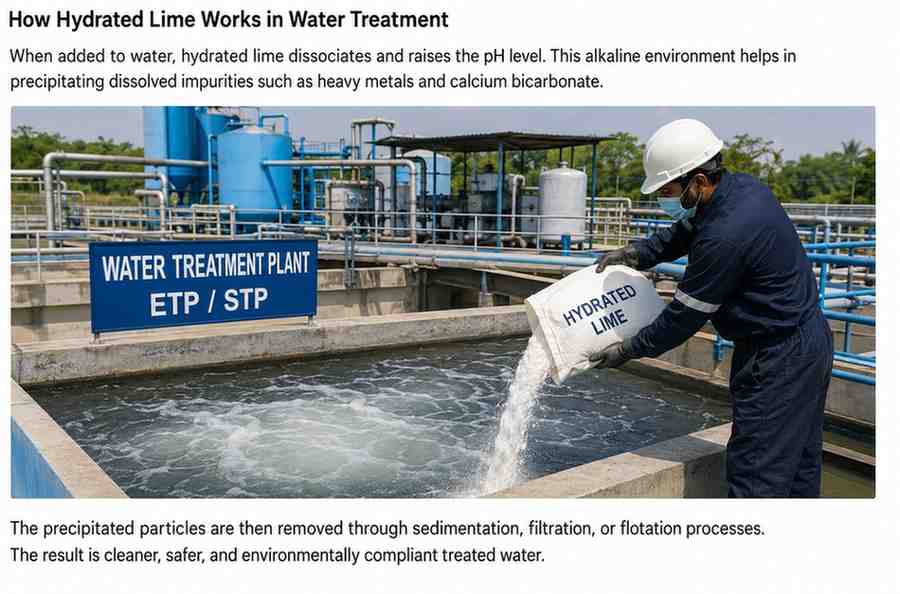
Hydrated lime is not a single-purpose neutralising chemical. Its value comes from the way several treatment effects can occur together.
A dose intended to increase pH may also precipitate metals. The resulting calcium carbonate and metal hydroxide particles may assist floc formation. The same treatment may alter sludge structure and improve—or, under different conditions, complicate—dewatering.
Table 2: Hydrated Lime Functions in Water and Wastewater Treatment
| Treatment Objective | Chemical or Physical Action | Critical Control Point | Common Plant Risk |
|---|---|---|---|
| Acid neutralisation | Hydroxide ions consume acidity | Acidity load and final pH | Overdosing or delayed pH response |
| Heavy-metal removal | Dissolved metals form insoluble hydroxides | Metal-specific optimum pH | Redissolution or chelation |
| Water softening | Calcium carbonate and magnesium hydroxide precipitate | Hardness, alkalinity and pH | Scaling and excess sludge |
| Coagulation support | Precipitates create solids and sweep floc | Mixing and settling | Fine carryover |
| Phosphorus removal | Calcium phosphate or associated precipitates form | pH and phosphate concentration | High chemical consumption |
| Sludge conditioning | Mineral solids modify cake structure | Dose and dewatering test | Increased cake quantity |
| Alkaline stabilization | Elevated pH suppresses biological activity | pH and contact time | Ammonia release |
| Odour management | Reduced putrefaction under high-pH conditions | Ventilation and pH retention | Ammonia odour at high pH |
EPA technical guidance identifies chemical coagulation, phosphate precipitation, pH adjustment and sludge stabilization among the established wastewater-treatment uses of lime.
1. pH Correction and Acid Neutralisation
When hydrated lime enters water, the dissolved portion releases hydroxide ions:
Ca(OH)₂ ⇌ Ca²⁺ + 2OH⁻
These hydroxide ions react with acidity. In an ETP, the acidity may come from mineral acids, acidic salts, process intermediates, acidic cleaning solutions, fermentation products or dissolved carbon dioxide.
The practical objective is not merely to “raise pH”. It may be to:
- protect a biological treatment stage from acidic shock;
- create the correct pH for metal precipitation;
- improve coagulation;
- reduce corrosion;
- meet the permitted outlet pH;
- or provide alkalinity consumed by a downstream process.
A properly designed system uses both flow and pH information. Large, variable plants may benefit from feed-forward control based on influent flow or acidity, followed by feedback correction using a downstream pH sensor.
One sensor placed immediately beside the lime injection point is rarely enough. Undispersed lime particles and local high-pH zones can mislead the controller, while the bulk water remains insufficiently treated.
2. Heavy-Metal Removal
Many dissolved metals become less soluble as metal hydroxides when pH rises:
M²⁺ + 2OH⁻ → M(OH)₂ ↓
The precipitated solids can then be removed by clarification, dissolved-air flotation, filtration or membrane separation.
Hydrated lime is widely used for this purpose in metal finishing, electroplating, galvanising, non-ferrous metal processing, battery, pigment, chemical and engineering-industry effluents.
EPA guidance for metal-finishing wastewater describes hydroxide precipitation using lime or caustic and identifies a typical favourable pH range of about 8.8 to 9.3 for combined treatment. That figure is a broad process reference, not a universal setpoint. Different metals have different minimum-solubility regions.
A mixed-metal ETP may therefore need staged treatment. Raising all wastewater to one high pH can be counterproductive because some amphoteric metal hydroxides may become soluble again under strongly alkaline conditions.
Chelating agents introduce another difficulty. EDTA, ammonia, cyanide, phosphates and certain organic acids can hold metals in solution even when the pH appears suitable. Pretreatment, oxidation, reduction, chelate-breaking chemistry or multi-stage precipitation may be needed before lime can deliver the expected result.
3. Lime Softening
Hardness is caused mainly by dissolved calcium and magnesium salts. In lime softening, hydrated lime raises the pH and promotes precipitation of calcium carbonate and magnesium hydroxide.
Illustrative reactions include:
Ca(HCO₃)₂ + Ca(OH)₂ → 2CaCO₃ ↓ + 2H₂O
Mg(HCO₃)₂ + 2Ca(OH)₂ → Mg(OH)₂ ↓ + 2CaCO₃ ↓ + 2H₂O
The solids are separated through flocculation, sedimentation and filtration. Where the treated water remains excessively alkaline, recarbonation or acid trimming may be used to reduce pH and stabilize the water.
Lime softening is used in raw-water treatment, utility-water systems, cooling-water side streams and industrial reuse schemes. EPA documentation confirms that calcium hydroxide raises pH so calcium and magnesium compounds can precipitate and be removed as sludge.
4. Coagulation, Flocculation and Phosphorus Removal
Hydrated lime is sometimes loosely described as a coagulant. More precisely, it can support coagulation by modifying pH and alkalinity and by generating mineral precipitates that capture or enmesh fine suspended matter.
In phosphorus treatment, elevated calcium concentration and alkaline pH can encourage the formation of calcium-phosphate solids. Lime may also be used with iron salts where pH adjustment and phosphate precipitation are required together.
The effectiveness depends on:
- rapid dispersion of the chemical;
- sufficient reaction time;
- controlled flocculation;
- adequate solids separation;
- and a final pH correction stage where necessary.
Lime alone should not be expected to solve every turbidity, colour or organic-loading problem. Polymers, iron or aluminium coagulants, oxidation, adsorption or biological treatment may still be required.
5. Sludge Conditioning and Stabilization
Hydrated lime can be added to sludge for conditioning, odour reduction and stabilization. Calcium carbonate formed in the sludge can create a more granular structure, potentially improving porosity and reducing compressibility in some filter-press or vacuum-filtration applications. The benefit must be confirmed through dewatering trials because the additional mineral matter also increases total cake mass.
For alkaline stabilization, the operating requirement is defined by both pH and contact time. As an international process benchmark, U.S. EPA biosolids guidance describes pH 12 or above after two hours of contact for specified Class B treatment conditions. More intensive time-temperature conditions apply to Class A processes. Indian facilities must follow the applicable local authorization, sludge-use route and regulatory requirements rather than automatically adopting a foreign standard.
High pH suppresses putrefactive activity, but there is an operating catch: conditions above roughly pH 9.5 favour the release of ammonia from ammonium-bearing sludge. Covered mixing tanks, controlled ventilation and odour treatment may therefore be needed.
How Is Hydrated Lime Dosage Calculated?
There is no credible universal statement such as “dose 100 ppm of hydrated lime in every ETP”.
Two wastewaters with identical pH may require very different doses because their acidity, alkalinity, buffering, dissolved metals and suspended solids are different. Sludge dosage also varies with solids concentration and chemical composition. EPA field studies have similarly found lime demand to depend on sludge type, percentage solids and composition.
A Useful Neutralisation Calculation
Pure hydrated lime provides a theoretical neutralising capacity of approximately:
1 kg pure Ca(OH)₂ ≈ 1.35 kg alkalinity as CaCO₃
A preliminary product-dose calculation can be expressed as:
Hydrated lime dose, mg/L = Required alkalinity, mg/L as CaCO₃ ÷
(1.35 × assay fraction × expected utilisation fraction)
Assume:
- acidity to be neutralised: 150 mg/L as CaCO₃;
- hydrated lime assay: 92%;
- estimated plant utilisation: 85%.
The preliminary dose is:
150 ÷ (1.35 × 0.92 × 0.85) ≈ 142 mg/L of product
At 500 m³/day, this equals approximately 71 kg/day.
This estimate covers the assumed acid-neutralisation demand only. Extra lime may be consumed by metal precipitation, magnesium removal, phosphate reactions, carbon dioxide, poor dispersion or sludge stabilization.
Table 3: Correct Dosage Basis for Different Applications
| Application | Dose Should Be Based On | Plant Verification | Error to Avoid |
|---|---|---|---|
| Acid neutralisation | Acidity titration, not pH alone | Bench titration and full-scale pH trend | Using a fixed ppm dose |
| Heavy-metal removal | Metal-specific pH response | Jar test plus dissolved-metal analysis | Testing total metal only |
| Softening | Calcium, magnesium, alkalinity and CO₂ | Hardness and residual turbidity | Ignoring recarbonation |
| Coagulation support | Turbidity, phosphorus and settling response | Jar test and clarifier observation | Treating lime as a universal coagulant |
| Sludge stabilization | Dry solids, buffering and target pH-time profile | Repeated pH measurements | Measuring only the initial pH |
| Biological-process support | Alkalinity demand and process pH | Online pH and alkalinity monitoring | Dosing directly into sensitive biomass |
A Practical Seven-Step Dosage Procedure
- Prepare a representative composite sample.
- Record pH, acidity, alkalinity, hardness, metals and suspended solids.
- Titrate the sample with a standard alkali or known lime slurry.
- Plot dose against stabilized pH rather than relying on a single reading.
- Conduct jar tests for settling, metal removal and sludge generation.
- Correct the dose for actual hydrated lime assay and plant efficiency.
- Validate the result at controlled full scale before enabling automatic dosing.
Hydrated Lime for ETP Applications
Industrial ETPs receive wastewater shaped by the manufacturing process. The right application point can be more important than the total quantity of chemical.
Table 4: Industry-Wise Hydrated Lime Applications
| Industry | Typical Effluent Challenge | Role of Hydrated Lime | Engineering Caution |
|---|---|---|---|
| Metal finishing and plating | Acidity, chromium, nickel, zinc, copper and chelates | Neutralisation and hydroxide precipitation | Cr(VI), cyanide and chelates may need pretreatment |
| Textile processing | Variable pH, dyes, salts and suspended matter | pH correction and coagulation support | Lime alone will not remove all colour or COD |
| Food and beverage | Acidic CIP water, fermentation acids, high BOD/COD | Neutralisation before DAF or biological treatment | Prevent high-pH shock to biomass |
| Pharmaceutical | Batch variation, solvents, acids and trace metals | Segregated neutralisation and precipitation | Characterise each high-strength stream |
| Chemical manufacturing | Mineral acids, acidic salts and metal-bearing batches | Equalisation, neutralisation and solids formation | Exothermic or incompatible streams require segregation |
| Power and utility plants | Acid cleaning waste, hardness and metal-bearing water | Neutralisation, softening and precipitation | Control gypsum and carbonate scaling |
| Pulp and paper | Variable pH and suspended solids | pH adjustment and clarification support | Confirm impact on downstream process water |
| Engineering and automotive | Rinse water, phosphates, oil and metals | Metal precipitation and pH correction | Remove oil and treat special contaminants first |
Metal and Chemical Plants
For a chemical plant receiving occasional concentrated acid batches, the best arrangement is generally segregation followed by controlled transfer into equalisation. Directly releasing a concentrated batch into the neutralisation tank can overwhelm the mixer and controller.
Where metals are present, operators should measure dissolved metal after filtration. A low total-metal concentration in settled water may simply reflect solids separation; the dissolved result reveals whether the precipitation chemistry actually worked.
Textile ETPs
Textile wastewater can fluctuate widely over a single production day. Hydrated lime may correct acidic streams and support coagulation, but excessive dosage can increase suspended solids and scaling without resolving soluble colour.
The usual solution is a combined treatment programme: equalisation, pH control, coagulant or oxidation treatment where required, solids separation and biological treatment.
Food and Beverage ETPs
Dairy, beverage, starch, fermentation and food-processing plants may generate acidic cleaning water and process effluent. Lime can prepare the wastewater for DAF or biological treatment.
The controller should respond to the acid load, not only the flow. A low-flow CIP discharge may carry more neutralisation demand than a much larger quantity of ordinary wash water.
Pharmaceutical ETPs
Pharmaceutical plants benefit from segregation. Solvent-rich, antibiotic-bearing, high-TDS and strong acid or alkali streams may require different routes. Hydrated lime can neutralise suitable acidic effluent and support metal or phosphate precipitation, but it is not a substitute for oxidation, solvent recovery, biological treatment or advanced polishing.
Power Plants
Potential applications include acidic boiler-cleaning waste, pretreatment softening, certain ash-water streams and metal-bearing utility wastewater. Scaling control is crucial. Calcium entering sulfate-rich water can create gypsum, while uncontrolled carbonate chemistry can foul pipelines and tanks.
Hydrated Lime for STP Applications
Municipal sewage usually operates near a biologically acceptable pH, so continuous heavy lime dosing is not automatically required. Its more common STP roles include:
- correcting unusually acidic influent;
- restoring alkalinity where biological processes consume it;
- supporting tertiary phosphorus removal;
- conditioning sludge;
- stabilizing sewage sludge or septage;
- and adjusting pH before reuse or discharge.
Table 5: ETP and STP Use Compared
| Factor | Industrial ETP | Municipal STP |
|---|---|---|
| Influent variability | Often batch-driven and chemically extreme | Usually more continuous, with diurnal variation |
| Main lime use | Neutralisation, metals and process-specific treatment | Alkalinity support, tertiary treatment and sludge |
| Typical control basis | Flow, acidity, metals and production schedule | Flow, alkalinity, biological health and sludge solids |
| Risk of overdosing | Scale, metal redissolution and excess sludge | Biological inhibition and high effluent pH |
| Preferred application | Equalisation or reaction tank | Controlled pretreatment, tertiary stage or sludge line |
| Final verification | pH plus pollutant-specific analysis | pH, alkalinity, nutrients, solids and biological performance |
Lime should not be injected indiscriminately into an aeration basin. A local high-pH zone can disturb microorganisms even when the average tank pH appears normal. Slurry should be well dispersed in a designated, mixed contact point.
Operational Benefits—and the Costs That Must Be Counted
Hydrated lime can offer several advantages:
- high neutralising capacity per kilogram;
- compatibility with metal precipitation and softening;
- wide availability within the industrial minerals market in India;
- dry storage and long-distance transport;
- simpler preparation than quicklime because no plant slaker is required;
- and the ability to provide alkalinity without adding sodium.
Yet the lowest chemical price per tonne does not always produce the lowest treatment cost.
The full calculation should include:
- effective Ca(OH)₂ content;
- slurry-system power;
- cleaning and maintenance;
- sludge production;
- polymer requirement;
- dewatering performance;
- cake transport and disposal;
- scaling downtime;
- and the cost of out-of-specification discharge.
Hydrated Lime vs Quick Lime
Both chemicals deliver calcium alkalinity. The difference is what the treatment plant must do before that alkalinity becomes safely usable.
Table 6: Quick Lime vs Hydrated Lime
| Parameter | Hydrated Lime | Quick Lime |
|---|---|---|
| Chemical form | Ca(OH)₂ | CaO |
| Preparation | Mixed with water to form slurry | Must be slaked with controlled water addition |
| Reaction with water | No main slaking stage required | Strongly exothermic |
| Theoretical CaCO₃ equivalent | About 1.35 kg/kg pure chemical | About 1.78 kg/kg pure chemical |
| Equipment | Slurry tank, agitator and feeder | Silo, feeder, slaker, grit removal and slurry system |
| Operator skill | Moderate | Higher |
| Typical plant fit | Small to medium, variable or flexible demand | Large, continuous high-volume demand |
| Transport efficiency | Lower alkalinity per tonne | Higher alkalinity per tonne |
| Main risk | Dust, settling, scale and grit | Heat, incomplete slaking, grit and equipment failure |
| Best buying comparison | Cost per usable alkalinity unit | Cost per usable alkalinity after slaking |
EPA guidance distinguishes quicklime, which must first be hydrated, from hydrated lime, which needs only enough water to prepare a pumpable milk-of-lime slurry.
For a high-consumption plant with trained operators and a well-maintained slaker, quicklime may deliver a lower cost per neutralising unit. For a plant needing simpler operation, frequent starts and stops or lower consumption, industrial hydrated lime is often easier to manage.
Hydrated Lime vs Caustic Soda
Caustic soda, or sodium hydroxide, is the other common alkali considered for pH correction and metals precipitation.
Table 7: Hydrated Lime vs Caustic Soda
| Parameter | Hydrated Lime | Caustic Soda |
|---|---|---|
| Chemical | Ca(OH)₂ | NaOH |
| Feed form | Suspended slurry | Fully soluble liquid or solid |
| Theoretical CaCO₃ equivalent | About 1.35 kg/kg pure chemical | About 1.25 kg/kg pure chemical |
| pH response | Slower and mixing-dependent | Very rapid |
| Fine pH control | More difficult at very low demand | Generally easier |
| Metal precipitation | Supplies hydroxide and calcium | Supplies hydroxide without calcium |
| Dissolved salt contribution | Adds calcium; may precipitate | Adds soluble sodium |
| Reagent-derived solids | Can add mineral solids | Lower direct mineral-solids addition |
| Maintenance | Slurry scaling and line cleaning | Corrosion-resistant liquid equipment |
| Overshoot risk | Moderated by limited solubility but still possible | High if control response is poor |
| Typical preference | Bulk neutralisation and precipitation | Precise, rapid or low-sludge pH control |
| Cost comparison | Often competitive per active alkalinity | Highly dependent on solution strength and market price |
EPA water-treatment modelling recognises both sodium hydroxide and calcium hydroxide as chemicals used to increase pH and alkalinity. EPA supply-chain information also identifies sodium hydroxide as a pH-adjustment and metals-precipitation chemical.
The right choice is often a combination. A plant may use lime for bulk neutralisation and metal precipitation, then use a small caustic dose for precise final trim.
Five Practical Industrial Scenarios
The following are engineering examples rather than guaranteed performance claims.
Table 8: Illustrative Application Scenarios
| Plant | Treatment Challenge | Practical Lime Strategy | Key Measurement |
|---|---|---|---|
| Chemical unit | Intermittent acidic metal-bearing batch | Segregate, equalise and dose in controlled stages | Acidity, pH and dissolved metals |
| Textile mill | Variable dye-bath and wash-water pH | Lime before coagulation, with adequate equalisation | pH, colour, COD and sludge volume |
| Food plant | Acidic CIP discharge entering biological ETP | Neutralise before DAF or biological treatment | pH, alkalinity and BOD/COD load |
| Pharmaceutical plant | Multiple batch streams with different chemistry | Characterise and treat compatible streams separately | pH, solvent load and specific contaminants |
| Power plant | Acid cleaning waste with metals and sulfate | Controlled neutralisation with scale assessment | pH, metals, calcium and sulfate |
Scenario 1: Chemical Plant
An acidic reactor-wash stream containing trace metals is held in a dedicated tank. It is metered into equalisation, treated first to the optimum metal-precipitation pH, flocculated and clarified. Final pH is checked after sufficient reaction time rather than immediately after the dosing point.
Scenario 2: Textile Mill
The plant uses lime to correct acidic dye-house wastewater before a coagulant stage. Jar testing identifies the point at which colour removal improves without creating an unmanageable increase in sludge.
Scenario 3: Food-Processing Unit
Acidic CIP water is segregated and slowly blended into the main ETP. Hydrated lime corrects the load before DAF and biological treatment, preventing a rapid pH fall in the aeration basin.
Scenario 4: Pharmaceutical Plant
High-strength streams are mapped by production batch. Lime is applied only where its chemistry is suitable. Solvent-bearing or biologically inhibitory streams follow separate treatment routes.
Scenario 5: Power Plant
Acid cleaning wastewater is neutralised in a mixed reaction tank. Operators monitor calcium sulfate and carbonate scaling potential before committing to continuous lime operation.
How Buyers Should Select Hydrated Lime
A purchase specification should describe the treatment need, not merely ask for “white hydrated lime”.
Colour has little value if the product contains excessive grit, inconsistent active content or poorly reactive particles.
Table 9: Hydrated Lime Procurement Checklist
| Parameter | Why It Matters | Evidence to Request |
|---|---|---|
| Available Ca(OH)₂ or assay | Determines usable alkalinity | Batch certificate of analysis |
| Acid-neutralising capacity | Reflects practical chemical performance | Supplier or independent test |
| Particle-size distribution | Affects wetting, reaction and suspension | Sieve or laser-particle analysis |
| Insoluble matter and grit | Influences pumps, valves, tanks and sludge | Insolubles test and retained-residue data |
| Moisture | Reduces active material per tonne and affects flow | Moisture result on each batch |
| Magnesium content | Can influence softening and sludge behaviour | Ca/Mg composition |
| Iron and silica | May matter in reuse or sensitive applications | Application-specific impurity data |
| Bulk density | Affects silo and feeder calibration | Loose and tapped bulk density |
| Reactivity | Influences residence time and utilisation | Standard reactivity or plant trial |
| Batch consistency | Supports stable automatic dosing | Historical CoA trend |
| Packaging | Protects material from moisture and CO₂ | Bag or bulk-supply specification |
| Traceability | Supports investigations and audits | Batch coding and retention system |
Ten Common Purchasing and Operating Mistakes
Table 10: Mistake, Consequence and Corrective Action
| Mistake | Likely Consequence | Better Practice |
|---|---|---|
| Buying only on price per tonne | Higher dose or sludge cost | Compare cost per treated m³ |
| Comparing only total calcium | Misleading activity estimate | Specify available Ca(OH)₂ or ANC |
| Ignoring insolubles | Blocked pumps and grit accumulation | Set a residue limit |
| No sample trial | Unpredictable plant response | Conduct titration and jar tests |
| Weak slurry agitation | Settling and variable concentration | Size mixer for continuous suspension |
| Long dead-end pipelines | Deposits and plugging | Use short, flushed or recirculated lines |
| Poor silo moisture control | Caking and reduced activity | Keep storage sealed and dry |
| Single pH target for mixed metals | Incomplete removal or redissolution | Use staged precipitation where needed |
| Sensor beside injection point | False high-pH signal | Measure after adequate mixing time |
| Ignoring sludge disposal | Unexpected operating cost | Include cake quantity in chemical evaluation |
Hydrated lime dust is alkaline and requires controlled transfer, dust extraction, suitable PPE and adherence to the product safety data sheet. OSHA lists occupational exposure limits for calcium hydroxide dust, reinforcing the need for enclosed handling and effective housekeeping.
How Vigyan Lime & Chemicals Approaches Water-Treatment Quality
For an ETP or STP buyer, consistency matters more than a dramatic laboratory value from one exceptional batch. The product must behave similarly from delivery to delivery so feeders, pH controllers and operating instructions remain dependable.
Vigyan Lime & Chemicals’ published manufacturing profile highlights:
- experience in lime and industrial minerals since 1948;
- high-purity and application-oriented grades;
- in-house laboratory capability;
- customized solutions;
- supply across India and overseas;
- and manufacturing locations across Rajasthan, Uttarakhand and Himachal Pradesh.
The company’s website also lists quality-management and industry certifications and identifies water treatment as one of its served sectors.
For an industrial buyer, the useful conversation begins with process data. Flow, existing pH, acidity, alkalinity, metals, hardness, sludge characteristics, current chemical consumption and the required outlet standard should be reviewed before a grade is proposed.
That approach is more reliable than treating every enquiry as a request for the same generic industrial hydrated lime.
Frequently Asked Questions
1. How is hydrated lime used in an ETP?
Hydrated lime is mixed with water in a slurry-preparation tank and metered into a well-agitated reaction or neutralisation tank. Depending on the process, it may be used to neutralise acidity, increase pH for metal precipitation, support coagulation or condition sludge. Adequate mixing and reaction time are essential because lime is fed as a suspension rather than a fully dissolved solution.
2. Why is hydrated lime used in wastewater treatment?
It provides hydroxide ions for neutralisation and calcium ions that can participate in precipitation and softening reactions. One chemical can therefore support pH correction, heavy-metal removal, hardness reduction, phosphorus treatment and sludge management.
3. What is the correct hydrated lime dosage for water treatment?
The dose must be established from acidity, alkalinity, hardness, metals, buffering and the treatment objective. A laboratory titration or jar test should be used. A fixed dosage copied from another plant is unreliable because two wastewaters with the same pH may have very different chemical demand.
4. Can hydrated lime be used for pH correction?
Yes. Calcium hydroxide is widely used to increase pH and alkalinity. For stable operation, the dosing system should consider influent flow, acid load, reaction time and the location of the pH sensor.
5. Does hydrated lime remove heavy metals?
It can precipitate many dissolved metals as hydroxides, after which the solids must be separated. The optimum pH varies by metal, and chelating agents can prevent effective precipitation. Chromium reduction, cyanide destruction or oil removal may also be required before hydroxide precipitation.
6. Is hydrated lime suitable for STPs?
Yes, but its role is usually more selective than in an industrial ETP. It may be used for alkalinity correction, tertiary phosphorus removal, sludge conditioning or alkaline stabilization. Excessive direct dosing into biological treatment can disturb microorganisms.
7. Is hydrated lime better than quicklime?
Neither is universally better. Quicklime provides more neutralising capacity per tonne but requires a properly designed slaker and skilled operation. Hydrated lime is easier to prepare and is often preferable for lower or variable consumption.
8. Is hydrated lime better than caustic soda?
Hydrated lime is often attractive for bulk neutralisation, metal precipitation and softening. Caustic soda offers fast dissolution and precise liquid dosing. The final choice should consider chemical price, active strength, sludge, dissolved solids, maintenance and operator safety.
9. Can hydrated lime remove COD and BOD?
It does not directly provide complete COD or BOD treatment. Lime may remove some particulate or precipitable matter and may prepare wastewater for coagulation or biological treatment. Dissolved biodegradable and refractory organic compounds generally require additional processes.
10. Can lime remove colour from textile wastewater?
It may improve colour removal when used with coagulation or precipitation, but it is not a universal colour-removal chemical. Dye chemistry, pH, coagulant selection, oxidation and adsorption all influence the result.
11. What slurry concentration should be used?
The practical concentration depends on the feeder, pump, mixer, pipeline length and treatment demand. Lower concentrations are easier to suspend and meter but require more water and larger tanks. Higher concentrations reduce water use but increase settling, viscosity and line-blockage risk. The system should be established by equipment trials rather than a copied percentage.
12. How should hydrated lime be stored?
It should be kept dry, sealed and protected from moisture and carbon dioxide. Bulk systems require a suitable silo, dust collection and reliable discharge equipment. Bagged material should be stored on pallets away from damp walls and used through a first-in, first-out system.
13. Which grade of hydrated lime is suitable for ETP use?
The grade should be selected according to required assay, reactivity, particle size, insolubles and impurity limits. A basic neutralisation plant may accept a different specification from a water-reuse system, pharmaceutical facility or sensitive process-water application.
14. Is hydrated lime dangerous to handle?
It is strongly alkaline and can irritate or burn the eyes, skin and respiratory tract. Enclosed transfer, local dust extraction, protective eyewear, gloves, suitable respiratory protection and access to washing facilities should form part of the handling system. The supplier’s current safety data sheet must be followed.
15. How should a buyer identify the best hydrated lime supplier in India?
The best hydrated lime supplier is not simply the company offering the lowest rate per tonne. Buyers should compare active content, reactivity, insolubles, batch consistency, technical support, logistics, documentation and the total cost per cubic metre of treated water. A representative sample and plant trial should precede a major supply contract.
Final Summary
Hydrated lime remains one of the most versatile water treatment chemicals available to Indian industry. It can neutralise acidic wastewater, create the conditions needed for heavy-metal precipitation, reduce hardness, support clarification and assist with sludge treatment.
Its success, however, depends on disciplined engineering.
The wastewater must be characterised. The dose must be tested. The slurry must remain uniform. The pH sensor must be correctly located. Sludge and scale must be included in the economic calculation. Above all, the supplied material must be consistent from one batch to the next.
Industrial buyers evaluating hydrated lime for ETP or STP applications can share their water analysis, daily flow, present chemical dose, target parameters and feeding arrangement with Vigyan Lime & Chemicals for an application-oriented grade review through www.vigyanlime.com.