Hydrated Lime for Water Treatment: ETP & STP Guide
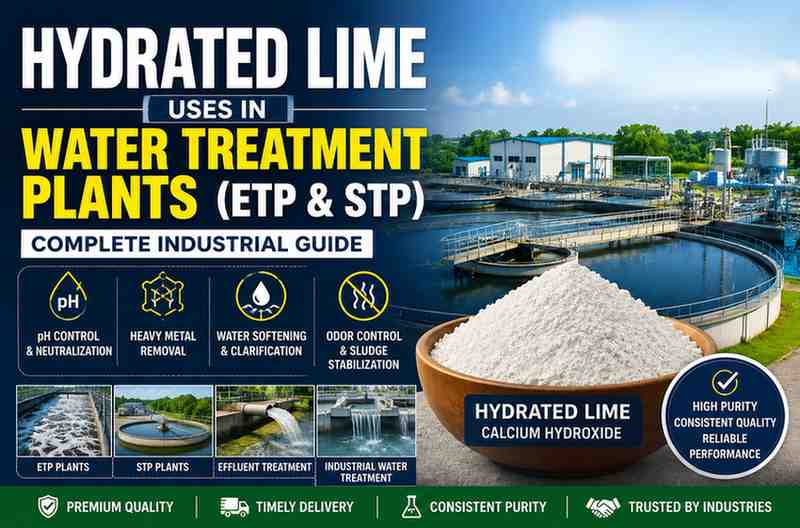
Hydrated Lime for Water Treatment: Complete Industrial Guide for ETP & STP Plants An effluent treatment plant rarely attracts attention when it is running well. The pH remains steady, metal concentrations stay within limits, the clarifier produces a clean overflow and the filter press delivers a manageable cake. The problems begin when the chemistry changes. An acidic batch enters the equalisation tank. A plating line releases chelated metals. A food-processing plant begins a new cleaning cycle. A textile unit changes dyes. Within minutes, the chemical demand can be very different from what the dosing system saw during the previous shift. This is where hydrated lime for water treatment earns its place. Also known as calcium hydroxide or slaked lime, it is used in industrial ETPs and municipal STPs for pH correction, acid neutralisation, heavy-metal precipitation, water softening, phosphorus removal, sludge conditioning and alkaline stabilization. In India, general discharge standards commonly prescribe a pH range of 5.5 to 9.0, although the applicable limit may differ under sector-specific standards, State Pollution Control Board consents or local discharge conditions. Reaching that final pH is not simply a matter of adding alkali until a meter displays the desired number. pH is logarithmic, and it does not by itself reveal how much acidity or buffering capacity is present in the wastewater. A plant may therefore have an acceptable pH reading and still consume a surprisingly large quantity of alkali. Another wastewater stream may show a very low pH but require relatively little chemical. The distinction between pH and acidity or alkalinity is one of the most important lessons in chemical treatment. This guide examines the chemistry, operating practice, dosage calculation and purchasing criteria behind industrial hydrated lime applications in ETP and STP systems. What Is Hydrated Lime? Hydrated lime is the common industrial name for calcium hydroxide, Ca(OH)₂. It is produced by adding a controlled quantity of water to quicklime, or calcium oxide: CaO + H₂O → Ca(OH)₂ + heat The controlled reaction is called hydration or slaking. When completed correctly, it converts reactive quicklime into a fine, dry alkaline powder. In a treatment plant, hydrated lime is normally mixed with water to form a suspension known as lime slurry or milk of lime. It is not usually dosed as a true solution because calcium hydroxide has limited solubility. Continuous agitation is therefore needed to prevent settling and maintain a reasonably uniform feed concentration. EPA operating guidance similarly describes lime as a slurry-fed treatment chemical and warns that poor handling can affect process performance, effluent quality and maintenance cost. Table 1: Industrial Profile of Hydrated Lime Parameter Hydrated Lime Characteristic Relevance to a Water Treatment Plant Chemical name Calcium hydroxide Formula Ca(OH)₂ Physical form Fine, dry alkaline powder Plant feed form Normally a continuously agitated slurry Main contribution Hydroxide ions and calcium ions Principal applications pH adjustment, neutralisation, precipitation, softening and sludge treatment Solubility behaviour Slightly soluble; excess material remains suspended Theoretical neutralising value About 1.35 kg of CaCO₃ equivalent per kg of pure Ca(OH)₂ Main operating concern Settling, scale, dust, grit and inconsistent slurry concentration Main buying concern Assay, reactivity, fineness, insolubles, moisture and batch consistency Calcium hydroxide is recognised as an important water treatment chemical for precipitative softening and pH adjustment. Its chemistry allows one mole of Ca(OH)₂ to release two hydroxide equivalents, although actual plant utilisation is lower than the theoretical value because of purity, dispersion, reaction time and wastewater composition. Why Do Water Treatment Plants Use Hydrated Lime? Hydrated lime is not a single-purpose neutralising chemical. Its value comes from the way several treatment effects can occur together. A dose intended to increase pH may also precipitate metals. The resulting calcium carbonate and metal hydroxide particles may assist floc formation. The same treatment may alter sludge structure and improve—or, under different conditions, complicate—dewatering. Table 2: Hydrated Lime Functions in Water and Wastewater Treatment Treatment Objective Chemical or Physical Action Critical Control Point Common Plant Risk Acid neutralisation Hydroxide ions consume acidity Acidity load and final pH Overdosing or delayed pH response Heavy-metal removal Dissolved metals form insoluble hydroxides Metal-specific optimum pH Redissolution or chelation Water softening Calcium carbonate and magnesium hydroxide precipitate Hardness, alkalinity and pH Scaling and excess sludge Coagulation support Precipitates create solids and sweep floc Mixing and settling Fine carryover Phosphorus removal Calcium phosphate or associated precipitates form pH and phosphate concentration High chemical consumption Sludge conditioning Mineral solids modify cake structure Dose and dewatering test Increased cake quantity Alkaline stabilization Elevated pH suppresses biological activity pH and contact time Ammonia release Odour management Reduced putrefaction under high-pH conditions Ventilation and pH retention Ammonia odour at high pH EPA technical guidance identifies chemical coagulation, phosphate precipitation, pH adjustment and sludge stabilization among the established wastewater-treatment uses of lime. 1. pH Correction and Acid Neutralisation When hydrated lime enters water, the dissolved portion releases hydroxide ions: Ca(OH)₂ ⇌ Ca²⁺ + 2OH⁻ These hydroxide ions react with acidity. In an ETP, the acidity may come from mineral acids, acidic salts, process intermediates, acidic cleaning solutions, fermentation products or dissolved carbon dioxide. The practical objective is not merely to “raise pH”. It may be to: protect a biological treatment stage from acidic shock; create the correct pH for metal precipitation; improve coagulation; reduce corrosion; meet the permitted outlet pH; or provide alkalinity consumed by a downstream process. A properly designed system uses both flow and pH information. Large, variable plants may benefit from feed-forward control based on influent flow or acidity, followed by feedback correction using a downstream pH sensor. One sensor placed immediately beside the lime injection point is rarely enough. Undispersed lime particles and local high-pH zones can mislead the controller, while the bulk water remains insufficiently treated. 2. Heavy-Metal Removal Many dissolved metals become less soluble as metal hydroxides when pH rises: M²⁺ + 2OH⁻ → M(OH)₂ ↓ The precipitated solids can then be removed by clarification, dissolved-air flotation, filtration or membrane separation. Hydrated lime is widely used for this purpose in metal finishing, electroplating, galvanising,