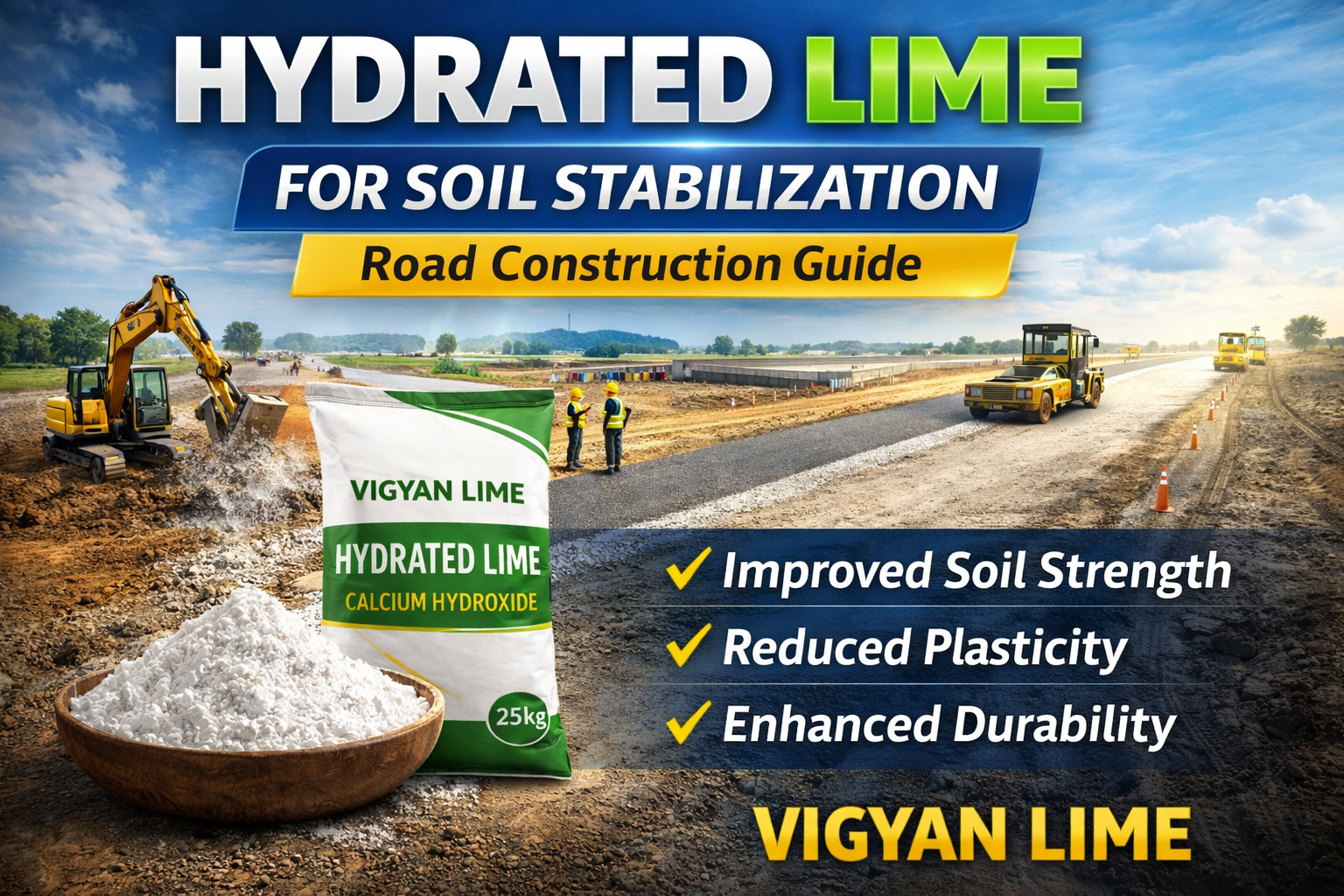
Hydrated Lime for soil stabilization is one of the most reliable and cost-effective solutions used in modern road construction projects. Whether it is highways, state roads, rural roads, airport runways, or industrial pavements, hydrated lime plays a critical role in improving weak soil conditions.
In India, many regions have clayey and highly plastic soils that are not suitable for direct road construction. Without proper stabilization, roads may suffer from cracking, rutting, swelling, and reduced lifespan. By adding high-quality Calcium Hydroxide (Ca(OH)₂), engineers can significantly enhance soil strength, durability, and long-term performance.
This complete guide explains everything you need to know about using hydrated lime in soil stabilization for road construction.
What is Hydrated Lime?
Hydrated Lime, also known as Calcium Hydroxide, is produced by adding water to Quick Lime (Calcium Oxide).
Chemical Reaction:
CaO + H₂O → Ca(OH)₂
It is a fine white powder with strong alkaline properties. These alkaline characteristics make hydrated lime ideal for reacting with clay minerals in soil, improving its engineering properties.
Why Soil Stabilization is Necessary in Road Construction
Before laying a road, the subgrade soil must be strong enough to support traffic loads. Weak soil can cause:
-
Uneven settlement
-
Pavement cracking
-
Surface deformation
-
Water retention problems
-
Reduced load-bearing capacity
Soil stabilization improves the engineering performance of the soil and ensures a longer pavement life.
How Hydrated Lime Stabilizes Soil
Hydrated lime works through two major mechanisms:
1. Immediate Modification
When hydrated lime is mixed with clay soil:
-
Plasticity reduces
-
Moisture content becomes manageable
-
Workability improves
-
Soil becomes friable and easier to compact
This stage happens within hours.
2. Long-Term Stabilization (Pozzolanic Reaction)
Over time, hydrated lime reacts chemically with silica and alumina present in clay soils. This reaction forms cementitious compounds that:
-
Increase compressive strength
-
Improve durability
-
Enhance load-bearing capacity
-
Reduce shrink-swell behavior
This long-term reaction provides permanent stabilization.
Types of Soils Suitable for Lime Stabilization
Hydrated lime is most effective for:
-
Clay soils
-
Highly plastic soils
-
Expansive soils
-
Silty clay
-
Black cotton soil
It is not usually effective for sandy soils without clay content.
Benefits of Hydrated Lime in Road Construction
1. Increased Soil Strength
Hydrated lime significantly increases the Unconfined Compressive Strength (UCS) of soil, making it suitable for subgrade and sub-base layers.
2. Reduced Plasticity
Plastic soils expand when wet and shrink when dry. Lime reduces plasticity index, minimizing cracking and deformation.
3. Improved Compaction
Lime-treated soil becomes easier to compact, resulting in better density and stability.
4. Moisture Control
Hydrated lime absorbs excess moisture and improves workability in wet conditions.
5. Enhanced Durability
Stabilized soil resists:
-
Freeze-thaw cycles
-
Wet-dry cycles
-
Traffic loads
6. Cost Savings
Compared to removing and replacing poor soil, lime stabilization is more economical.
Step-by-Step Process of Soil Stabilization Using Hydrated Lime
Step 1: Soil Testing
Laboratory tests determine:
-
Plasticity index
-
Moisture content
-
Required lime percentage
-
Soil classification
Step 2: Lime Spreading
Hydrated lime powder is uniformly spread over the prepared soil surface.
Step 3: Mixing
Mechanical mixers blend lime thoroughly into the soil.
Step 4: Moisture Adjustment
Water is added to achieve optimum moisture content.
Step 5: Compaction
Rollers compact the stabilized soil to required density.
Step 6: Curing
The treated layer is cured for proper pozzolanic reaction.
Recommended Lime Percentage
Typically, lime content ranges from:
3% to 8% by dry weight of soil
Exact percentage depends on:
-
Soil type
-
Plasticity index
-
Engineering requirements
Applications in Road and Infrastructure Projects
Hydrated lime is widely used in:
-
National highways
-
State highways
-
Rural road projects
-
Airport runways
-
Industrial flooring
-
Parking lots
-
Railway embankments
It is especially effective in regions with expansive clay soils.
Technical Advantages in Pavement Design
Using hydrated lime in subgrade offers:
-
Higher CBR (California Bearing Ratio)
-
Reduced pavement thickness requirement
-
Increased fatigue life
-
Reduced maintenance costs
Engineers often prefer lime stabilization in flexible pavement design.
Environmental Benefits
Hydrated lime supports sustainable construction because:
-
It reduces need for new borrow soil
-
Minimizes excavation
-
Lowers carbon footprint compared to full soil replacement
-
Enhances long-term durability
Additionally, lime-treated soil absorbs carbon dioxide over time.
Comparison: Lime Stabilization vs Cement Stabilization
Lime Stabilization
-
Best for clay soils
-
Improves plasticity
-
Long-term chemical bonding
-
Cost-effective for expansive soils
Cement Stabilization
-
Works for granular soils
-
Provides immediate strength
-
Higher material cost
For clay-rich soils, hydrated lime is often the preferred choice.
Quality Parameters for Soil Stabilization Grade Hydrated Lime
When selecting hydrated lime for road construction, ensure:
-
High Ca(OH)₂ purity
-
Fine particle size
-
Low insoluble matter
-
Consistent reactivity
-
Controlled moisture
High-quality lime ensures uniform mixing and reliable performance.
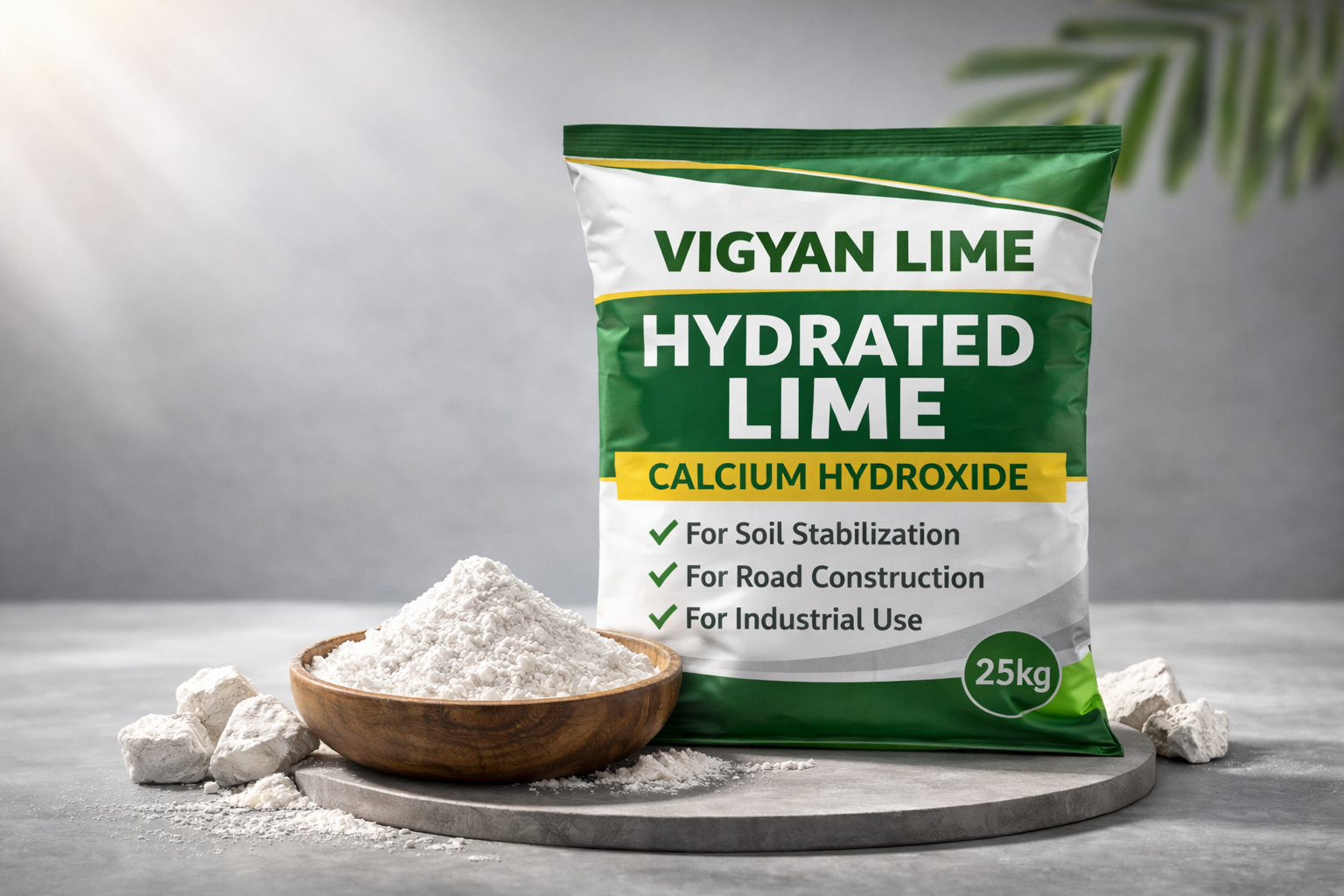
Why Choose Vigyan Lime for Soil Stabilization Projects?
Vigyan Lime is a trusted manufacturer of high-purity hydrated lime suitable for infrastructure and road construction projects across India.
With advanced production facilities and strict quality control, Vigyan Lime ensures consistent product performance for large-scale government and private projects.
Manufacturing Units
Jodhpur & Nagaur (Rajasthan)
Udaipur (Rajasthan)
Haldwani (Uttarakhand)
Sataun (Himachal Pradesh)
These strategically located units enable efficient supply to North, West, and Central India.
Industries and Projects Served
-
Road contractors
-
Infrastructure companies
-
Government tender projects
-
Civil engineering firms
-
Industrial developers
-
Airport authorities
Packaging Options
25 kg bags
50 kg bags
Bulk supply
Customized packaging for project requirements
Storage and Handling Guidelines
-
Store in dry, moisture-free area
-
Avoid direct exposure to rain
-
Use protective gear during handling
-
Ensure proper dust control measures
Frequently Asked Questions
What is the main purpose of hydrated lime in road construction?
It stabilizes weak clay soils and increases strength.
How long does lime stabilization last?
It provides long-term stabilization due to chemical bonding.
Is hydrated lime suitable for black cotton soil?
Yes, it is highly effective for expansive black cotton soil.
What percentage of lime is used in soil stabilization?
Generally between 3% to 8%, depending on soil type.
Hydrated Lime for soil stabilization is a proven and cost-effective solution for modern road construction projects. It enhances soil strength, reduces plasticity, improves durability, and increases pavement life.
For infrastructure developers, road contractors, and civil engineers, choosing high-quality hydrated lime is critical for achieving reliable results.
Vigyan Lime supplies premium-grade hydrated lime suitable for soil stabilization in highways, airport projects, and industrial infrastructure across India.
For bulk orders or technical details, contact:
Head Office
G-37, Race Course
Dehradun, Uttarakhand 248001
Email: info@vigyanlime.com
Phone:
+91-95685-01110, +91-95688-01110, +91-98370-55678